Kalaghatgi Prabhav, Sikorski Anna Maria, Knops Elena, Rupp Daniel, Sierra Saleta, Heger Eva, Neumann-Fraune Maria, Beggel Bastian, Walker Andreas, Timm Jörg, Walter Hauke, Obermeier Martin, Kaiser Rolf, Bartenschlager Ralf, Lengauer Thomas
German Center for Infection Research (DZIF)-Saarbrücken Partner Site, Department of Computational Biology and Applied Algorithmics, Max Planck Institute for Informatics, 66123, Saarbrücken, Germany.
German Center for Infection Research (DZIF)-Cologne-Bonn Partner Site, Institute of Virology, University of Cologne, 50935, Cologne, Germany.
PLoS One. 2016 May 19;11(5):e0155869. doi: 10.1371/journal.pone.0155869. eCollection 2016.
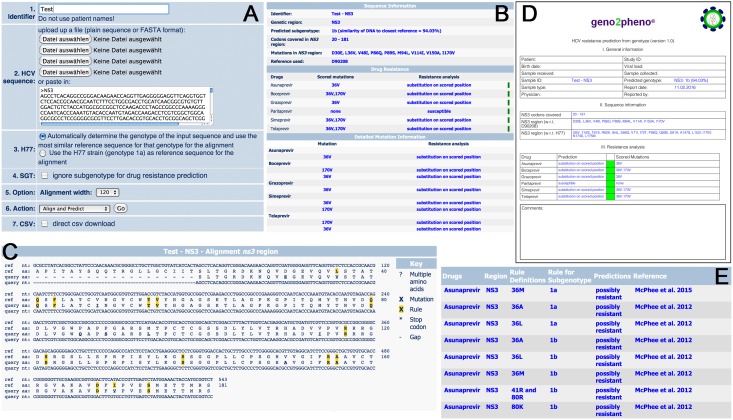
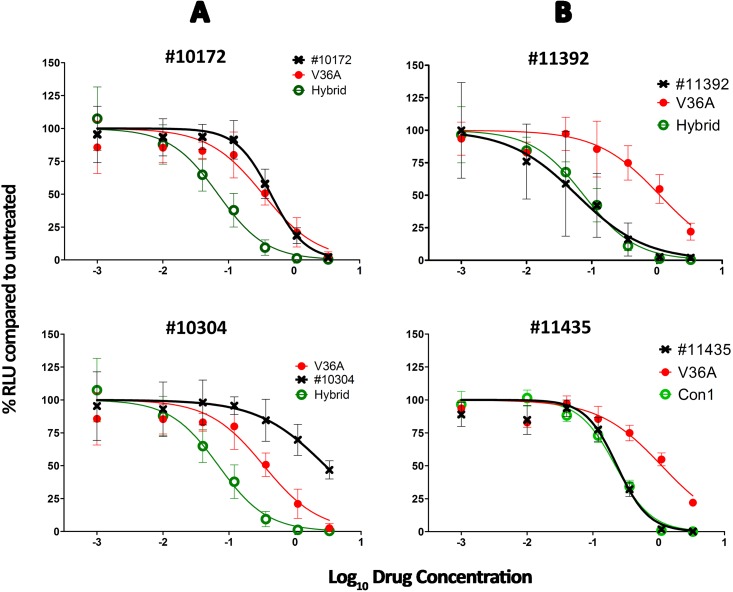
The face of hepatitis C virus (HCV) therapy is changing dramatically. Direct-acting antiviral agents (DAAs) specifically targeting HCV proteins have been developed and entered clinical practice in 2011. However, despite high sustained viral response (SVR) rates of more than 90%, a fraction of patients do not eliminate the virus and in these cases treatment failure has been associated with the selection of drug resistance mutations (RAMs). RAMs may be prevalent prior to the start of treatment, or can be selected under therapy, and furthermore they can persist after cessation of treatment. Additionally, certain DAAs have been approved only for distinct HCV genotypes and may even have subtype specificity. Thus, sequence analysis before start of therapy is instrumental for managing DAA-based treatment strategies. We have created the interpretation system geno2pheno[HCV] (g2p[HCV]) to analyse HCV sequence data with respect to viral subtype and to predict drug resistance. Extensive reviewing and weighting of literature related to HCV drug resistance was performed to create a comprehensive list of drug resistance rules for inhibitors of the HCV protease in non-structural protein 3 (NS3-protease: Boceprevir, Paritaprevir, Simeprevir, Asunaprevir, Grazoprevir and Telaprevir), the NS5A replicase factor (Daclatasvir, Ledipasvir, Elbasvir and Ombitasvir), and the NS5B RNA-dependent RNA polymerase (Dasabuvir and Sofosbuvir). Upon submission of up to eight sequences, g2p[HCV] aligns the input sequences, identifies the genomic region(s), predicts the HCV geno- and subtypes, and generates for each DAA a drug resistance prediction report. g2p[HCV] offers easy-to-use and fast subtype and resistance analysis of HCV sequences, is continuously updated and freely accessible under http://hcv.geno2pheno.org/index.php. The system was partially validated with respect to the NS3-protease inhibitors Boceprevir, Telaprevir and Simeprevir by using data generated with recombinant, phenotypic cell culture assays obtained from patients' virus variants.
丙型肝炎病毒(HCV)治疗的面貌正在发生巨大变化。专门针对HCV蛋白的直接作用抗病毒药物(DAAs)已被研发出来,并于2011年进入临床实践。然而,尽管持续病毒学应答(SVR)率高达90%以上,但仍有一部分患者无法清除病毒,在这些病例中,治疗失败与耐药突变(RAMs)的产生有关。RAMs可能在治疗开始前就已普遍存在,或者在治疗过程中被选择出来,而且在治疗停止后它们可能仍然存在。此外,某些DAAs仅被批准用于特定的HCV基因型,甚至可能具有亚型特异性。因此,治疗开始前的序列分析对于管理基于DAAs 的治疗策略至关重要。我们创建了geno2pheno[HCV](g2p[HCV])解读系统,用于分析HCV序列数据的病毒亚型并预测耐药性。我们对与HCV耐药性相关的文献进行了广泛的综述和加权,以创建一份关于非结构蛋白3中的HCV蛋白酶抑制剂(NS3蛋白酶:博赛匹韦、帕利瑞韦、simeprevir、阿舒瑞韦、格佐普瑞韦和特拉匹韦)、NS5A复制因子(达卡他韦、来迪派韦、艾尔巴韦和奥比他韦)以及NS5B RNA依赖性RNA聚合酶(达沙布韦和索磷布韦)的耐药规则综合列表。提交最多八个序列后,g2p[HCV]会对输入序列进行比对,识别基因组区域,预测HCV基因型和亚型,并为每种DAA生成一份耐药性预测报告。g2p[HCV]提供了对HCV序列易于使用且快速的亚型和耐药性分析,该系统不断更新,可通过http://hcv.geno2pheno.org/index.php免费获取。通过使用从患者病毒变体获得的重组表型细胞培养试验产生的数据,该系统在NS3蛋白酶抑制剂博赛匹韦、特拉匹韦和simeprevir方面得到了部分验证。