
肝细胞癌中DKK2肿瘤抑制基因失活等位基因的选择性保留
Selective Retention of an Inactive Allele of the DKK2 Tumor Suppressor Gene in Hepatocellular Carcinoma.
作者信息
Lin Yung-Feng, Li Ling-Hui, Lin Chih-Hung, Tsou Mei-Hua, Chuang Ming-Tai Kiffer, Wu Keh-Ming, Liao Tsai-Lien, Li Jian-Chiuan, Wang Wei-Jie, Tomita Angela, Tomita Beverly, Huang Shiu-Feng, Tsai Shih-Feng
机构信息
Department of Life Sciences and Institute of Genome Sciences, National Yang-Ming University, Taipei, Taiwan.
Institute of Molecular and Genomic Medicine, National Health Research Institutes, Zhunan, Taiwan.
出版信息
PLoS Genet. 2016 May 20;12(5):e1006051. doi: 10.1371/journal.pgen.1006051. eCollection 2016 May.
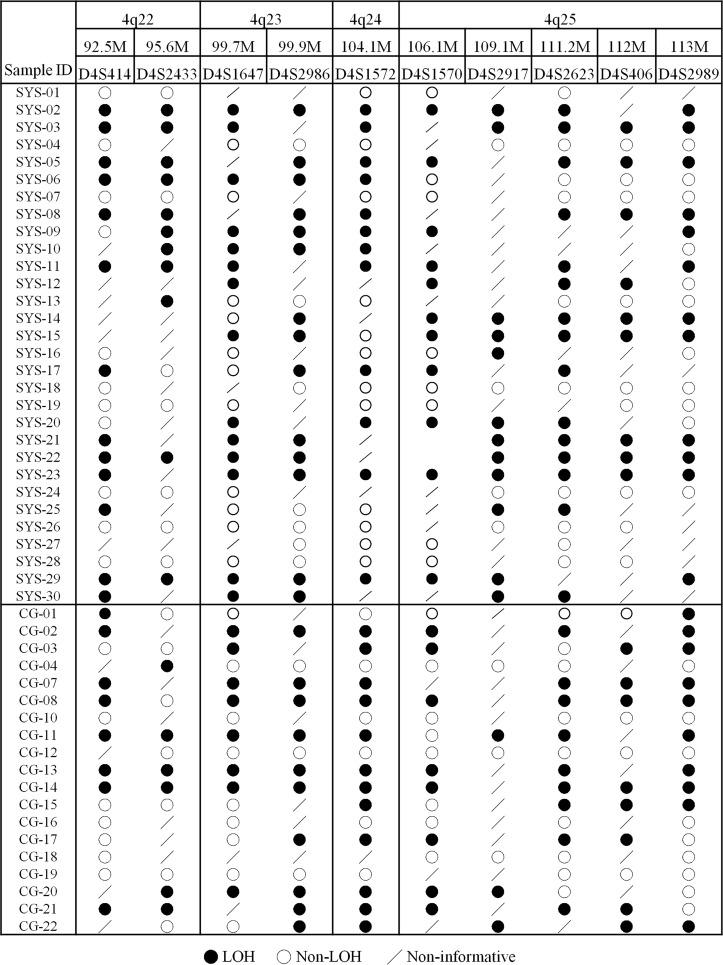
In an effort to identify the functional alleles associated with hepatocellular carcinoma (HCC), we investigated 152 genes found in the 4q21-25 region that exhibited loss of heterozygosity (LOH). A total of 2,293 pairs of primers were designed for 1,449 exonic and upstream promoter regions to amplify and sequence 76.8-114 Mb on human chromosome 4. Based on the results from analyzing 12 HCC patients and 12 healthy human controls, we discovered 1,574 sequence variations. Among the 99 variants associated with HCC (p < 0.05), four are from the Dickkopf 2 (DKK2) gene: three in the promoter region (g.-967A>T, g.-923C>A, and g.-441T>G) and one in the 5'UTR (c.550T>C). To verify the results, we expanded the subject cohort to 47 HCC cases and 88 healthy controls for conducting haplotype analysis. Eight haplotypes were detected in the non-tumor liver tissue samples, but one major haplotype (TAGC) was found in the tumor tissue samples. Using a reporter assay, this HCC-associated allele registered the lowest level of promoter activity among all the tested haplotype sequences. Retention of this allele in LOH was associated with reduced DKK2 transcription in the HCC tumor tissues. In HuH-7 cells, DKK2 functioned in the Wnt/β-catenin signaling pathway, as an antagonist of Wnt3a, in a dose-dependent manner that inhibited Wnt3a-induced cell proliferation. Taken together, the genotyping and functional findings are consistent with the hypothesis that DKK2 is a tumor suppressor; by selectively retaining a transcriptionally inactive DKK2 allele, the reduction of DKK2 function results in unchecked Wnt/β-catenin signaling, contributing to HCC oncogenesis. Thus our study reveals a new mechanism through which a tumor suppressor gene in a LOH region loses its function by allelic selection.
为了确定与肝细胞癌(HCC)相关的功能等位基因,我们研究了在4q21 - 25区域发现的152个表现出杂合性缺失(LOH)的基因。针对1449个外显子和上游启动子区域设计了总共2293对引物,以扩增和测序人类4号染色体上76.8 - 114 Mb的区域。基于对12例HCC患者和12例健康对照的分析结果,我们发现了1574个序列变异。在与HCC相关的99个变异中(p < 0.05),有4个来自Dickkopf 2(DKK2)基因:3个在启动子区域(g.-967A>T、g.-923C>A和g.-441T>G),1个在5'UTR(c.550T>C)。为了验证结果,我们将研究对象队列扩大到47例HCC病例和88例健康对照,进行单倍型分析。在非肿瘤肝组织样本中检测到8种单倍型,但在肿瘤组织样本中发现了一种主要单倍型(TAGC)。使用报告基因检测法,在所有测试的单倍型序列中,这种与HCC相关的等位基因的启动子活性水平最低。在LOH中保留该等位基因与HCC肿瘤组织中DKK2转录减少有关。在HuH - 7细胞中,DKK2作为Wnt3a的拮抗剂,以剂量依赖的方式在Wnt/β - 连环蛋白信号通路中发挥作用,抑制Wnt3a诱导的细胞增殖。综合来看,基因分型和功能研究结果与DKK2是一种肿瘤抑制基因的假设一致;通过选择性保留转录无活性的DKK2等位基因,DKK2功能的降低导致Wnt/β - 连环蛋白信号通路失控,促进HCC的发生。因此,我们的研究揭示了一种新机制,即LOH区域中的肿瘤抑制基因通过等位基因选择失去其功能。



 Zotero 插件