Gold Ralf, Arnold Douglas L, Bar-Or Amit, Hutchinson Michael, Kappos Ludwig, Havrdova Eva, MacManus David G, Yousry Tarek A, Pozzilli Carlo, Selmaj Krysztof, Sweetser Marianne T, Zhang Ray, Yang Minhua, Potts James, Novas Mark, Miller David H, Kurukulasuriya Nuwan C, Fox Robert J, Phillips Theodore J
Department of Neurology, St. Josef Hospital, Ruhr University Bochum, Bochum, Germany.
NeuroRx Research, Montreal, QC, Canada/Montreal Neurological Institute, McGill University, Montreal, QC, Canada.
Mult Scler. 2017 Feb;23(2):253-265. doi: 10.1177/1352458516649037. Epub 2016 Jul 11.
Delayed-release dimethyl fumarate (DMF) demonstrated strong efficacy and a favorable benefit-risk profile for patients with relapsing-remitting multiple sclerosis (RRMS) in phase 3 DEFINE/CONFIRM studies. ENDORSE is an ongoing long-term extension of DEFINE/CONFIRM.
We report efficacy and safety results of a 5-year interim analysis of ENDORSE (2 years DEFINE/CONFIRM; minimum 3 years ENDORSE).
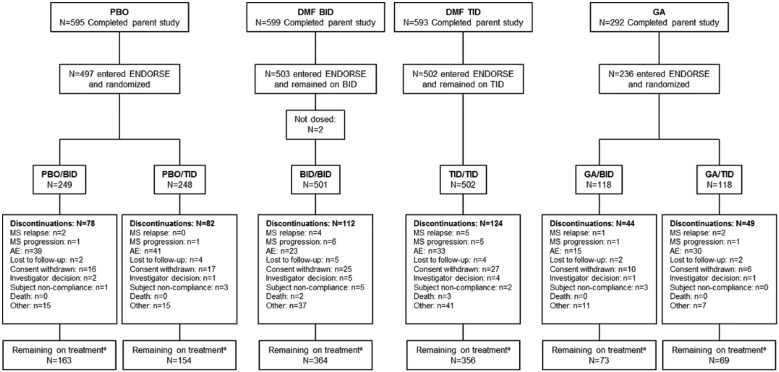
In ENDORSE, patients randomized to DMF 240 mg twice (BID) or thrice daily (TID) in DEFINE/CONFIRM continued this dosage, and those initially randomized to placebo (PBO) or glatiramer acetate (GA) were re-randomized to DMF 240 mg BID or TID.
For patients continuing DMF BID (BID/BID), annualized relapse rates were 0.202, 0.163, 0.139, 0.143, and 0.138 (years 1-5, respectively) and 63%, 73%, and 88% were free of new or enlarging T2 hyperintense lesions, new T1 hypointense lesions, and gadolinium-enhanced lesions, respectively, at year 5. Adverse events (AEs; serious adverse events (SAEs)) were reported in 91% (22%; BID/BID), 95% (24%; PBO/BID), and 88% (16%; GA/BID) of the patients. One case of progressive multifocal leukoencephalopathy was reported in the setting of severe, prolonged lymphopenia.
Treatment with DMF was associated with continuously low clinical and magnetic resonance imaging (MRI) disease activity in patients with RRMS. These interim data demonstrate a sustained treatment benefit and an acceptable safety profile with DMF.
在3期DEFINE/CONFIRM研究中,缓释富马酸二甲酯(DMF)对复发缓解型多发性硬化症(RRMS)患者显示出强大的疗效和良好的获益风险比。ENDORSE是DEFINE/CONFIRM正在进行的长期扩展研究。
我们报告ENDORSE研究5年中期分析的疗效和安全性结果(DEFINE/CONFIRM研究2年;ENDORSE研究至少3年)。
在ENDORSE研究中,在DEFINE/CONFIRM研究中随机接受240 mg DMF每日两次(BID)或每日三次(TID)治疗的患者继续该剂量治疗,而最初随机接受安慰剂(PBO)或醋酸格拉替雷(GA)治疗的患者重新随机接受240 mg DMF BID或TID治疗。
对于继续接受DMF BID治疗的患者(BID/BID组),年化复发率分别为0.202、0.163、0.139、0.143和0.138(分别为第1 - 5年),在第5年时,分别有63%、73%和88%的患者没有新的或扩大的T2高信号病灶、新的T1低信号病灶和钆增强病灶。分别有91%(22%;BID/BID组)、95%(24%;PBO/BID组)和88%(16%;GA/BID组)的患者报告了不良事件(AE;严重不良事件(SAE))。在严重、长期淋巴细胞减少的情况下报告了1例进行性多灶性白质脑病病例。
RRMS患者接受DMF治疗与持续较低的临床和磁共振成像(MRI)疾病活动相关。这些中期数据表明DMF具有持续的治疗获益和可接受的安全性。