Gohil Kushal N, Neurgaonkar Priya S, Paranjpe Aditi, Dastager Syed G, Dharne Mahesh S
National Collection of Industrial Microorganisms (NCIM), CSIR-National Chemical Laboratory (NCL), Pune, India; Academy of Scientific and Innovative Research (AcSIR), New Delhi, India.
National Collection of Industrial Microorganisms (NCIM), CSIR-National Chemical Laboratory (NCL), Pune, India.
Genom Data. 2016 Apr 19;8:72-6. doi: 10.1016/j.gdata.2016.04.003. eCollection 2016 Jun.
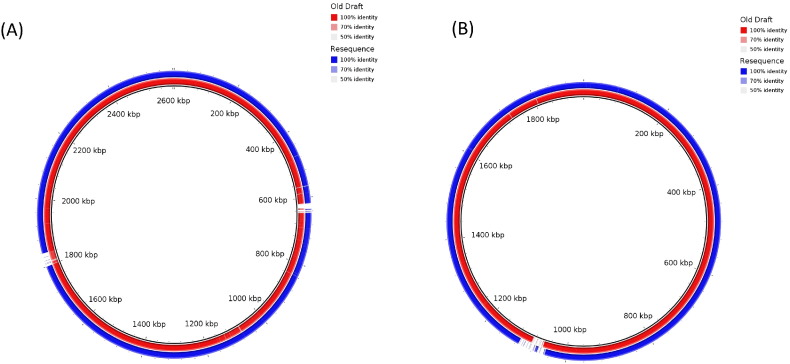
Advances in de novo sequencing technologies allow us to track deeper insights into microbial genomes for restructuring events during the course of their evolution inside and outside the host. Bacterial species belonging to Ochrobactrum genus are being reported as emerging, and opportunistic pathogens in this technology driven era probably due to insertion and deletion of genes. The Ochrobactrum intermedium M86 was isolated in 2005 from a case of non-ulcer dyspeptic human stomach followed by its first draft genome sequence in 2009. Here we report re-sequencing of O. intermedium M86 laboratory adapted strain in terms of gain and loss of genes. We also attempted for finer scale genome sequence with 10 times more genome coverage than earlier one followed by comparative evaluation on Ion PGM and Illumina MiSeq. Despite their similarities at genomic level, lab-adapted strain mainly lacked genes encoding for transposase protein, insertion elements family, phage tail-proteins that were not detected in original strain on both chromosomes. Interestingly, a 5 kb indel was detected in chromosome 2 that was absent in original strain mapped with phage integrase gene of Rhizobium spp. and may be acquired and integrated through horizontal gene transfer indicating the gene loss and gene gain phenomenon in this genus. Majority of indel fragments did not match with known genes indicating more bioinformatic dissection of this fragment. Additionally we report genes related to antibiotic resistance, heavy metal tolerance in earlier and re-sequenced strain. Though SNPs detected, there did not span urease and flagellar genes. We also conclude that third generation sequencing technologies might be useful for understanding genomic architecture and re-arrangement of genes in the genome due to their ability of larger coverage that can be used to trace evolutionary aspects in microbial system.
从头测序技术的进步使我们能够更深入地追踪微生物基因组在宿主内外进化过程中的重组事件。属于苍白杆菌属的细菌物种被报道为新兴的,在这个技术驱动的时代,它们可能是机会性病原体,这可能是由于基因的插入和缺失。中间苍白杆菌M86于2005年从一例非溃疡性消化不良患者的胃中分离出来,随后在2009年获得了其初步基因组序列。在此,我们报告了中间苍白杆菌M86实验室适应菌株在基因得失方面的重测序情况。我们还尝试获得比之前基因组覆盖度高10倍的更精细的基因组序列,随后在Ion PGM和Illumina MiSeq上进行比较评估。尽管它们在基因组水平上有相似之处,但实验室适应菌株主要缺少编码转座酶蛋白、插入元件家族、噬菌体尾蛋白的基因,在两条染色体上的原始菌株中均未检测到这些基因。有趣的是,在2号染色体上检测到一个5 kb的插入缺失,原始菌株中没有该缺失,该插入缺失与根瘤菌属的噬菌体整合酶基因定位在一起,可能是通过水平基因转移获得并整合的,这表明该属存在基因丢失和基因获得现象。大多数插入缺失片段与已知基因不匹配,这表明需要对该片段进行更多的生物信息学分析。此外,我们报告了早期菌株和重测序菌株中与抗生素抗性、重金属耐受性相关的基因。虽然检测到了单核苷酸多态性,但它们并未跨越脲酶和鞭毛基因。我们还得出结论,由于第三代测序技术具有更大的覆盖能力,可用于追踪微生物系统中的进化方面,因此可能有助于理解基因组结构和基因组中基因的重排。