Cheng Feifei, Su Li, Qian Cheng
Institute of Pathology and Southwest Cancer Center, Southwest Hospital, Third Military Medical University, Chongqing, China.
School of Life Science, Zhejiang Sci-Tech University, Hangzhou, China.
Oncotarget. 2016 Jul 26;7(30):48832-48841. doi: 10.18632/oncotarget.9453.
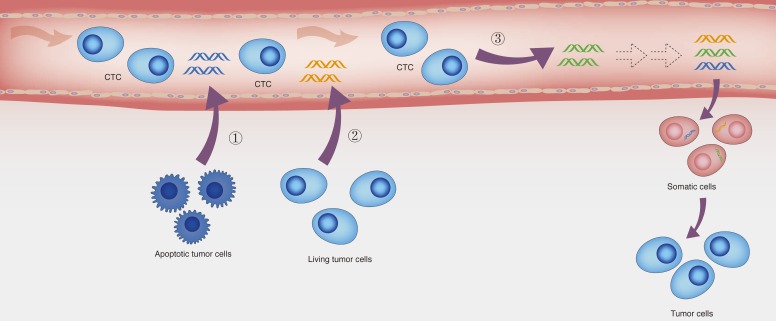
Tissue biopsy is the standard diagnostic procedure for cancers and also provides a material for genotyping, which can assist in the targeted therapies of cancers. However, tissue biopsy-based cancer diagnostic procedures have limitations in their assessment of cancer development, prognosis and genotyping, due to tumor heterogeneity and evolution. Circulating tumor DNA (ctDNA) is single- or double-stranded DNA released by the tumor cells into the blood and it thus harbors the mutations of the original tumor. In recent years, liquid biopsy based on ctDNA analysis has shed a new light on the molecular diagnosis and monitoring of cancer. Studies found that the screening of genetic mutations using ctDNA is highly sensitive and specific, suggesting that ctDNA analysis may significantly improve current systems of tumor diagnosis, even facilitating early-stage detection. Moreover, ctDNA analysis is capable of accurately determining the tumor progression, prognosis and assisting in targeted therapy. Therefore, using ctDNA as a liquid biopsy may herald a revolution for tumor management. Herein, we review the biology of ctDNA, its detection methods and potential applications in tumor diagnosis, treatment and prognosis.
组织活检是癌症的标准诊断程序,还能提供用于基因分型的材料,有助于癌症的靶向治疗。然而,由于肿瘤的异质性和进化,基于组织活检的癌症诊断程序在评估癌症发展、预后和基因分型方面存在局限性。循环肿瘤DNA(ctDNA)是肿瘤细胞释放到血液中的单链或双链DNA,因此携带了原始肿瘤的突变。近年来,基于ctDNA分析的液体活检为癌症的分子诊断和监测带来了新的曙光。研究发现,使用ctDNA筛查基因突变具有高度的敏感性和特异性,这表明ctDNA分析可能会显著改善当前的肿瘤诊断系统,甚至有助于早期检测。此外,ctDNA分析能够准确确定肿瘤进展、预后并协助靶向治疗。因此,将ctDNA用作液体活检可能预示着肿瘤管理的一场革命。在此,我们综述了ctDNA的生物学特性、检测方法及其在肿瘤诊断、治疗和预后中的潜在应用。