Morel T, Aymé S, Cassiman D, Simoens S, Morgan M, Vandebroek M
KU Leuven Department of Pharmaceutical and Pharmacological Sciences, Leuven, Belgium.
INSERM, US14, Paris, France.
Orphanet J Rare Dis. 2016 May 26;11(1):70. doi: 10.1186/s13023-016-0444-9.
Rare disease patients and caregivers face uncommon, serious, debilitating conditions often characterised by poor prognosis and limited treatment options. This study aimed to explore what they consider of value when choosing between hypothetical therapeutic options and to quantify both their benefit-risk preferences and the influence of disease context.
A mixed-methods survey with patients and caregivers was conducted in the United Kingdom across a range of rare diseases. Discrete-choice experiments that compared hypothetical treatment profiles of benefits and risks were used to measure respondent preferences across a set of seven attributes related to health outcomes, safety, and process of care. Bespoke questions on current disease management and the joint use of the 12-item WHODAS 2.0 questionnaire and of two Likert scales capturing self- and proxy-assessed disease-induced threat to life and impairment were implemented to describe disease context. Additionally, qualitative insights on the definitions of value and risk were collected from respondents.
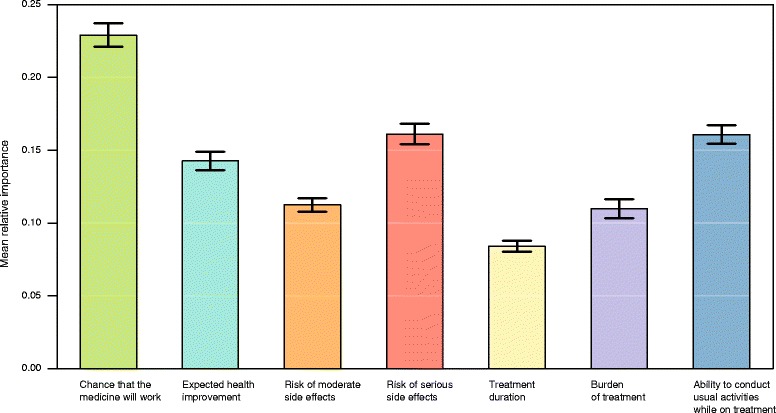
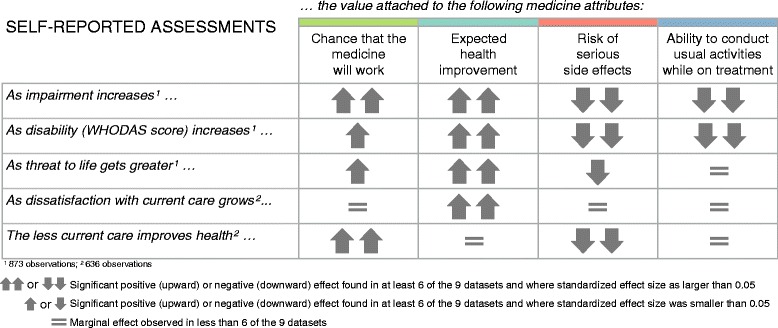
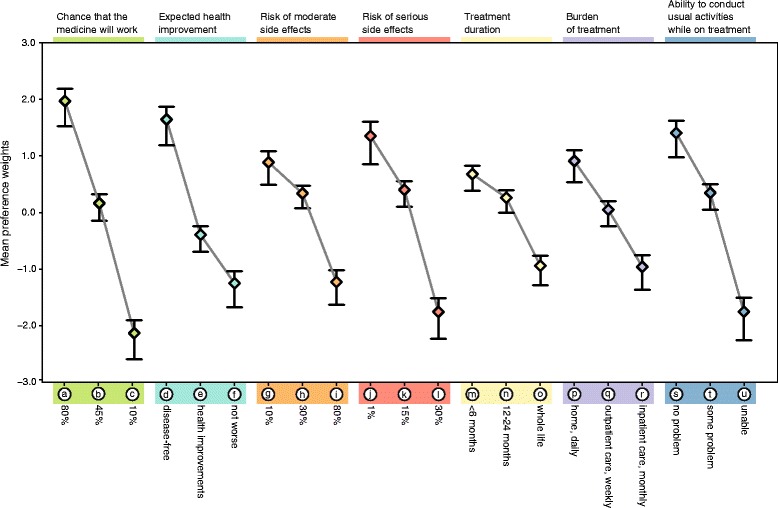
Final study sample included 721 patients and 152 informal caregivers, across 52 rare diseases. When choosing between hypothetical novel treatments for rare diseases, respondents attributed most importance to drug response, risk of serious side effects, and the ability to conduct usual activities while on treatment. In contrast, attributes related to treatment modalities were the least important. Respondents expressed a willingness to accept risks in hopes of finding some benefit, such as a higher chance of drug response or greater health improvement potential. Increasing disease severity, impairment or disability, and the lack of effective therapeutic options were shown to raise significantly the willingness to gain benefit through increased risk.
This is the first study performing a quantitative discrete choice experiment amongst patients and caregivers across 52 rare conditions. It enables a more detailed understanding of the relationship between disease context, treatment attributes and the degree of risk respondents are willing to take to gain a specific degree of benefit. Researchers of novel therapeutics for rare diseases should be encouraged to invest in preference elicitation studies to generate rigorous patient evidence and specific regulatory guidance should be issued to acknowledge their importance and their use in marketing authorisations.
罕见病患者及其照料者面临着罕见、严重且使人衰弱的疾病状况,其特点通常是预后不良且治疗选择有限。本研究旨在探讨他们在假设的治疗方案之间进行选择时所认为的价值,并量化他们的获益-风险偏好以及疾病背景的影响。
在英国针对一系列罕见病对患者及其照料者进行了一项混合方法调查。采用离散选择实验,比较假设的获益和风险治疗概况,以衡量受访者对与健康结果、安全性和护理过程相关的一组七个属性的偏好。实施了关于当前疾病管理的定制问题,以及联合使用12项世界卫生组织残疾评定量表2.0问卷和两个李克特量表,以获取自我和代理评估的疾病对生命的威胁和损害,从而描述疾病背景。此外,还从受访者那里收集了关于价值和风险定义的定性见解。
最终研究样本包括来自52种罕见病的721名患者和152名非正式照料者。在为罕见病选择假设的新型治疗方法时,受访者最重视药物反应、严重副作用风险以及治疗期间进行日常活动的能力。相比之下,与治疗方式相关的属性最不重要。受访者表示愿意接受风险,希望获得一些益处,例如更高的药物反应几率或更大的健康改善潜力。疾病严重程度增加、损伤或残疾以及缺乏有效的治疗选择被证明会显著提高通过增加风险来获得益处的意愿。
这是第一项在52种罕见病的患者及其照料者中进行定量离散选择实验的研究。它能够更详细地了解疾病背景、治疗属性与受访者为获得特定程度的益处而愿意承担的风险程度之间的关系。应鼓励罕见病新型疗法的研究人员开展偏好诱导研究,以生成严格的患者证据,并且应发布具体的监管指南,以认可其重要性及其在上市许可中的应用。