Armstrong Stuart D, Xia Dong, Bah Germanus S, Krishna Ritesh, Ngangyung Henrietta F, LaCourse E James, McSorley Henry J, Kengne-Ouafo Jonas A, Chounna-Ndongmo Patrick W, Wanji Samuel, Enyong Peter A, Taylor David W, Blaxter Mark L, Wastling Jonathan M, Tanya Vincent N, Makepeace Benjamin L
From the ‡Institute of Infection & Global Health, University of Liverpool, Liverpool L3 5RF, UK;
§Institut de Recherche Agricole pour le Développement, Regional Centre of Wakwa, BP65 Ngaoundéré, Cameroon;
Mol Cell Proteomics. 2016 Aug;15(8):2554-75. doi: 10.1074/mcp.M115.055640. Epub 2016 May 25.
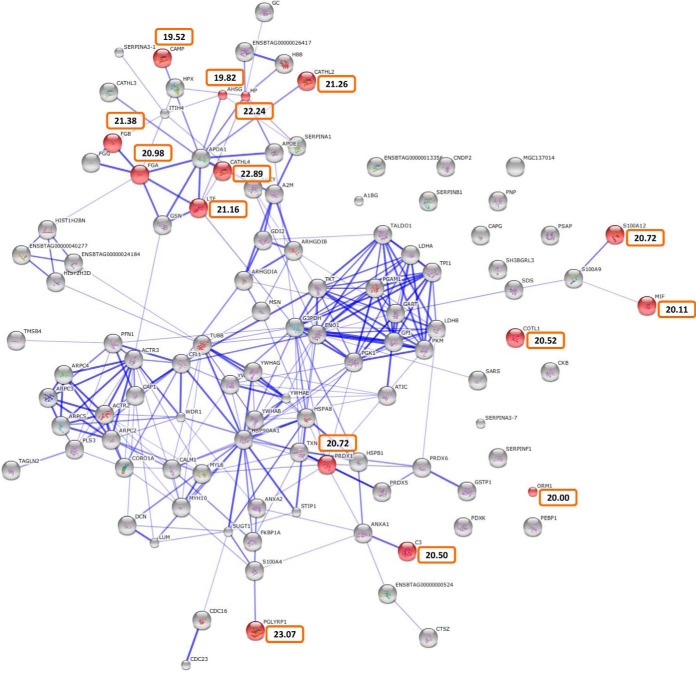
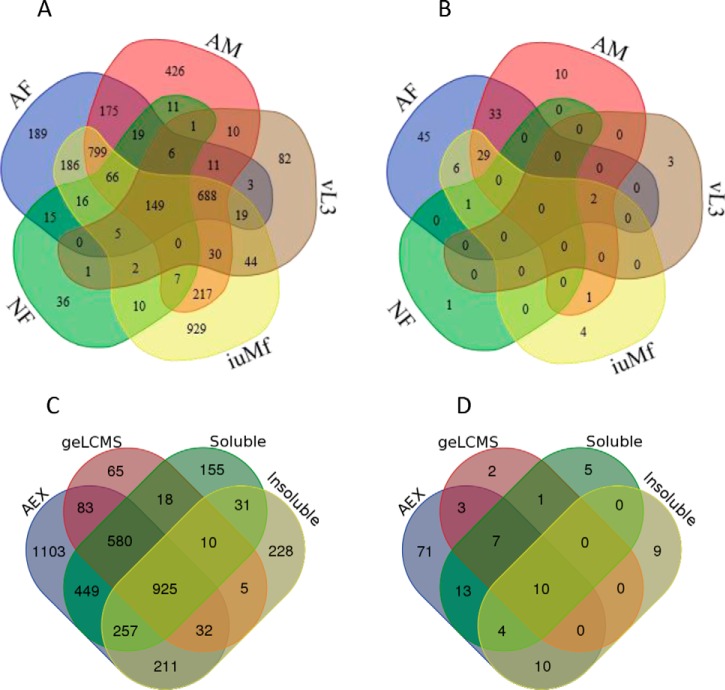
Despite 40 years of control efforts, onchocerciasis (river blindness) remains one of the most important neglected tropical diseases, with 17 million people affected. The etiological agent, Onchocerca volvulus, is a filarial nematode with a complex lifecycle involving several distinct stages in the definitive host and blackfly vector. The challenges of obtaining sufficient material have prevented high-throughput studies and the development of novel strategies for disease control and diagnosis. Here, we utilize the closest relative of O. volvulus, the bovine parasite Onchocerca ochengi, to compare stage-specific proteomes and host-parasite interactions within the secretome. We identified a total of 4260 unique O. ochengi proteins from adult males and females, infective larvae, intrauterine microfilariae, and fluid from intradermal nodules. In addition, 135 proteins were detected from the obligate Wolbachia symbiont. Observed protein families that were enriched in all whole body extracts relative to the complete search database included immunoglobulin-domain proteins, whereas redox and detoxification enzymes and proteins involved in intracellular transport displayed stage-specific overrepresentation. Unexpectedly, the larval stages exhibited enrichment for several mitochondrial-related protein families, including members of peptidase family M16 and proteins which mediate mitochondrial fission and fusion. Quantification of proteins across the lifecycle using the Hi-3 approach supported these qualitative analyses. In nodule fluid, we identified 94 O. ochengi secreted proteins, including homologs of transforming growth factor-β and a second member of a novel 6-ShK toxin domain family, which was originally described from a model filarial nematode (Litomosoides sigmodontis). Strikingly, the 498 bovine proteins identified in nodule fluid were strongly dominated by antimicrobial proteins, especially cathelicidins. This first high-throughput analysis of an Onchocerca spp. proteome across the lifecycle highlights its profound complexity and emphasizes the extremely close relationship between O. ochengi and O. volvulus The insights presented here provide new candidates for vaccine development, drug targeting and diagnostic biomarkers.
尽管经过40年的防控努力,盘尾丝虫病(河盲症)仍是最重要的被忽视热带病之一,有1700万人受其影响。病原体旋盘尾丝虫是一种丝虫线虫,其生命周期复杂,在终宿主和蚋传播媒介中涉及几个不同阶段。获取足够材料面临的挑战阻碍了高通量研究以及疾病控制和诊断新策略的开发。在此,我们利用旋盘尾丝虫的近亲——牛寄生虫奥氏盘尾丝虫,比较特定阶段的蛋白质组以及分泌组中的宿主 - 寄生虫相互作用。我们从成年雄虫和雌虫、感染性幼虫、子宫内微丝蚴以及皮内结节液中总共鉴定出4260种独特的奥氏盘尾丝虫蛋白。此外,还从专性共生菌沃尔巴克氏体中检测到135种蛋白质。相对于完整搜索数据库,在所有全身提取物中富集的观察到的蛋白质家族包括免疫球蛋白结构域蛋白,而氧化还原和解毒酶以及参与细胞内运输的蛋白质则表现出阶段特异性的过度表达。出乎意料的是,幼虫阶段表现出几个线粒体相关蛋白质家族的富集,包括肽酶家族M16的成员以及介导线粒体分裂和融合的蛋白质。使用Hi - 3方法对整个生命周期的蛋白质进行定量分析支持了这些定性分析。在结节液中,我们鉴定出94种奥氏盘尾丝虫分泌蛋白,包括转化生长因子 - β的同源物以及一个新的6 - ShK毒素结构域家族的第二个成员,该家族最初是从一种模式丝虫线虫(巴西日圆线虫)中描述的。引人注目的是,在结节液中鉴定出的498种牛蛋白主要是抗菌蛋白,尤其是cathelicidins。对盘尾丝虫属蛋白质组在整个生命周期内进行的首次高通量分析突出了其深刻的复杂性,并强调了奥氏盘尾丝虫与旋盘尾丝虫之间极其密切的关系。本文所提供的见解为疫苗开发、药物靶点和诊断生物标志物提供了新的候选物。