Ma Xiaorong, Xu Yan, Zhang Wanggang, Wang Jin, Cao Xingmei, Chen Yinxia, He Aili, Liu Jie, Wang Jianli, Zhao Wanhong, Yang Yun
Department of Hematology, The Second Affiliated Hospital of Xi'an Jiaotong University, Xi'an, Shanxi, China (mainland).
Department of Hematology, The Second Affiliated Hospital of Xi'an Jiaotong University, Xi'an, Shanxi, China (mainland).
Med Sci Monit. 2016 May 27;22:1792-800. doi: 10.12659/msm.895383.
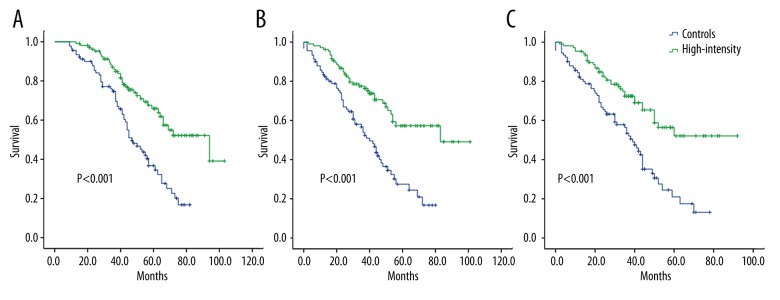
BACKGROUND Patients <60 years old with high-risk diffuse large B-cell lymphoma (DLBCL) receiving standard RCHOP(E) treatment display high relapse rates. Here, we compared this standard regimen to a high-intensity regimen in terms of recurrence and long-term survival. MATERIAL AND METHODS Newly diagnosed DLBCL patients <60 years old who were treated at the Second Hospital Affiliated with Xi'an Jiaotong University between January 2004 and December 2013 (n=198, 18-60 years) were included in the study. The high-intensity group included 107 patients (54.0%) who received >8 courses of chemotherapy (high-dose CHOP, CHOP-E, EPOCH, MAED, MMED, and HyperCVAD). The control group included 91 patients (46.0%) who received 6-8 courses of CHOP-based treatment. Response rate (RR), survival, relapse, and adverse effects were compared. RESULTS Baseline characteristics of the patients were similar between the 2 groups. Median follow-up was 64.5 months. RR in the high-intensity and control groups was 88.8% and 84.6% (P=0.387), respectively; 5-year overall survival was 66.4% and 36.3% (P<0.001), respectively; 5-year progression-free survival was 56.1% and 28.6% (P<0.001), respectively; 5-year disease-free survival was 54.2% and 24.2% (P<0.001), respectively; and relapse rate during follow-up was 29.5% and 67.5% (P<0.001), respectively. There were no significant differences in adverse effects between the 2 groups. CONCLUSIONS High-intensity chemotherapy is associated with better prognosis of patients <60 years old with newly diagnosed high-risk DLBCL.
年龄小于60岁的高危弥漫性大B细胞淋巴瘤(DLBCL)患者接受标准RCHOP(E)治疗时复发率较高。在此,我们比较了该标准方案与高强度方案在复发率和长期生存率方面的差异。
纳入2004年1月至2013年12月在西安交通大学第二附属医院接受治疗的年龄小于60岁的新诊断DLBCL患者(n = 198,年龄18 - 60岁)。高强度组包括107例患者(54.0%),接受了超过8个疗程的化疗(高剂量CHOP、CHOP-E、EPOCH、MAED、MMED和HyperCVAD)。对照组包括91例患者(46.0%),接受了6 - 8个疗程的基于CHOP的治疗。比较了缓解率(RR)、生存率、复发率和不良反应。
两组患者的基线特征相似。中位随访时间为64.5个月。高强度组和对照组的RR分别为88.8%和84.6%(P = 0.387);5年总生存率分别为66.4%和36.3%(P < 0.001);5年无进展生存率分别为56.1%和28.6%(P < 0.001);5年无病生存率分别为54.2%和24.2%(P < 0.001);随访期间的复发率分别为29.