Rhouma Mohamed, Beaudry Francis, Thériault William, Bergeron Nadia, Beauchamp Guy, Laurent-Lewandowski Sylvette, Fairbrother John Morris, Letellier Ann
Chaire de recherche en salubrité des viandes (CRSV), Faculté de médecine vétérinaire, Université de Montréal, Saint-Hyacinthe, QC, J2S 7C6, Canada.
Groupe de recherche et d'enseignement en salubrité alimentaire (GRESA), Faculté de médecine vétérinaire, Université de Montréal, Saint-Hyacinthe, QC, J2S 7C6, Canada.
Vet Res. 2016 May 27;47(1):58. doi: 10.1186/s13567-016-0344-y.
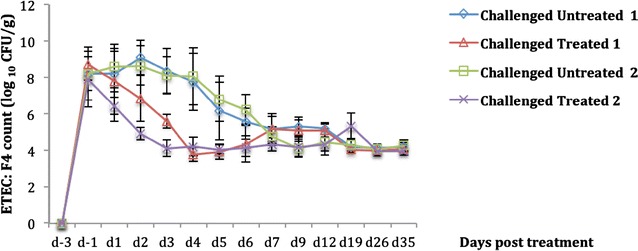
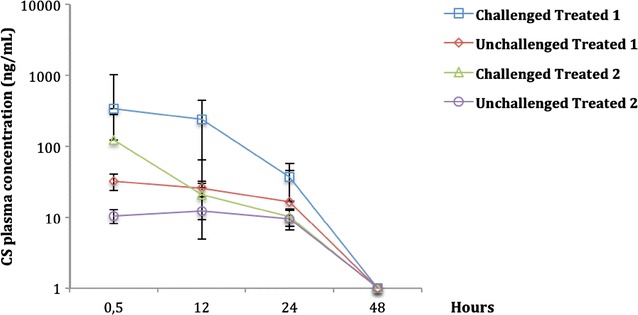
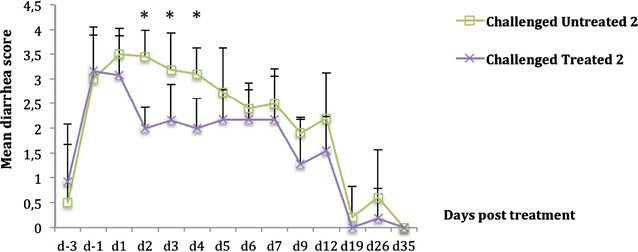
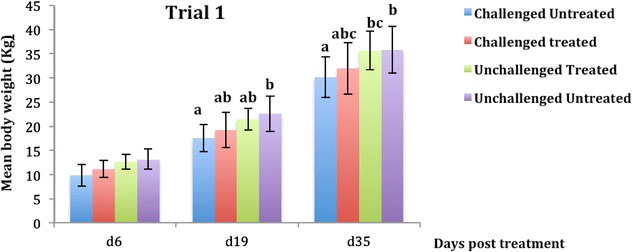
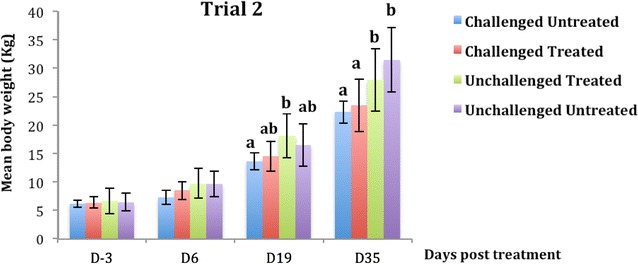
Enterotoxigenic Escherichia coli (ETEC: F4) associated with post-weaning diarrhea (PWD) in pigs has developed resistance against several antimicrobial families, leading to increased use of colistin sulfate (CS) for the treatment of this disease. The objective of this study was to determine the efficacy of oral CS treatment in experimental PWD due to ETEC: F4 challenge and determine the effect of this challenge on CS intestinal absorption. In this study, 96 pigs were divided into two trials based on CS dose (100 000 or 50 000 IU/kg). Fecal shedding of ETEC: F4, total E. coli, and CS-resistant E. coli, diarrhea scores, and weight changes were evaluated. Colistin sulfate plasma concentrations were determined by HPLC-MS/MS. Regardless of the dose, CS treatment resulted in a reduction of fecal ETEC: F4 and total E. coli shedding, and in diarrhea scores but only during the treatment period. However, CS treatment resulted in a slight increase in fecal shedding of CS resistant E. coli and did not prevent weight loss in challenged pigs. In addition, challenge with ETEC: F4 resulted in an increase of CS intestinal absorption. Our study is among the first to demonstrate that under controlled conditions, CS was effective in reducing fecal shedding of ETEC: F4 and total E. coli in experimental PWD. However, CS treatment was associated with a slight selection pressure on E. coli and did not prevent pig weight loss. Further studies are needed in field conditions, to better characterize CS therapeutic regimen efficacy and bacterial resistance dissemination.
与仔猪断奶后腹泻(PWD)相关的产肠毒素大肠杆菌(ETEC:F4)已对多种抗菌药物产生耐药性,导致硫酸黏菌素(CS)在治疗该疾病中的使用增加。本研究的目的是确定口服CS治疗因ETEC:F4攻毒引起的实验性PWD的疗效,并确定这种攻毒对CS肠道吸收的影响。在本研究中,96头猪根据CS剂量(100000或50000 IU/kg)分为两个试验组。评估了ETEC:F4、总大肠杆菌和耐CS大肠杆菌的粪便排出量、腹泻评分和体重变化。通过HPLC-MS/MS测定硫酸黏菌素血浆浓度。无论剂量如何,CS治疗均导致粪便中ETEC:F4和总大肠杆菌排出量减少,腹泻评分降低,但仅在治疗期间如此。然而,CS治疗导致耐CS大肠杆菌的粪便排出量略有增加,并且未能防止攻毒猪体重减轻。此外,ETEC:F4攻毒导致CS肠道吸收增加。我们的研究是首批证明在受控条件下,CS在减少实验性PWD中ETEC:F4和总大肠杆菌的粪便排出方面有效的研究之一。然而,CS治疗与对大肠杆菌的轻微选择压力相关,并且未能防止猪体重减轻。需要在田间条件下进行进一步研究,以更好地表征CS治疗方案的疗效和细菌耐药性传播情况。