Lai Yau-Huei, Yun Chun-Ho, Su Cheng-Huang, Yang Fei-Shih, Yeh Hung-I, Hou Charles Jia-Yin, Wu Tung-Hsin, Cury Ricardo C, Bezerra Hiram G, Hung Chung-Lieh
Division of Cardiology, Department of Internal Medicine, Mackay Memorial Hospital, Taipei, Taiwan Division of Cardiology, Department of Internal Medicine, Mackay Memorial Hospital, Hsinchu, Taiwan Mackay Junior College of Medicine, Nursing, and Management, Taipei, Taiwan Mackay Medical College, Taipei, Taiwan.
Department of Radiology, Mackay Memorial Hospital, Taipei, Taiwan Department of Biomedical Imaging and Radiological Sciences, National Yang Ming University, Taipei, Taiwan.
Echo Res Pract. 2016 Mar;3(1):5-15. doi: 10.1530/ERP-15-0031. Epub 2016 Jan 5.
Pericardial adipose tissue had been shown to exert local effects on adjacent cardiac structures. Data regarding the mechanistic link between such measures and left atrial (LA) structural/functional remodeling, a clinical hallmark of early stage heart failure (HF) and atrial fibrillation (AF) incidence, in asymptomatic population remain largely unexplored.
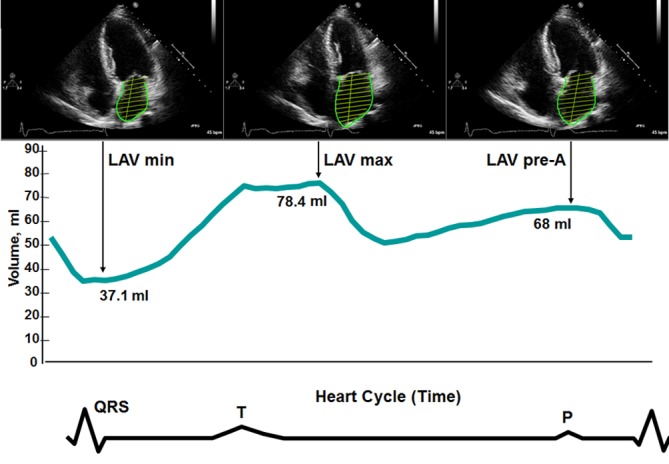
This retrospective analysis includes 356 subjects free from significant valvular disorders, atrial fibrillation, or clinical HF. Regional adipose tissue including pericardial and periaortic fat volumes, interatrial septal (IAS), and left atrioventricular groove (AVG) fat thickness were all measured by multidetector computed tomography (MDCT) (Aquarius 3D Workstation, TeraRecon, San Mateo, CA, USA). We measured LA volumes, booster performance, reservoir capacity as well as conduit function, and analyzed their association with adiposity measures.
All four adiposity measures were positively associated with greater LA volumes (all P < 0.05), while IAS and AVG fat were also related to larger LA kinetic energy and worse reservoir capacity (both P < 0.01). In multivariate models, IAS fat thickness remained independently associated with larger LA volumes, increased LA kinetic energy and ejection force (β-coef: 0.17 & 0.15, both P < 0.05), and impaired LA reservoir and conduit function (β-coef: -0.20 & -0.12, both P < 0.05) after adjusting for clinical variables.
Accumulated visceral adiposity, especially interatrial fat depots, was associated with certain LA structural/functional remodeling characterized by impaired LA reservoir and conduit function though augmented kinetic energy and ejection performance. Our data suggested that interatrial fat burden may be associated with certain detrimental LA functions with compensatory LA adaptation in an asymptomatic population.
心包脂肪组织已被证明对相邻心脏结构产生局部影响。在无症状人群中,关于此类指标与左心房(LA)结构/功能重塑(早期心力衰竭(HF)和心房颤动(AF)发病率的临床标志)之间的机制联系的数据在很大程度上仍未得到探索。
这项回顾性分析纳入了356名无严重瓣膜疾病、心房颤动或临床HF的受试者。通过多排螺旋计算机断层扫描(MDCT)(美国加利福尼亚州圣马特奥市TeraRecon公司的Aquarius 3D工作站)测量包括心包和主动脉周围脂肪体积、房间隔(IAS)和左房室沟(AVG)脂肪厚度在内的局部脂肪组织。我们测量了LA容积、增强性能、储器容量以及管道功能,并分析了它们与肥胖指标的关联。
所有四项肥胖指标均与更大的LA容积呈正相关(均P<0.05),而IAS和AVG脂肪也与更大的LA动能和更差的储器容量相关(均P<0.01)。在多变量模型中,调整临床变量后,IAS脂肪厚度仍与更大的LA容积、增加的LA动能和射血力独立相关(β系数:0.17和0.15,均P<0.05),以及LA储器和管道功能受损(β系数:-0.20和-0.12,均P<0.05)。
累积的内脏脂肪,尤其是房间隔脂肪堆积,与某些LA结构/功能重塑相关,其特征是LA储器和管道功能受损,但动能和射血性能增强。我们的数据表明,在无症状人群中,房间隔脂肪负担可能与某些有害的LA功能以及LA的代偿性适应有关。