Yan Heping, Kapoor Vaishali, Nguyen Kim, Akers Walter J, Li Hua, Scott Jalen, Laforest Richard, Rogers Buck, Thotala Dinesh, Hallahan Dennis
Department of Radiation Oncology, Washington University in St. Louis, St. Louis, Missouri, USA.
Mallinckrodt Institute of Radiology, Washington University in St. Louis, St. Louis, Missouri, USA.
Oncotarget. 2016 Jul 12;7(28):43352-43362. doi: 10.18632/oncotarget.9713.
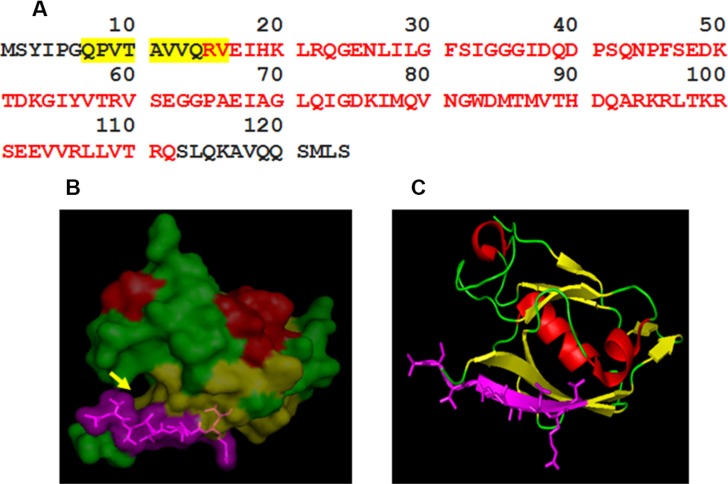
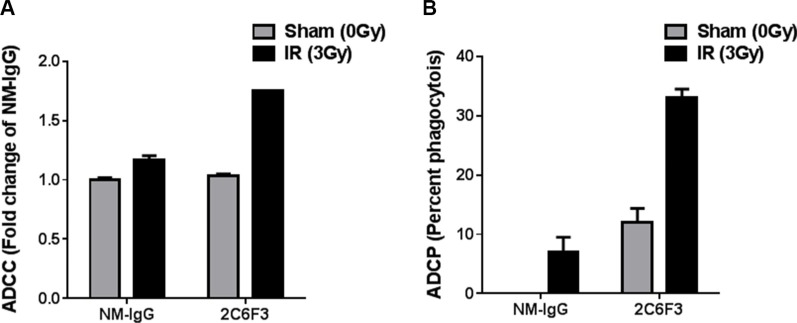
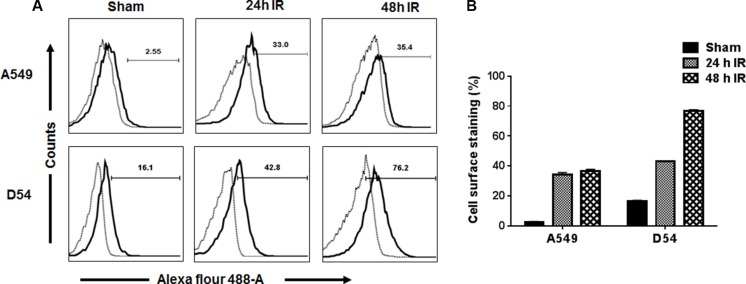
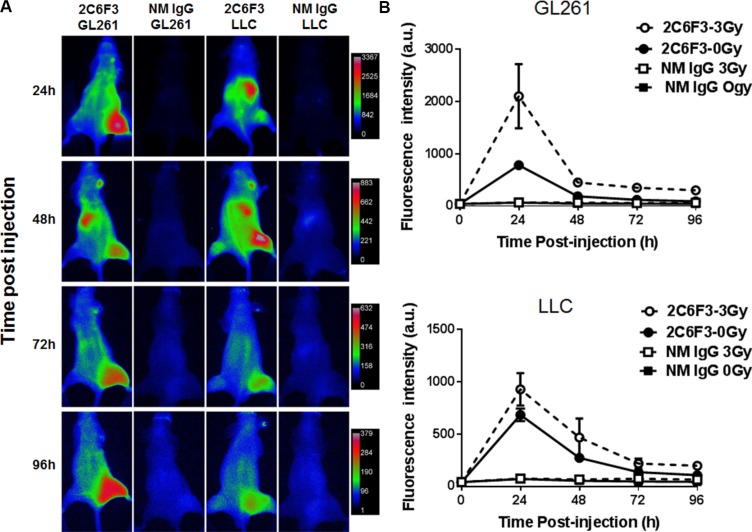
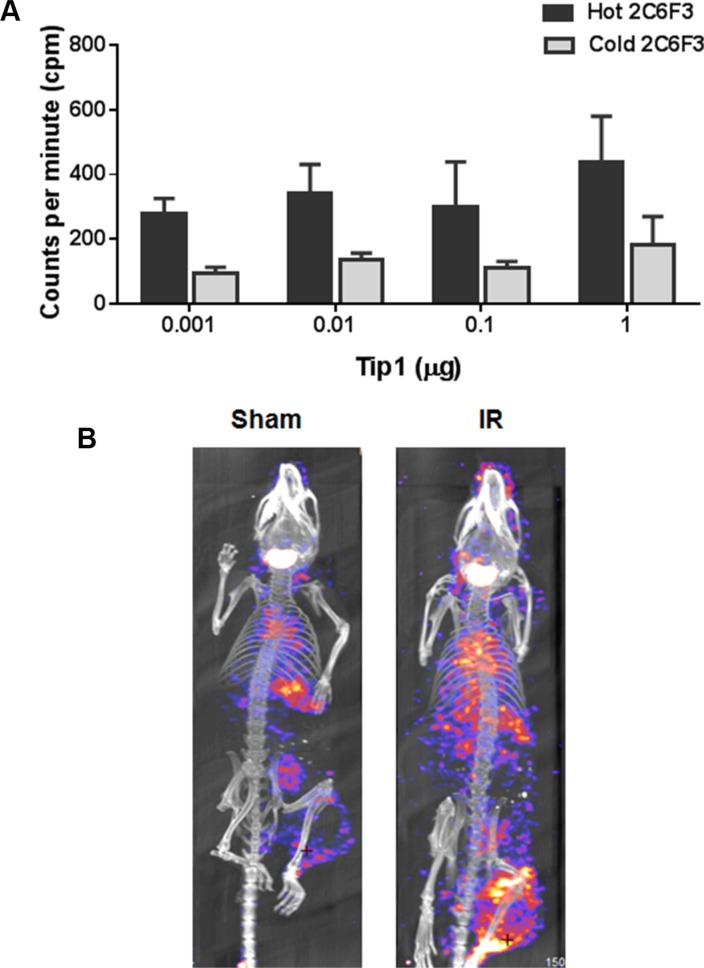
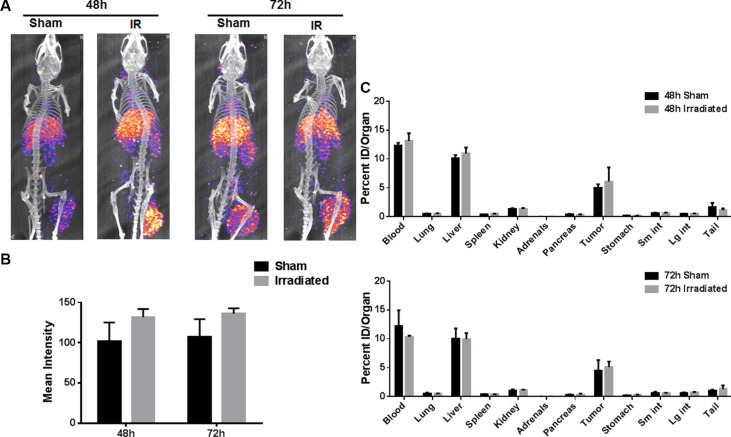
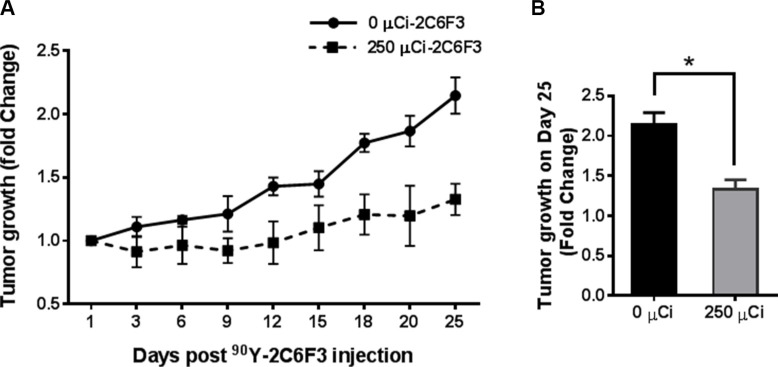
Radiation-inducible neo-antigens are proteins expressed on cancer cell surface after exposure to ionizing radiation (IR). These neo-antigens provide opportunities to specifically target cancers while sparing normal tissues. Tax interacting protein-1 (TIP-1) is induced by irradiation and is translocated to the surface of cancer cells. We have developed a monoclonal antibody, 2C6F3, against TIP-1.Epitope mapping revealed that 2C6F3 binds to the QPVTAVVQRV epitope of the TIP-1 protein. 2C6F3 binds to the surface of lung cancer (A549, LLC) and glioma (D54, GL261) cell lines. 2C6F3 binds specifically to TIP-1 and ELISA analysis showed that unconjugated 2C6F3 efficiently blocked binding of radiolabeled 2C6F3 to purified TIP-1 protein. To study in vivo tumor binding, we injected near infrared (NIR) fluorochrome-conjugated 2C6F3 via tail vein in mice bearing subcutaneous LLC and GL261 heterotopic tumors. The NIR images indicated that 2C6F3 bound specifically to irradiated LLC and GL261 tumors, with little or no binding in un-irradiated tumors.We also determined the specificity of 2C6F3 to bind tumors in vivo using SPECT/CT imaging. 2C6F3 was conjugated with diethylene triamine penta acetic acid (DTPA) chelator and radiolabeled with 111Indium (111In). SPECT/CT imaging revealed that 111In-2C6F3 bound more to the irradiated LLC tumors compared to un-irradiated tumors. Furthermore, injection of DTPA-2C6F3 labeled with the therapeutic radioisotope, 90Y, (90Y-DTPA-2C6F3) significantly delayed LLC tumor growth. 2C6F3 mediated antibody dependent cell-mediated cytotoxicity (ADCC) and antibody dependent cell-mediated phagocytosis (ADCP) in vitro.In conclusion, the monoclonal antibody 2C6F3 binds specifically to TIP-1 on cancer and radio-immunoconjugated 2C6F3 improves tumor control.
辐射诱导的新抗原是癌细胞在暴露于电离辐射(IR)后在其表面表达的蛋白质。这些新抗原为特异性靶向癌症同时 sparing正常组织提供了机会。Tax相互作用蛋白-1(TIP-1)由辐射诱导并转位到癌细胞表面。我们开发了一种针对TIP-1的单克隆抗体2C6F3。表位作图显示2C6F3与TIP-1蛋白的QPVTAVVQRV表位结合。2C6F3与肺癌(A549、LLC)和神经胶质瘤(D54、GL261)细胞系的表面结合。2C6F3特异性结合TIP-1,酶联免疫吸附测定分析表明未偶联的2C6F3有效阻断放射性标记的2C6F3与纯化的TIP-1蛋白的结合。为了研究体内肿瘤结合情况,我们通过尾静脉向携带皮下LLC和GL261异位肿瘤的小鼠注射近红外(NIR)荧光染料偶联的2C6F3。近红外图像表明2C6F3特异性结合受辐射的LLC和GL261肿瘤,在未受辐射的肿瘤中几乎没有或没有结合。我们还使用单光子发射计算机断层扫描/计算机断层扫描(SPECT/CT)成像确定了2C6F3在体内结合肿瘤的特异性。2C6F3与二乙烯三胺五乙酸(DTPA)螯合剂偶联并用111铟(111In)进行放射性标记。SPECT/CT成像显示与未受辐射的肿瘤相比,111In-2C6F3与受辐射的LLC肿瘤结合更多。此外,注射用治疗性放射性同位素90钇(90Y)标记的DTPA-2C6F3(90Y-DTPA-2C6F3)显著延迟了LLC肿瘤的生长。2C6F3在体外介导抗体依赖性细胞介导的细胞毒性(ADCC)和抗体依赖性细胞介导的吞噬作用(ADCP)。总之,单克隆抗体2C6F3特异性结合癌症上的TIP-1,放射性免疫偶联的2C6F3改善了肿瘤控制。