Heredia-Pi Ileana, Servan-Mori Edson, Darney Blair G, Reyes-Morales Hortensia, Lozano Rafael
Center for Health System Research, National Institute of Public Health, Av. Universidad #655, 62100, Cuernavaca, Morelos, Mexico .
Research Department, Federico Gomez Children's Hospital, Mexico City, Mexico .
Bull World Health Organ. 2016 Jun 1;94(6):452-61. doi: 10.2471/BLT.15.168302.
To propose an antenatal care classification for measuring the continuum of health care based on the concept of adequacy: timeliness of entry into antenatal care, number of antenatal care visits and key processes of care.
In a cross-sectional, retrospective study we used data from the Mexican National Health and Nutrition Survey (ENSANUT) in 2012. This contained self-reported information about antenatal care use by 6494 women during their last pregnancy ending in live birth. Antenatal care was considered to be adequate if a woman attended her first visit during the first trimester of pregnancy, made a minimum of four antenatal care visits and underwent at least seven of the eight recommended procedures during visits. We used multivariate ordinal logistic regression to identify correlates of adequate antenatal care and predicted coverage.
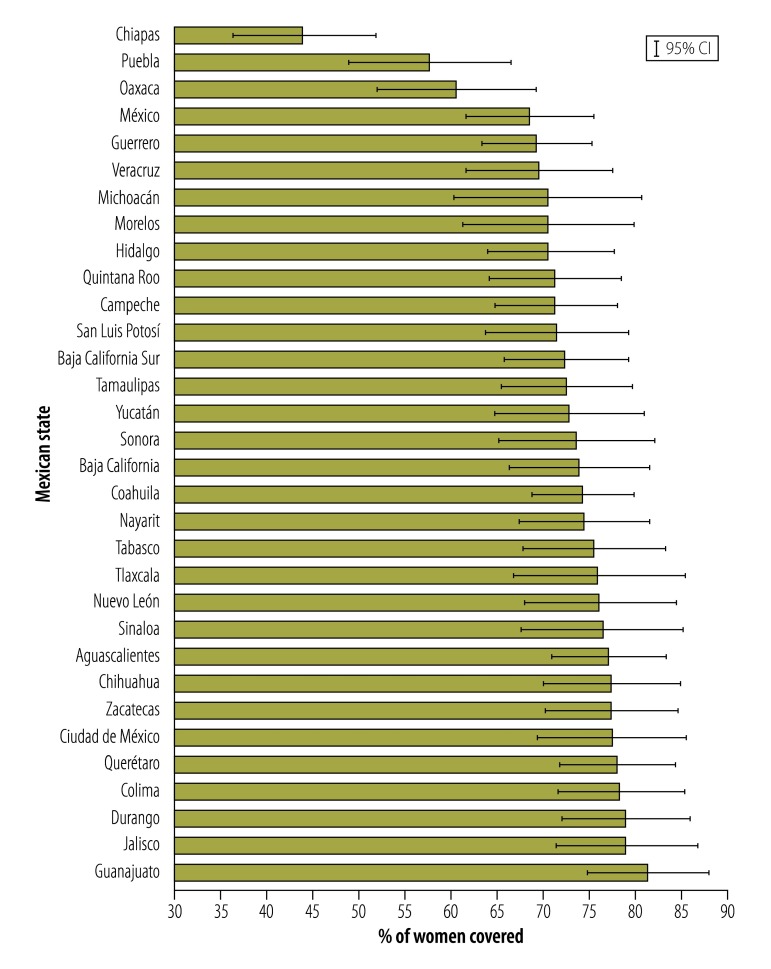
Based on a population-weighted sample of 9 052 044, 98.4% of women received antenatal care during their last pregnancy, but only 71.5% (95% confidence interval, CI: 69.7 to 73.2) received maternal health care classified as adequate. Significant geographic differences in coverage of care were identified among states. The probability of receiving adequate antenatal care was higher among women of higher socioeconomic status, with more years of schooling and with health insurance.
While basic antenatal care coverage is high in Mexico, adequate care remains low. Efforts by health systems, governments and researchers to measure and improve antenatal care should adopt a more rigorous definition of care to include important elements of quality such as continuity and processes of care.
基于充分性概念提出一种产前保健分类方法,以衡量医疗保健的连续性,该概念包括进入产前保健的及时性、产前保健就诊次数和关键保健流程。
在一项横断面回顾性研究中,我们使用了2012年墨西哥全国卫生和营养调查(ENSANUT)的数据。该数据包含6494名妇女在其最后一次妊娠并以活产结束期间自我报告的产前保健使用情况。如果一名妇女在妊娠早期进行首次就诊,进行至少四次产前保健就诊,并在就诊期间接受八项推荐程序中的至少七项,则认为产前保健是充分的。我们使用多变量有序逻辑回归来确定充分产前保健的相关因素并预测覆盖率。
基于9052044人的人口加权样本,98.4%的妇女在其最后一次妊娠期间接受了产前保健,但只有71.5%(95%置信区间,CI:69.7至73.2)接受了分类为充分的孕产妇保健。在各州之间发现了护理覆盖率的显著地理差异。社会经济地位较高、受教育年限较长且有医疗保险的妇女接受充分产前保健的概率更高。
虽然墨西哥的基本产前保健覆盖率很高,但充分保健率仍然很低。卫生系统、政府和研究人员为衡量和改善产前保健所做的努力应采用更严格的保健定义,以纳入质量的重要要素,如连续性和保健流程。