
Usefulness of surgical closure following intraoperative endoscopic additional stenting of duodenal perforation by stent: Report of a case.
作者信息
Shimizu Kenji, Takamori Hiroshi, Baba Hideo
机构信息
Department of Surgery, Saiseikai Kumamoto Hospital, 5-3-1 Chikami, Minami-ku, Kumamoto 861-4193, Japan.
Department of Surgery, Saiseikai Kumamoto Hospital, 5-3-1 Chikami, Minami-ku, Kumamoto 861-4193, Japan.
出版信息
Int J Surg Case Rep. 2016;25:21-3. doi: 10.1016/j.ijscr.2016.05.061. Epub 2016 Jun 3.
INTRODUCTION
Malignant duodenal stenosis occurs in patients with advanced periampullary cancer. Insertion of a self-expanding metal stent for the treatment of this condition carries the risk of subsequent perforation of the duodenum. We report successful treatment of duodenal perforation induced by a stent.
PRESENTATION OF CASE
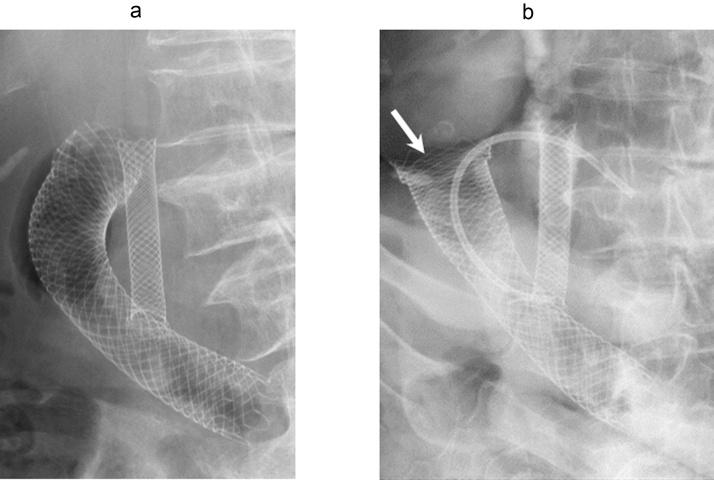
An 80-year-old woman suffering from stenosis caused by advanced periampullary cancer underwent metallic stent placement and her symptoms improved. While attempting biliary re-stenting to prevent restenosis after 4 months, the proximal end of the duodenal metallic stent migrated into the abdominal cavity. Using a laparotomy intraoperative endoscope, duodenal stents were placed into the prolapsed stent in the form of stent-in-stent to reduce the axial force of the stent, after which the puncture site was closed by suturing. No leakage or stenosis was observed at the duodenum, and the patient was able to eat normally until her death 4 months after surgery.
CONCLUSION
Surgical closure following intraoperative endoscopic additional stenting is a viable option for duodenal perforation caused by a stent.



 Zotero 插件