Price R Jordan, Lillycrop Karen A, Burdge Graham C
Academic Unit of Human Development and Health , Faculty of Medicine , University of Southampton , Southampton , UK.
Centre for Biological Sciences , Faculty of Natural and Environmental Sciences , University of Southampton , Southampton , UK.
J Nutr Sci. 2016 Apr 26;5:e17. doi: 10.1017/jns.2016.8. eCollection 2016.
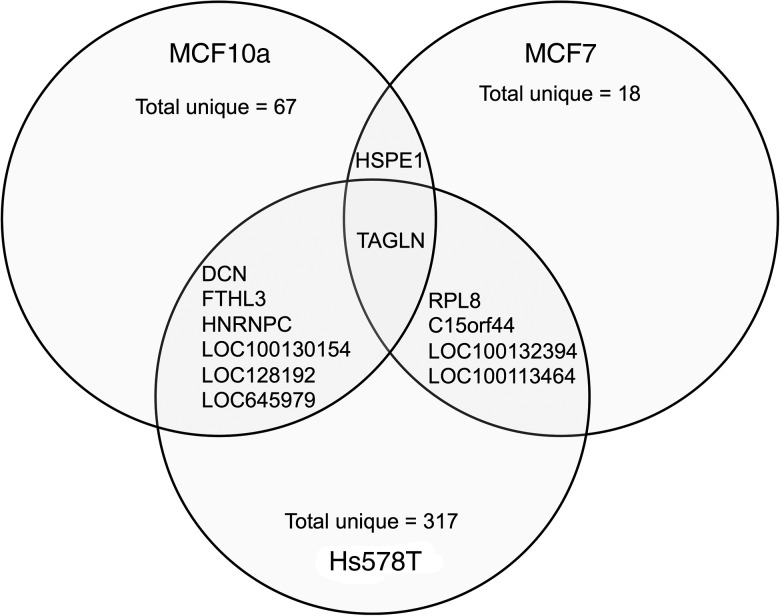
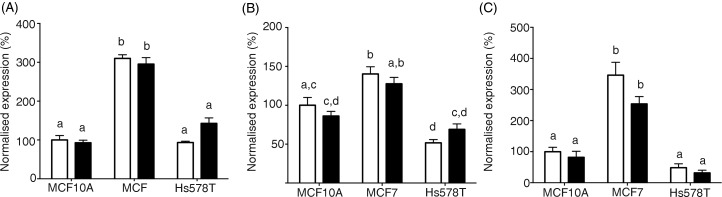
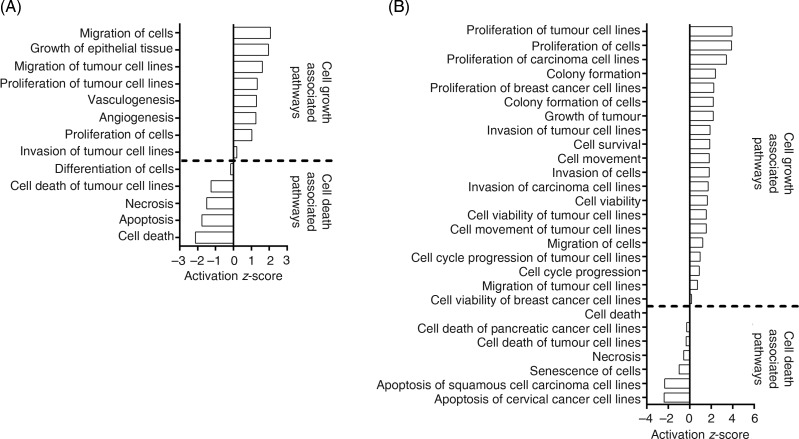
The effect of folic acid (FA) on breast cancer (BC) risk is uncertain. We hypothesised that this uncertainty may be due, in part, to differential effects of FA between BC cells with different phenotypes. To test this we investigated the effect of treatment with FA concentrations within the range of unmetabolised FA reported in humans on the expression of the transcriptome of non-transformed (MCF10A) and cancerous (MCF7 and Hs578T) BC cells. The total number of transcripts altered was: MCF10A, seventy-five (seventy up-regulated); MCF7, twenty-four (fourteen up-regulated); and Hs578T, 328 (156 up-regulated). Only the cancer-associated gene TAGLN was altered by FA in all three cell lines. In MCF10A and Hs578T cells, FA treatment decreased pathways associated with apoptosis, cell death and senescence, but increased those associated with cell proliferation. The folate transporters SLC19A1, SLC46A1 and FOLR1 were differentially expressed between cell lines tested. However, the level of expression was not altered by FA treatment. These findings suggest that physiological concentrations of FA can induce cell type-specific changes in gene regulation in a manner that is consistent with proliferative phenotype. This has implications for understanding the role of FA in BC risk. In addition, these findings support the suggestion that differences in gene expression induced by FA may involve differential activities of folate transporters. Together these findings indicate the need for further studies of the effect of FA on BC.
叶酸(FA)对乳腺癌(BC)风险的影响尚不确定。我们推测,这种不确定性可能部分归因于FA对不同表型的BC细胞的不同作用。为了验证这一点,我们研究了在人体中报道的未代谢FA浓度范围内的FA处理对非转化型(MCF10A)和癌性(MCF7和Hs578T)BC细胞转录组表达的影响。转录本改变的总数为:MCF10A,75个(70个上调);MCF7,24个(14个上调);Hs578T,328个(156个上调)。在所有三种细胞系中,只有癌症相关基因TAGLN被FA改变。在MCF10A和Hs578T细胞中,FA处理减少了与细胞凋亡、细胞死亡和衰老相关的通路,但增加了与细胞增殖相关的通路。叶酸转运蛋白SLC19A1、SLC46A1和FOLR1在测试的细胞系之间差异表达。然而,其表达水平未被FA处理改变。这些发现表明,生理浓度的FA可以以与增殖表型一致的方式诱导基因调控中的细胞类型特异性变化。这对于理解FA在BC风险中的作用具有重要意义。此外,这些发现支持了FA诱导的基因表达差异可能涉及叶酸转运蛋白不同活性的观点。这些发现共同表明需要进一步研究FA对BC的影响。