Angilletta Michael J, Zelic Maximilian H, Adrian Gregory J, Hurliman Alex M, Smith Colton D
School of Life Sciences, Arizona State University, Tempe, AZ 85287, USA.
Conserv Physiol. 2013 Jun 11;1(1):cot018. doi: 10.1093/conphys/cot018. eCollection 2013.
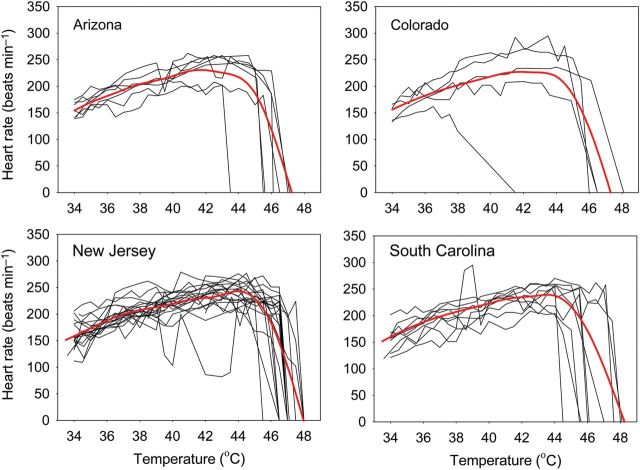
The frequency and magnitude of heat waves have increased in recent decades, imposing additional stresses on organisms in extreme environments. Most reptilian embryos are regularly exposed to thermal stress because they develop in shallow, warm soils for weeks to months. We studied cardiac performance during warming to infer lethal temperatures for embryonic lizards in the Sceloporus undulatus complex. Embryos from four populations throughout the geographical range (New Jersey, South Carolina, Colorado, and Arizona) were warmed at a rate observed in natural nests. Embryos from all populations exhibited a similar pattern of thermal sensitivity, as follows: heart rate rose between 34 and 41°C, remained stable between 41 and 44°C, and dropped sharply between 44 and 47°C. No embryos recovered from cardiac arrest, indicating that the upper lethal temperature was ≤47°C. Despite the putative selective pressures, the thermal limit to cardiac performance seems to have been conserved during the evolution of this species.
近几十年来,热浪的频率和强度不断增加,给极端环境中的生物带来了额外压力。大多数爬行动物胚胎经常受到热应激,因为它们在浅暖的土壤中发育数周甚至数月。我们研究了升温过程中的心脏功能,以推断西部强棱蜥复合体中胚胎蜥蜴的致死温度。来自整个地理分布范围(新泽西州、南卡罗来纳州、科罗拉多州和亚利桑那州)四个种群的胚胎,以在自然巢穴中观察到的速率进行升温。所有种群的胚胎都表现出相似的热敏感模式,如下:心率在34至41°C之间上升,在41至44°C之间保持稳定,在44至47°C之间急剧下降。没有胚胎从心脏骤停中恢复,这表明致死温度上限≤47°C。尽管存在假定的选择压力,但在该物种的进化过程中,心脏功能的热极限似乎一直保持不变。