Yang Aifu, Zhou Zunchun, Pan Yongjia, Jiang Jingwei, Dong Ying, Guan Xiaoyan, Sun Hongjuan, Gao Shan, Chen Zhong
Liaoning Key Lab of Marine Fishery Molecular Biology, Liaoning Ocean and Fisheries Science Research Institute, Dalian, Liaoning, 116023, Peoples' Republic of China.
BMC Genomics. 2016 Jun 14;17:459. doi: 10.1186/s12864-016-2810-3.
Sea cucumber Apostichopus japonicus is an important economic species in China, which is affected by various diseases; skin ulceration syndrome (SUS) is the most serious. In this study, we characterized the transcriptomes in A. japonicus challenged with Vibrio splendidus to elucidate the changes in gene expression throughout the three stages of SUS progression.
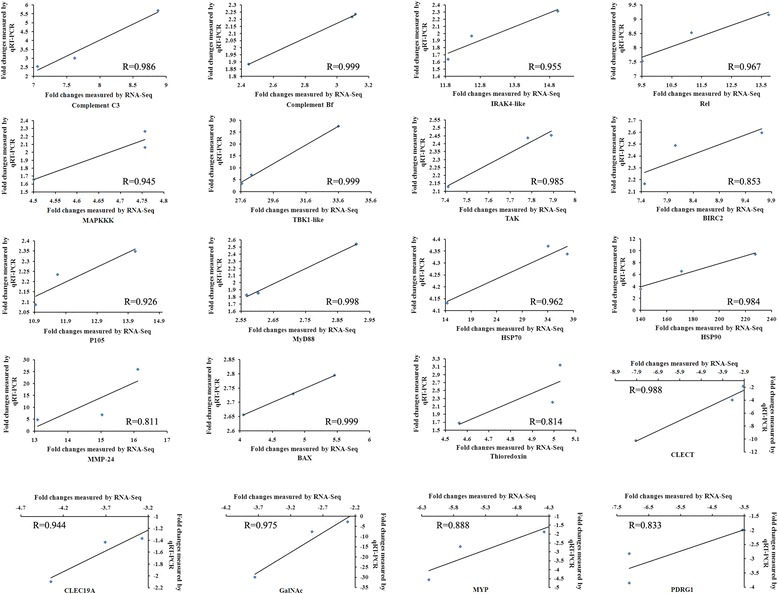
RNA sequencing of 21 cDNA libraries from various tissues and developmental stages of SUS-affected A. japonicus yielded 553 million raw reads, of which 542 million high-quality reads were generated by deep-sequencing using the Illumina HiSeq™ 2000 platform. The reference transcriptome comprised a combination of the Illumina reads, 454 sequencing data and Sanger sequences obtained from the public database to generate 93,163 unigenes (average length, 1,052 bp; N50 = 1,575 bp); 33,860 were annotated. Transcriptome comparisons between healthy and SUS-affected A. japonicus revealed greater differences in gene expression profiles in the body walls (BW) than in the intestines (Int), respiratory trees (RT) and coelomocytes (C). Clustering of expression models revealed stable up-regulation as the main pattern occurring in the BW throughout the three stages of SUS progression. Significantly affected pathways were associated with signal transduction, immune system, cellular processes, development and metabolism. Ninety-two differentially expressed genes (DEGs) were divided into four functional categories: attachment/pathogen recognition (17), inflammatory reactions (38), oxidative stress response (7) and apoptosis (30). Using quantitative real-time PCR, twenty representative DEGs were selected to validate the sequencing results. The Pearson's correlation coefficient (R) of the 20 DEGs ranged from 0.811 to 0.999, which confirmed the consistency and accuracy between these two approaches.
Dynamic changes in global gene expression occur during SUS progression in A. japonicus. Elucidation of these changes is important in clarifying the molecular mechanisms associated with the development of SUS in sea cucumber.
刺参是中国重要的经济物种,受多种疾病影响,其中皮肤溃疡综合征(SUS)最为严重。在本研究中,我们对受灿烂弧菌攻击的刺参转录组进行了表征,以阐明SUS进展三个阶段中基因表达的变化。
对来自受SUS影响的刺参不同组织和发育阶段的21个cDNA文库进行RNA测序,产生了5.53亿条原始读数,其中通过使用Illumina HiSeq™ 2000平台进行深度测序产生了5.42亿条高质量读数。参考转录组由Illumina读数、454测序数据和从公共数据库获得的桑格序列组合而成,产生了93163个单基因(平均长度为1052 bp;N50 = 1575 bp);33860个得到注释。健康刺参与受SUS影响的刺参之间的转录组比较显示,体壁(BW)中的基因表达谱差异比肠道(Int)、呼吸树(RT)和体腔细胞(C)中的更大。表达模型聚类显示,在SUS进展的三个阶段中,体壁中主要的模式是稳定上调。受显著影响的途径与信号转导、免疫系统、细胞过程、发育和代谢相关。92个差异表达基因(DEG)分为四个功能类别:附着/病原体识别(17个)、炎症反应(38个)、氧化应激反应(7个)和细胞凋亡(30个)。使用定量实时PCR,选择了20个代表性DEG来验证测序结果。这20个DEG的皮尔逊相关系数(R)在从到0.811至0.999之间,证实了这两种方法之间的一致性和准确性。
刺参SUS进展过程中发生了全局基因表达的动态变化。阐明这些变化对于阐明海参SUS发生发展的分子机制很重要。