
髋关节改良后路入路技术说明
Technical Note on Modified Posterior Approach to the Hip Joint.
作者信息
Iyer Krishna Mohan
机构信息
Flat 120/H-2K, First Floor, 152, Kailash Apartments, Malleswaram, 8th Main Road, Bangalore-560 003, Karnataka State. India.
出版信息
J Orthop Case Rep. 2015 Jan-Mar;5(1):69-72. doi: 10.13107/jocr.2250-0685.260.
INTRODUCTION
The posterior approach is the most commonly and relatively easy to be used to expose the hip joint. Posterior approaches allow excellent visualization of the entire acetabulum and the upper femoral shaft, and thus they are popular for revision joint replacement surgery particularly in cases where only the femoral component needs to be replaced. There may be a higher dislocation rate with minimal movement as compared to anterior approaches if the posterior approach is used in fractured neck of femur surgery in demented or elderly bedridden patients who often lie crouched in bed with their hips in a flexed and adducted position. The expected purpose of this modification of the Posterior Approach to the Hip Joint is to overcome the fear of dislocation and hence combine the advantages of the Posterior route with greater stability.
TECHNIQUE
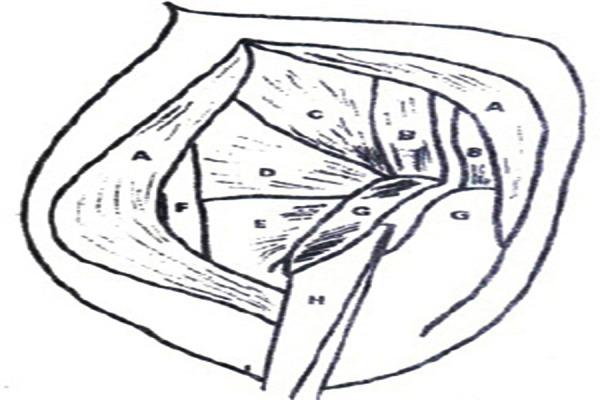
The author's original paper written 30 years ago (Iyer, 1981) presented an original technique devised to confer greater stability to the hip joint posteriorly to minimize the greater incidence of dislocation which has been reported extensively in literature. The technique involves an osteotomy of the posterior overhanging part of the greater trochanter to include the insertions of the short lateral rotators along with the posterior third of the gluteus medius, which can then be turned back in one piece like the page of a book to include the capsule of the hip joint. This gives wide exposure of the posterior lip of the acetabulum and is relatively bloodless in its exposure. This approach is very useful in the elderly particularly demented patients requiring a hemiarthroplasty and also in primary and revision total hip replacement. This approach has been tested in cadavers to conclude the greater stability given as compared to the routine resuture or reattachment of the short lateral rotators.
CONCLUSION
The modified technique provides for greater stability as compared to the Southern Approach.
引言
后入路是最常用且相对易于用于暴露髋关节的方法。后入路能很好地显露整个髋臼和股骨干上段,因此在翻修关节置换手术中很受欢迎,尤其是在仅需更换股骨部件的情况下。如果在患有痴呆或长期卧床的老年患者的股骨颈骨折手术中采用后入路,与前入路相比,在活动极少的情况下脱位率可能更高,这些患者常蜷缩在床上,髋关节处于屈曲内收位。这种改良的髋关节后入路的预期目的是克服对脱位的担忧,从而将后入路的优势与更高的稳定性相结合。
技术
作者30年前撰写的原始论文(Iyer,1981年)介绍了一种原始技术,旨在增强髋关节后方的稳定性,以尽量减少文献中广泛报道的较高脱位发生率。该技术包括对大转子后方悬垂部分进行截骨,以包括短外旋肌的附着点以及臀中肌后三分之一,然后可将其像书页一样整体向后翻转,以包括髋关节囊。这样能广泛暴露髋臼后唇,且暴露过程相对不出血。这种方法对需要进行半髋关节置换术的老年患者尤其是痴呆患者以及初次和翻修全髋关节置换术都非常有用。该方法已在尸体上进行测试,结果表明与常规重新缝合或重新附着短外旋肌相比,其稳定性更高。
结论
与南方入路相比,改良技术提供了更高的稳定性。



 Zotero 插件