• 文献检索
  • 文档翻译
  • 深度研究
  • 学术资讯
  • Suppr Zotero 插件Zotero 插件
  • 邀请有礼
  • 套餐&价格
  • 历史记录
应用&插件
Suppr Zotero 插件Zotero 插件浏览器插件Mac 客户端Windows 客户端微信小程序
定价
高级版会员购买积分包购买API积分包
服务
文献检索文档翻译深度研究API 文档MCP 服务
关于我们
关于 Suppr公司介绍联系我们用户协议隐私条款
关注我们

Suppr 超能文献

核心技术专利:CN118964589B侵权必究
粤ICP备2023148730 号-1Suppr @ 2026

文献检索

告别复杂PubMed语法,用中文像聊天一样搜索,搜遍4000万医学文献。AI智能推荐,让科研检索更轻松。

立即免费搜索

文件翻译

保留排版,准确专业,支持PDF/Word/PPT等文件格式,支持 12+语言互译。

免费翻译文档

深度研究

AI帮你快速写综述,25分钟生成高质量综述,智能提取关键信息,辅助科研写作。

立即免费体验

经后路行转子后外侧突出部改良截骨术在髋关节置换术中的应用:一项解剖学研究

Modified osteotomy of posterolateral overhanging part of the trochanter via posterior approach for hip arthroplasty: an anatomical study.

作者信息

Zhou Xiaoxiao, Ji Houlin, Guo Jinhua, Yang Yang, Cai Pan, Zhang Xianlong

机构信息

Department of Orthopedics, Shanghai University of Medicine & Health Sciences Affiliated Zhoupu Hospital, Shanghai, China.

Graduate School of Shanghai University of Traditional Chinese Medicine, Shanghai, China.

出版信息

BMC Musculoskelet Disord. 2020 Feb 24;21(1):119. doi: 10.1186/s12891-020-3088-9.

DOI:10.1186/s12891-020-3088-9
PMID:32093650
原文链接:https://pmc.ncbi.nlm.nih.gov/articles/PMC7041102/
Abstract

BACKGROUD

The osteotomy of the posterolateral overhanging part (PLOP) of the greater trochanter via posterior approach has been used for the hip arthroplasty for decades with good results. However, the osteotomy method remains undefined and the precise adjacent structures around PLOP have not been reported. The purpose of this study was to present a modified PLOP osteotomy approach and perform a detailed study of the topographic and surgical anatomy of the PLOP.

METHODS

The peri-PLOP soft tissue and the bony parameters were measured using 10 cadavers with 20 hips and 20 skeletal hip specimens, respectively.

RESULTS

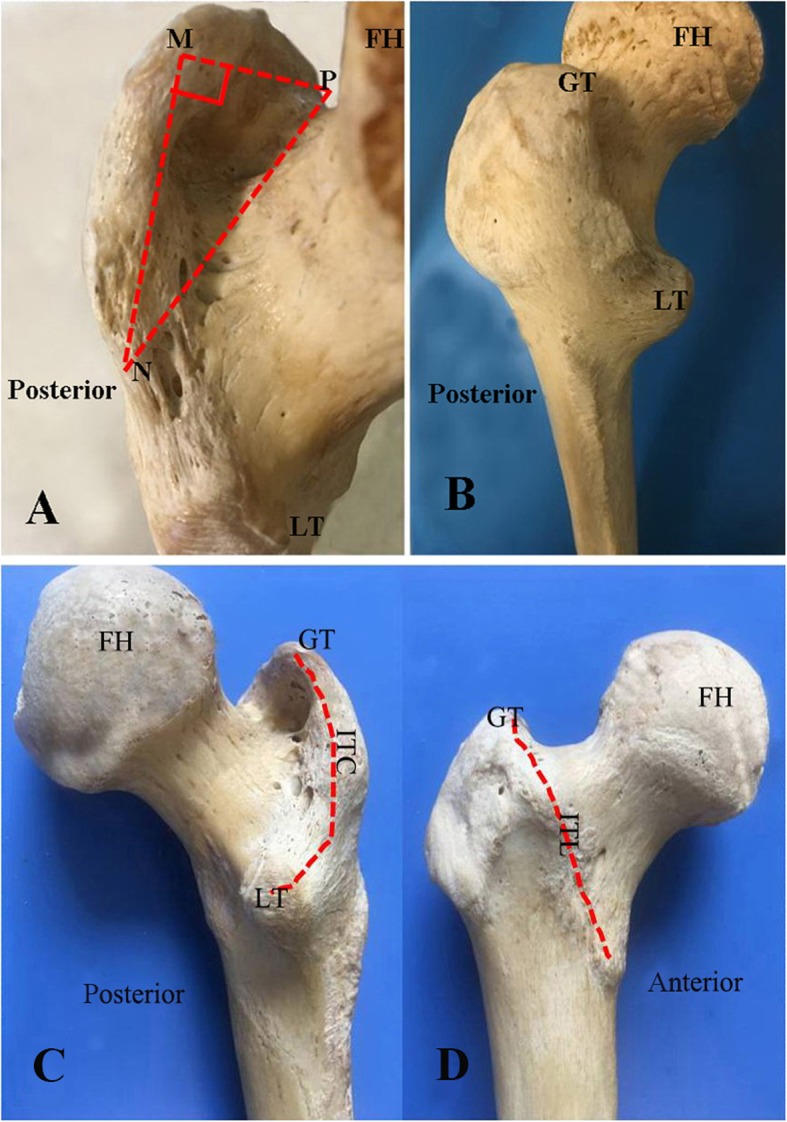
A 1.8-cm vertical osteotomy did not jeopardize the femoral neck, and a 1.8-cm wide bone block did not damage the insertions of the short external rotators. The average distances between the most distal branch of the superior gluteal nerve/artery and the 1.8-cm point of the greater trochanter were 5.70 ± 0.66 cm and 6.33 ± 0.56 cm, respectively.

CONCLUSION

For osteotomy of the PLOP, we suggested that the width of the upper side from the lateral to medial greater trochanter should be 1.8 cm, depth of vertical osteotomy should be 1.8 cm, and length of the posterior edge should be 4 cm. Obturator externus tendon should be kept within the bone block of osteotomy. The proximal extension of the gluteus medius muscle split should be limited to 5.5 cm at the 1.8 cm-point of the greater trochanter.

LEVEL OF EVIDENCE

Prospective comparative study Level II.

摘要

背景

经后路对大转子后外侧悬垂部(PLOP)进行截骨术已用于髋关节置换术数十年,效果良好。然而,截骨方法仍不明确,且PLOP周围精确的毗邻结构尚未见报道。本研究的目的是提出一种改良的PLOP截骨方法,并对PLOP的局部解剖和手术解剖进行详细研究。

方法

分别使用10具尸体的20个髋关节和20个骨骼化髋关节标本测量PLOP周围软组织和骨骼参数。

结果

1.8 cm的垂直截骨不会危及股骨颈,1.8 cm宽的骨块不会损伤短外旋肌的附着点。臀上神经/动脉最远端分支与大转子1.8 cm点之间的平均距离分别为5.70±0.66 cm和6.33±0.56 cm。

结论

对于PLOP截骨术,我们建议大转子从外侧到内侧上缘的宽度应为1.8 cm,垂直截骨深度应为1.8 cm,后缘长度应为4 cm。闭孔外肌腱应保留在截骨骨块内。臀中肌劈开的近端延伸在大转子1.8 cm点处应限制在5.5 cm以内。

证据水平

前瞻性比较研究二级。

https://cdn.ncbi.nlm.nih.gov/pmc/blobs/6d84/7041102/25c81a3041d2/12891_2020_3088_Fig3_HTML.jpg
https://cdn.ncbi.nlm.nih.gov/pmc/blobs/6d84/7041102/523ebea961ac/12891_2020_3088_Fig1_HTML.jpg
https://cdn.ncbi.nlm.nih.gov/pmc/blobs/6d84/7041102/a46d79d21531/12891_2020_3088_Fig2_HTML.jpg
https://cdn.ncbi.nlm.nih.gov/pmc/blobs/6d84/7041102/25c81a3041d2/12891_2020_3088_Fig3_HTML.jpg
https://cdn.ncbi.nlm.nih.gov/pmc/blobs/6d84/7041102/523ebea961ac/12891_2020_3088_Fig1_HTML.jpg
https://cdn.ncbi.nlm.nih.gov/pmc/blobs/6d84/7041102/a46d79d21531/12891_2020_3088_Fig2_HTML.jpg
https://cdn.ncbi.nlm.nih.gov/pmc/blobs/6d84/7041102/25c81a3041d2/12891_2020_3088_Fig3_HTML.jpg

相似文献

1
Modified osteotomy of posterolateral overhanging part of the trochanter via posterior approach for hip arthroplasty: an anatomical study.经后路行转子后外侧突出部改良截骨术在髋关节置换术中的应用:一项解剖学研究
BMC Musculoskelet Disord. 2020 Feb 24;21(1):119. doi: 10.1186/s12891-020-3088-9.
2
Partial greater trochanter osteotomy for hip reduction in total hip arthroplasty for high dislocated hip: a preliminary report.全髋关节置换术中大转子部分截骨用于高位脱位髋关节复位:初步报告
BMC Musculoskelet Disord. 2014 Sep 4;15:293. doi: 10.1186/1471-2474-15-293.
3
A Vessel-Preserving Surgical Hip Dislocation Through a Modified Posterior Approach: Assessment of Femoral Head Vascularity Using Gadolinium-Enhanced MRI.通过改良后入路行保留血管的手术性髋关节脱位:使用钆增强磁共振成像评估股骨头血供
J Bone Joint Surg Am. 2016 Mar 16;98(6):475-83. doi: 10.2106/JBJS.15.00367.
4
Anterolateral muscle sparing approach total hip arthroplasty: an anatomic and clinical study.前外侧肌肉保留入路全髋关节置换术:一项解剖学与临床研究
Chin Med J (Engl). 2008 Aug 5;121(15):1358-63.
5
Greater trochanter osteotomy with cementless THA for Crowe type IV DDH.采用非骨水泥型全髋关节置换术并做大转子截骨治疗Crowe Ⅳ型发育性髋关节发育不良
Orthopedics. 2013 May;36(5):e601-5. doi: 10.3928/01477447-20130426-22.
6
[Becker V-shaped lateral rotation osteotomy in total hip arthroplasty for Crowe type IV development dislocation of hip].[全髋关节置换术中用于治疗Crowe IV型发育性髋关节脱位的贝克尔V形外旋截骨术]
Zhongguo Xiu Fu Chong Jian Wai Ke Za Zhi. 2013 Sep;27(9):1032-6.
7
Exposure of the hip by anterior osteotomy of the greater trochanter.通过大转子前截骨术暴露髋关节。
Bull Hosp Jt Dis. 1998;57(3):159-61.
8
Experience with a modified posterior approach to the hip joint. A technical note.
J Arthroplasty. 1991 Mar;6(1):11-8. doi: 10.1016/s0883-5403(06)80152-x.
9
Greater trochanter of the hip: attachment of the abductor mechanism and a complex of three bursae--MR imaging and MR bursography in cadavers and MR imaging in asymptomatic volunteers.髋部大转子:外展肌机制的附着点及三个滑囊复合体——尸体的磁共振成像和磁共振滑囊造影以及无症状志愿者的磁共振成像
Radiology. 2001 Nov;221(2):469-77. doi: 10.1148/radiol.2211001634.
10
Effect of transtrochanteric rotational osteotomy on impingement and contact state of a femoral implant in conversion total hip arthroplasty - Retrospective simulation study.转子间旋转截骨术对全髋关节置换翻修术中股骨假体撞击及接触状态的影响——回顾性模拟研究
Clin Biomech (Bristol). 2020 Jan;71:68-72. doi: 10.1016/j.clinbiomech.2019.10.020. Epub 2019 Oct 22.

本文引用的文献

1
The incidence of hip dislocation and suture failure according to two different types of posterior soft tissue repair techniques in total hip arthroplasty: a prospective randomized controlled trial.全髋关节置换术中两种不同类型的后方软组织修复技术的髋关节脱位和缝线失败发生率:一项前瞻性随机对照试验。
Int Orthop. 2018 Sep;42(9):2049-2056. doi: 10.1007/s00264-018-3884-0. Epub 2018 Mar 21.
2
Technical Note on Modified Posterior Approach to the Hip Joint.髋关节改良后路入路技术说明
J Orthop Case Rep. 2015 Jan-Mar;5(1):69-72. doi: 10.13107/jocr.2250-0685.260.
3
Does Surgical Approach Affect Patient-reported Function After Primary THA?
初次全髋关节置换术后手术入路会影响患者报告的功能吗?
Clin Orthop Relat Res. 2016 Apr;474(4):971-81. doi: 10.1007/s11999-015-4639-5. Epub 2015 Nov 30.
4
Surgical approach in primary total hip arthroplasty: anatomy, technique and clinical outcomes.初次全髋关节置换术的手术入路:解剖、技术及临床结果
Can J Surg. 2015 Apr;58(2):128-39. doi: 10.1503/cjs.007214.
5
Prospective randomized study of direct anterior vs postero-lateral approach for total hip arthroplasty.前路与后外侧入路全髋关节置换术的前瞻性随机研究。
J Arthroplasty. 2013 Oct;28(9):1634-8. doi: 10.1016/j.arth.2013.01.034. Epub 2013 Mar 19.
6
Risk factors for dislocation after revision total hip arthroplasty.翻修全髋关节置换术后脱位的危险因素。
Clin Orthop Relat Res. 2013 Feb;471(2):410-6. doi: 10.1007/s11999-012-2561-7.
7
Surgical technique: a simple soft-tissue-only repair of the capsule and external rotators in posterior-approach THA.手术技术:后入路全髋关节置换术中仅行囊和外旋肌群的软组织修复的简单方法。
Clin Orthop Relat Res. 2012 Feb;470(2):511-5. doi: 10.1007/s11999-011-2113-6.
8
The capsule's contribution to total hip construct stability--a finite element analysis.胶囊对全髋关节结构稳定性的贡献——有限元分析。
J Orthop Res. 2011 Nov;29(11):1642-8. doi: 10.1002/jor.21435. Epub 2011 Apr 14.
9
Anatomy of piriformis, obturator internus and obturator externus: implications for the posterior surgical approach to the hip.梨状肌、闭孔内肌和闭孔外肌的解剖结构:对髋关节后方手术入路的影响
J Bone Joint Surg Br. 2010 Sep;92(9):1317-24. doi: 10.1302/0301-620X.92B9.23893.
10
Tackling the learning curve: comparison between the anterior, minimally invasive (Micro-hip®) and the lateral, transgluteal (Bauer) approach for primary total hip replacement.解决学习曲线问题:初次全髋关节置换中前路微创(Micro-hip®)和外侧经臀(Bauer)入路的比较。
Arch Orthop Trauma Surg. 2011 May;131(5):597-602. doi: 10.1007/s00402-010-1174-4. Epub 2010 Aug 20.