Nyberg J, Karlsson K E, Jönsson S, Yin Oqp, Miller R, Karlsson M O, Simonsson Ush
Department of Pharmaceutical Biosciences, Uppsala University, Uppsala, Sweden.
Modeling and Simulation, Translational Medicine, and Clinical Pharmacology, Daiichi Sankyo Pharma Development, Edison, New Jersey, USA.
CPT Pharmacometrics Syst Pharmacol. 2016 Apr;5(4):222-32. doi: 10.1002/psp4.12077. Epub 2016 Apr 15.
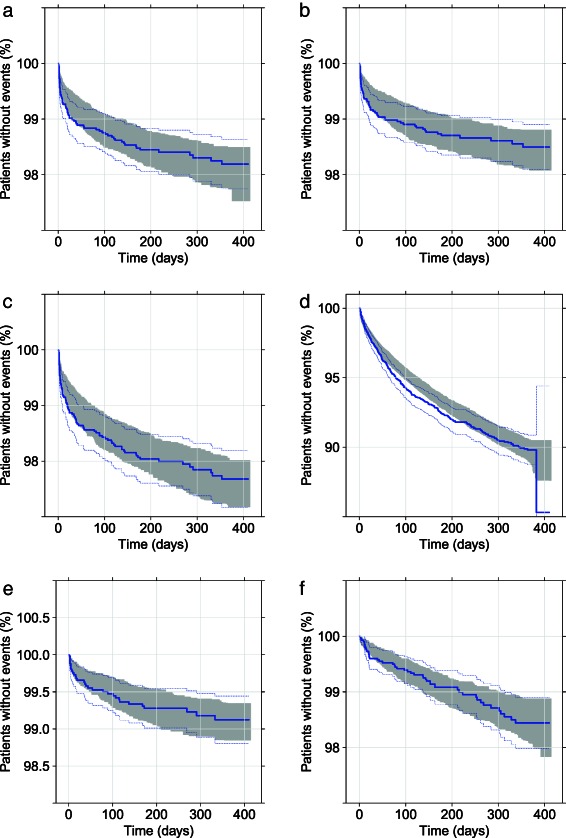
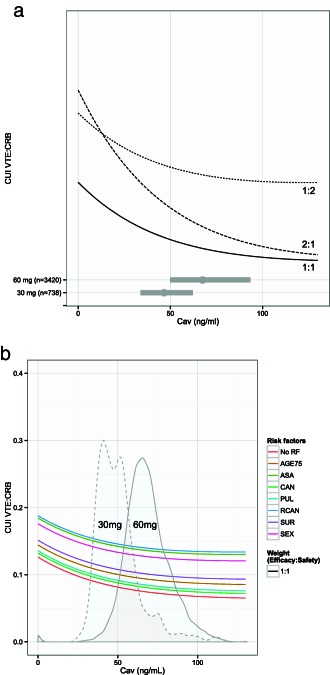
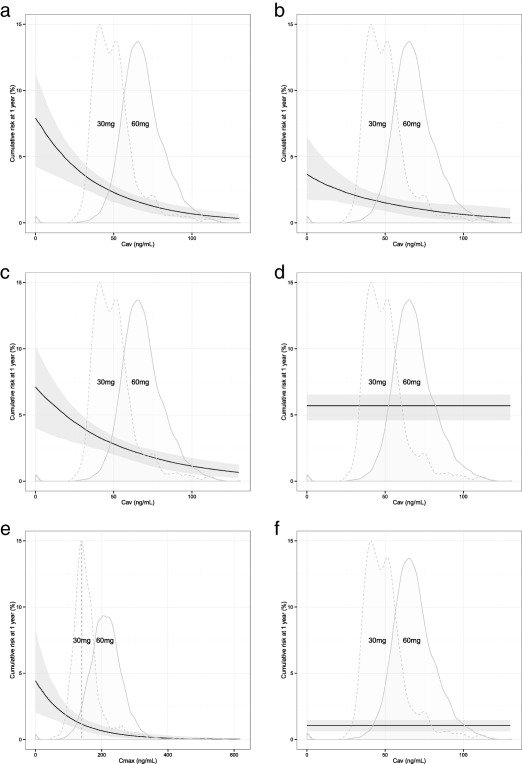
Edoxaban exposure-response relationships from the phase III study evaluating edoxaban for prevention and treatment of venous thromboembolism (VTE) in patients with acute deep vein thrombosis (DVT) and/or pulmonary embolism (PE) were assessed by parametric time-to-event analysis. Statistical significant exposure-response relationships were recurrent VTE with hazard ratio (HR) based on average edoxaban concentration at steady state (Cav) (HRCav) = 0.98 (i.e., change in the HR with every 1 ng/mL increase of Cav); the composite of recurrent DVT and nonfatal PE with HRCav = 0.99; and the composite of recurrent DVT, nonfatal PE, and all-cause mortality HRCav = 0.98, and all death using maximal edoxaban concentration (Cmax) with HR (Cmax) = 0.99. No statistical significant exposure-response relationships were found for clinically relevant bleeding or major adverse cardiovascular event. Results support the recommendation of once-daily edoxaban 60 mg, and a reduced 30 mg dose in patients with moderate renal impairment, body weight ≤60 kg, or use of P-glycoprotein inhibitors verapamil or quinidine.
通过参数化事件发生时间分析,评估了在急性深静脉血栓形成(DVT)和/或肺栓塞(PE)患者中评价依度沙班预防和治疗静脉血栓栓塞(VTE)的III期研究中的依度沙班暴露-反应关系。具有统计学显著意义的暴露-反应关系为:复发性VTE,基于稳态时依度沙班平均浓度(Cav)的风险比(HR)(HRCav)=0.98(即Cav每增加1 ng/mL时HR的变化);复发性DVT和非致命性PE的复合终点,HRCav=0.99;复发性DVT、非致命性PE和全因死亡率的复合终点,HRCav=0.98,以及使用依度沙班最大浓度(Cmax)的所有死亡情况,HR(Cmax)=0.99。对于临床相关出血或主要不良心血管事件,未发现具有统计学显著意义的暴露-反应关系。结果支持每日一次服用60 mg依度沙班的推荐,对于中度肾功能损害、体重≤60 kg或使用P-糖蛋白抑制剂维拉帕米或奎尼丁的患者,剂量减至30 mg。