
低灌注与高通透性不匹配可预测接受动脉内溶栓治疗的急性缺血性卒中患者的出血转化区域。
Mismatch of Low Perfusion and High Permeability Predicts Hemorrhagic Transformation Region in Acute Ischemic Stroke Patients Treated with Intra-arterial Thrombolysis.
作者信息
Chen Hui, Liu Nan, Li Ying, Wintermark Max, Jackson Alan, Wu Bing, Su Zihua, Chen Fei, Hu Jun, Zhang Yongwei, Zhu Guangming
机构信息
Department of Neurology, Military General Hospital of Beijing PLA, Beijing, 100700, China.
Stanford University, Department of Radiology, Neuroradiology Section, Stanford, CA, USA.
出版信息
Sci Rep. 2016 Jun 15;6:27950. doi: 10.1038/srep27950.
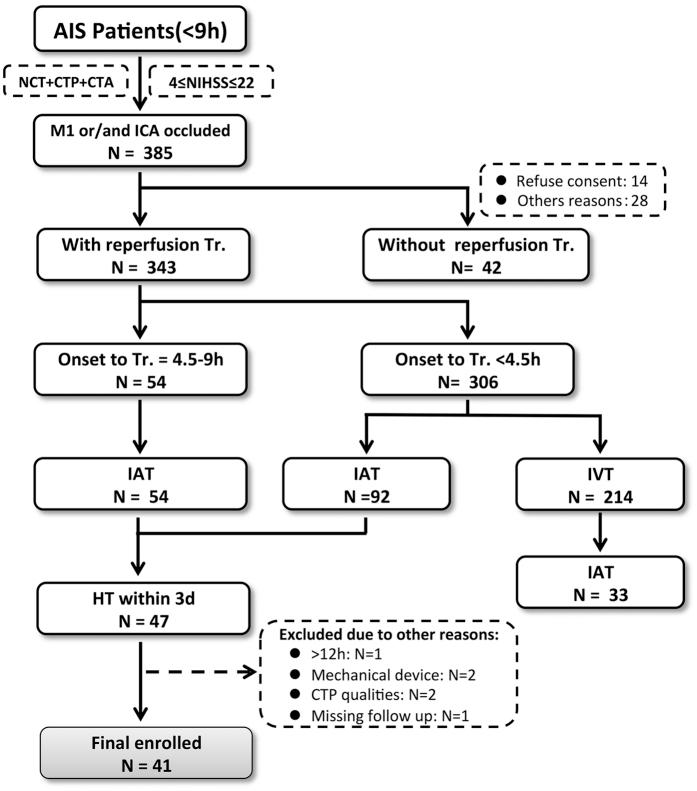
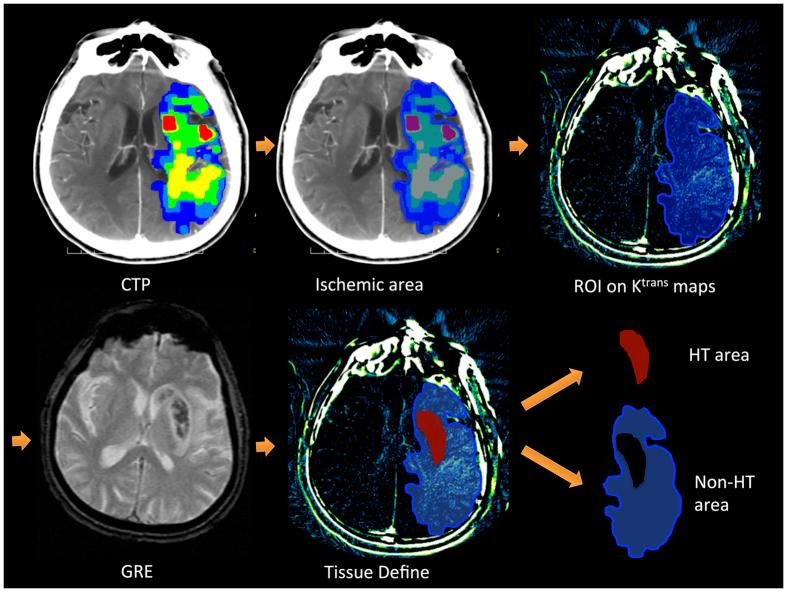
This study sought to determine whether the permeability related parameter K(trans), derived from computed tomography perfusion (CTP) imaging, can predict hemorrhagic transformation (HT) in patients with acute ischemic stroke who receive intra-arterial thrombolysis. Data from patients meeting the criterion were examined. CTP was performed and K(trans) maps were used to assess the permeability values in HT and non-HT regions. A receiver operating characteristic (ROC) curve was calculated, showing the sensitivity and specificity of K(trans) for predicting HT risk. Composite images were produced to illustrate the spatial correlations among perfusion, permeability changes and HT. This study examined 41 patients. Twenty-six patients had hemorrhagic infarction and 15 had parenchymal hemorrhage. The mean K(trans) value in HT regions was significantly lower than that in the non-HT regions (0.26 ± 0.21/min vs. 0.78 ± 0.64/min; P < 0.001). The ROC curve analysis identified an optimal cutoff value of 0.334/min for K(trans) to predict HT risk. Composite images suggested ischemic regions with low permeability, or the mismatch area of low perfusion and high permeability, more likely have HT. HT regions after intra-arterial thrombolysis had lower permeability values on K(trans) maps. The mismatch area of lower perfusion and higher permeability are more likely to develop HT.
本研究旨在确定从计算机断层扫描灌注(CTP)成像得出的与通透性相关的参数K(trans)能否预测接受动脉内溶栓治疗的急性缺血性卒中患者的出血性转化(HT)。对符合标准的患者数据进行了检查。进行了CTP检查,并使用K(trans)图评估HT区域和非HT区域的通透性值。计算了受试者工作特征(ROC)曲线,显示了K(trans)预测HT风险的敏感性和特异性。生成了复合图像以说明灌注、通透性变化和HT之间的空间相关性。本研究检查了41例患者。26例患者发生出血性梗死,15例患者发生实质内出血。HT区域的平均K(trans)值显著低于非HT区域(0.26±0.21/min对0.78±0.64/min;P<0.001)。ROC曲线分析确定K(trans)预测HT风险的最佳截断值为0.334/min。复合图像显示,通透性低的缺血区域,或灌注低与通透性高的不匹配区域,更有可能发生HT。动脉内溶栓后的HT区域在K(trans)图上的通透性值较低。灌注较低与通透性较高的不匹配区域更有可能发生HT。



 Zotero 插件