Mazaki Toru, Kasai Takatoshi, Yokoi Hiroyoshi, Kuramitsu Shoichi, Yamaji Kyohei, Morinaga Takashi, Masuda Hisaki, Shirai Shinichi, Ando Kenji
Department of Cardiology, Kobe Central Hospital, Kobe, Japan
Department of Cardiovascular Medicine, Juntendo University School of Medicine, Tokyo, Japan Cardiovascular Respiratory Sleep Medicine, Juntendo University Graduate School of Medicine, Tokyo, Japan.
J Am Heart Assoc. 2016 Jun 15;5(6):e003270. doi: 10.1161/JAHA.116.003270.
Sleep-disordered breathing (SDB) has been recognized as an important risk factor for cardiovascular diseases; however, the impact of SDB on long-term outcomes in patients with acute coronary syndrome has not been fully evaluated.
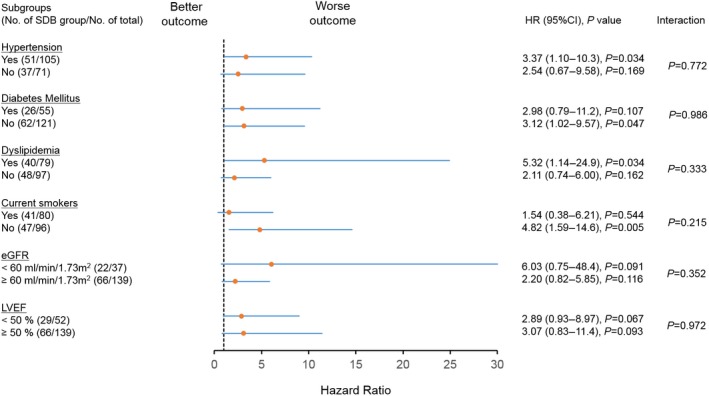
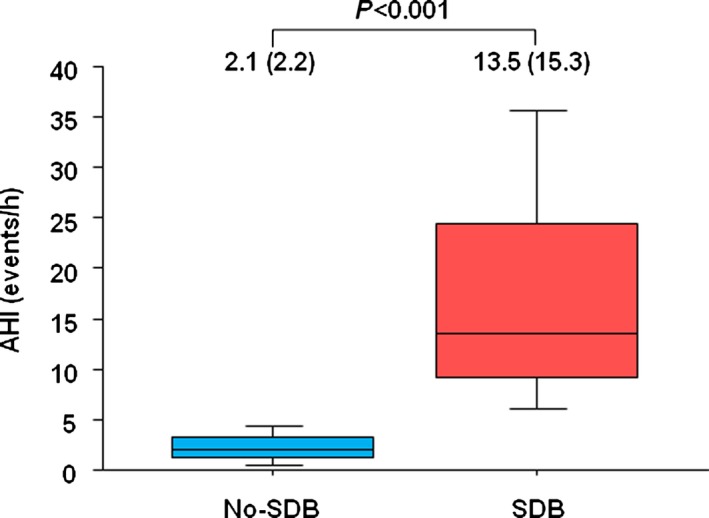
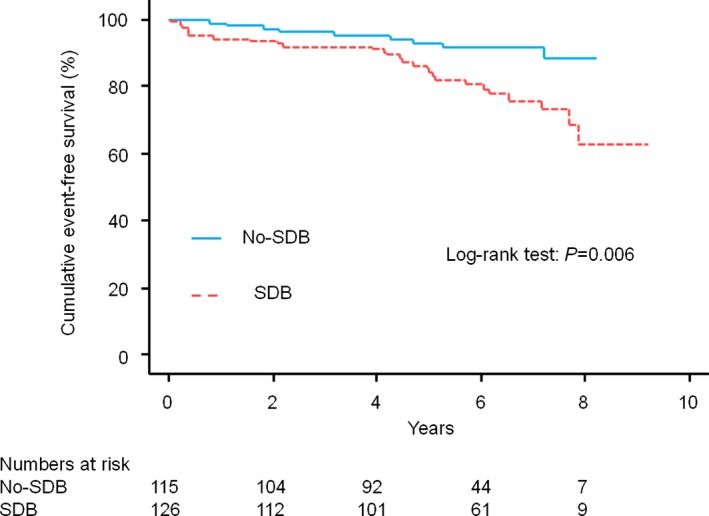
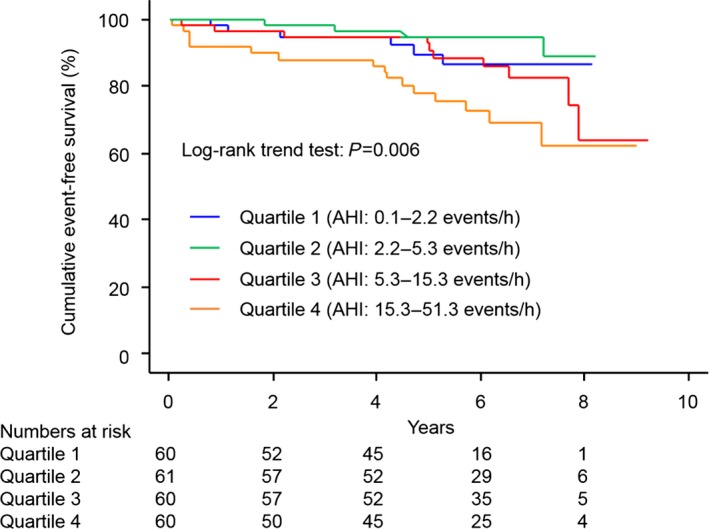
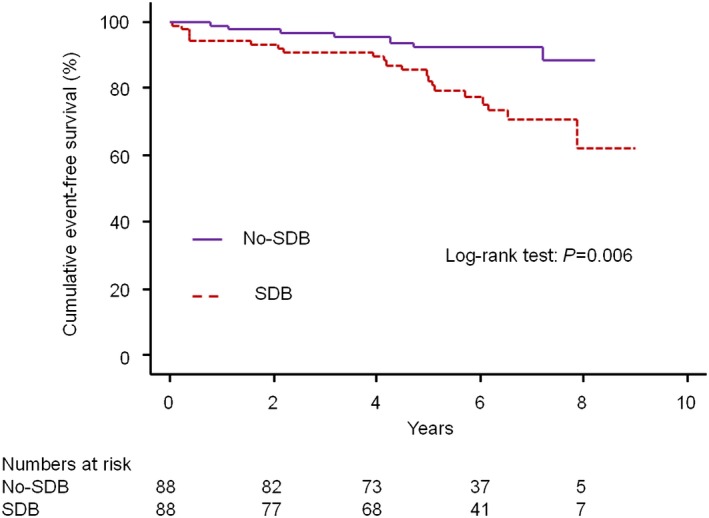
We performed overnight cardiorespiratory monitoring of 241 patients with acute coronary syndrome who were successfully treated with primary percutaneous coronary intervention between January 2005 and December 2008. The presence of SDB was defined as apnea-hypopnea index ≥5 events per hour. The end point was incidence of major adverse cardiocerebrovascular events, defined as a composite of all-cause death, recurrence of acute coronary syndrome, nonfatal stroke, and hospital admission for congestive heart failure. Patients were followed for a median period of 5.6 years. Among the 241 patients who were finally enrolled, comorbidity of SDB with acute coronary syndrome was found in 126 patients (52.3%). The cumulative incidence of major adverse cardiocerebrovascular events was significantly higher in patients with SDB than in those without SDB (21.4% versus 7.8%, P=0.006). Multivariable analysis revealed that the presence of SDB was a significant predictor of major adverse cardiocerebrovascular events (hazard ratio 2.28, 95% CI 1.06-4.92; P=0.035).
The study's results showed that the presence of SDB among patients with acute coronary syndrome following primary percutaneous coronary intervention is associated with a higher incidence of major adverse cardiocerebrovascular events during long-term follow-up.
睡眠呼吸紊乱(SDB)已被公认为心血管疾病的重要危险因素;然而,SDB对急性冠状动脉综合征患者长期预后的影响尚未得到充分评估。
我们对2005年1月至2008年12月期间成功接受直接经皮冠状动脉介入治疗的241例急性冠状动脉综合征患者进行了夜间心肺监测。SDB的存在定义为呼吸暂停低通气指数≥每小时5次事件。终点是主要不良心脑血管事件的发生率,定义为全因死亡、急性冠状动脉综合征复发、非致命性中风和因充血性心力衰竭住院的综合指标。患者的中位随访期为5.6年。在最终纳入的241例患者中,126例(52.3%)患者存在SDB合并急性冠状动脉综合征。SDB患者主要不良心脑血管事件的累积发生率显著高于无SDB患者(21.4%对7.8%,P = 0.006)。多变量分析显示,SDB的存在是主要不良心脑血管事件的显著预测因素(风险比2.28,95%置信区间1.06 - 4.92;P = 0.035)。
该研究结果表明,直接经皮冠状动脉介入治疗后的急性冠状动脉综合征患者中存在SDB与长期随访期间主要不良心脑血管事件的较高发生率相关。