Pérez Del Molino Bernal Inmaculada C, Lillebaek Troels, Pedersen Mathias K, Martinez-Martinez Luis, Folkvardsen Dorte B, Agüero Jesús, Rasmussen E Michael
Service of Microbiology, University Hospital Marqués de Valdecilla, Santander, Spain.
International Reference Laboratory of Mycobacteriology, Statens Serum Institut, Copenhagen, Denmark.
PLoS One. 2016 Jun 17;11(6):e0157266. doi: 10.1371/journal.pone.0157266. eCollection 2016.
Tuberculosis (TB) control strategies are focused mainly on prevention, early diagnosis, compliance to treatment and contact tracing. The objectives of this study were to explore the frequency and risk factors of recent transmission of clinical isolates of Mycobacterium tuberculosis complex (MTBC) in Cantabria in Northern Spain from 2012 through 2013 and to analyze their clonal complexity for better understanding of the transmission dynamics in a moderate TB incidence setting.
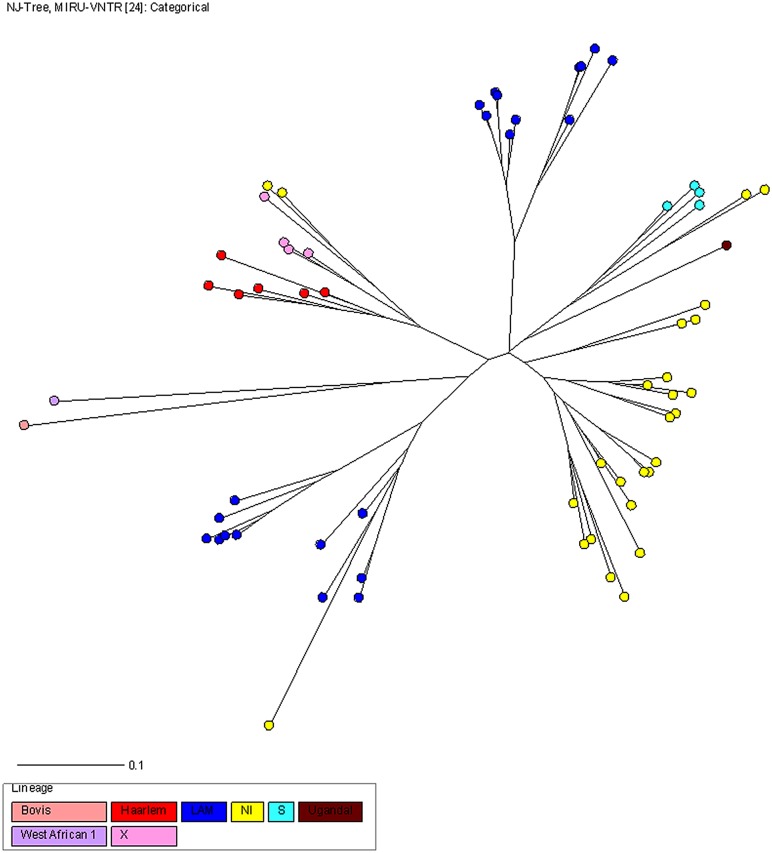
DNA from 85 out of 87 isolates from bacteriologically confirmed cases of MTBC infection were extracted directly from frozen stocks and genotyped using the mycobacterial interspersed repetitive units-variable number tandem repeat (MIRU-VNTR) method. The MIRU-VNTRplus database tool was used to identify clusters and lineages and to build a neighbor joining (NJ) phylogenetic tree. In addition, data were compared to the SITVIT2 database at the Pasteur Institute of Guadeloupe.
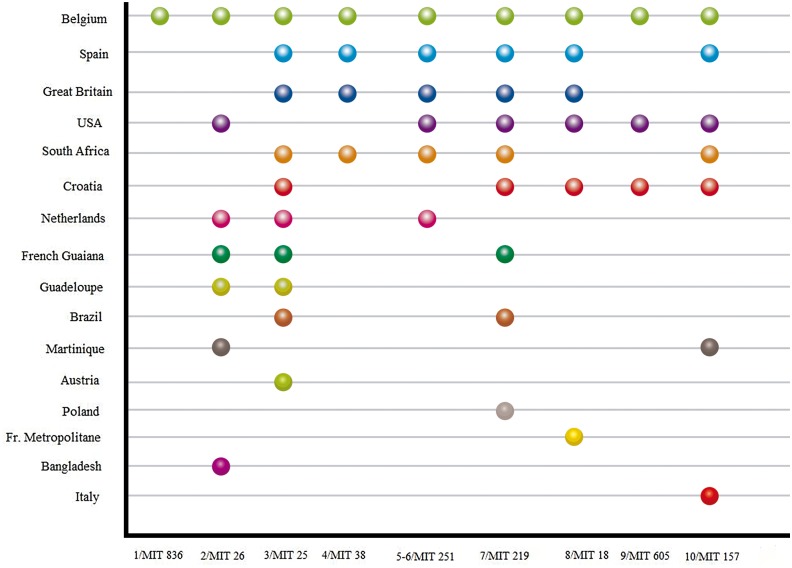
The rate of recent transmission was calculated to 24%. Clustering was associated with being Spanish-born. A high prevalence of isolates of the Euro-American lineage was found. In addition, MIRU-VNTR profiles of the studied isolates corresponded to previously found MIRU-VNTR types in other countries, including Spain, Belgium, Great Britain, USA, Croatia, South Africa and The Netherlands. Six of the strains analyzed represented clonal variants.
Transmission of MTBC is well controlled in Cantabria. The majority of TB patients were born in Spain. The population structure of MTBC in Cantabria has a low diversity of major clonal lineages with the Euro-American lineage predominating.
结核病(TB)控制策略主要集中在预防、早期诊断、治疗依从性和接触者追踪。本研究的目的是探讨2012年至2013年西班牙北部坎塔布里亚地区结核分枝杆菌复合群(MTBC)临床分离株近期传播的频率和危险因素,并分析其克隆复杂性,以便更好地了解中度结核病发病率地区的传播动态。
从87例经细菌学确诊的MTBC感染病例的分离株中,选取85株,直接从冷冻菌株中提取DNA,并使用分枝杆菌散布重复单位-可变数目串联重复序列(MIRU-VNTR)方法进行基因分型。使用MIRU-VNTRplus数据库工具识别聚类和谱系,并构建邻接(NJ)系统发育树。此外,将数据与瓜德罗普岛巴斯德研究所的SITVIT2数据库进行比较。
近期传播率计算为24%。聚类与出生在西班牙有关。发现欧美谱系的分离株患病率很高。此外,所研究分离株的MIRU-VNTR图谱与之前在其他国家发现的MIRU-VNTR类型相对应,包括西班牙、比利时、英国、美国、克罗地亚、南非和荷兰。分析的6株菌株代表克隆变体。
坎塔布里亚地区MTBC的传播得到了很好的控制。大多数结核病患者出生在西班牙。坎塔布里亚地区MTBC的种群结构主要克隆谱系多样性较低,欧美谱系占主导地位。