Dong Xinzhe, Sun Xiaorong, Sun Lu, Maxim Peter G, Xing Lei, Huang Yong, Li Wenwu, Wan Honglin, Zhao Xianguang, Xing Ligang, Yu Jinming
Department of Radiation Oncology, Shandong Cancer Hospital, Shandong University, Jinan, Shandong, China.
Key Laboratory of Radiation Oncology of Shandong Province, Shandong Cancer Hospital and Institute, Jinan, Shandong, China.
PLoS One. 2016 Jun 20;11(6):e0157836. doi: 10.1371/journal.pone.0157836. eCollection 2016.
To observe the early change of metabolic tumor heterogeneity during chemoradiotherapy and to determine its prognostic value for patients with locally advanced non-small cell lung cancer (NSCLC).
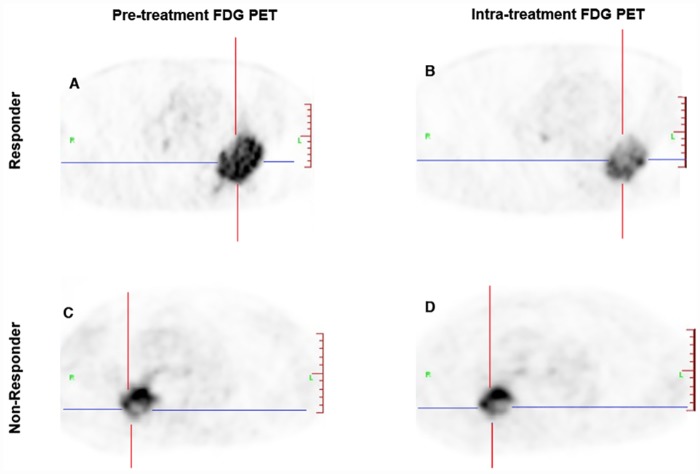
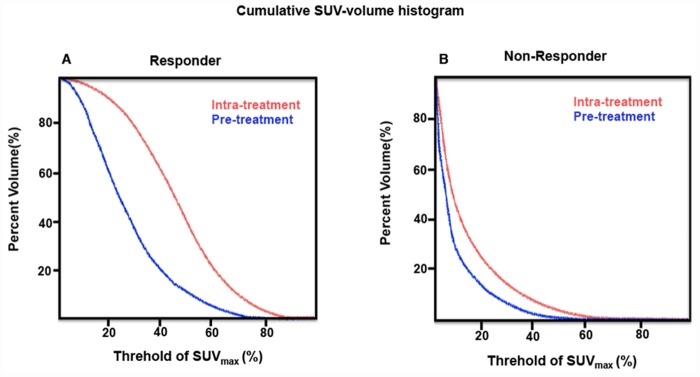
From January 2007 to March 2010, 58 patients with NSCLC were included who were received 18F-fluorodeoxyglucose (18F-FDG) PET/CT before and following 40 Gy radiotherapy with the concurrent cisplatin-based chemotherapy (CCRT). Primary tumor FDG uptake heterogeneity was determined using global and local scale textural features extracted from standardized uptake value (SUV) histogram analysis (coefficient of variation [COV], skewness, kurtosis, area under the curve of the cumulative SUV histogram [AUC-CSH]) and normalized gray-level co-occurrence matrix (contrast, dissimilarity, entropy, homogeneity). SUVmax and metabolic tumor volume (MTV) were also evaluated. Correlations were analyzed between parameters on baseline or during treatments with tumor response, progression-free survival (PFS), and overall survival (OS).
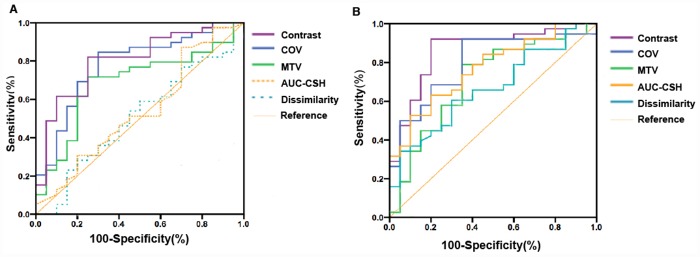
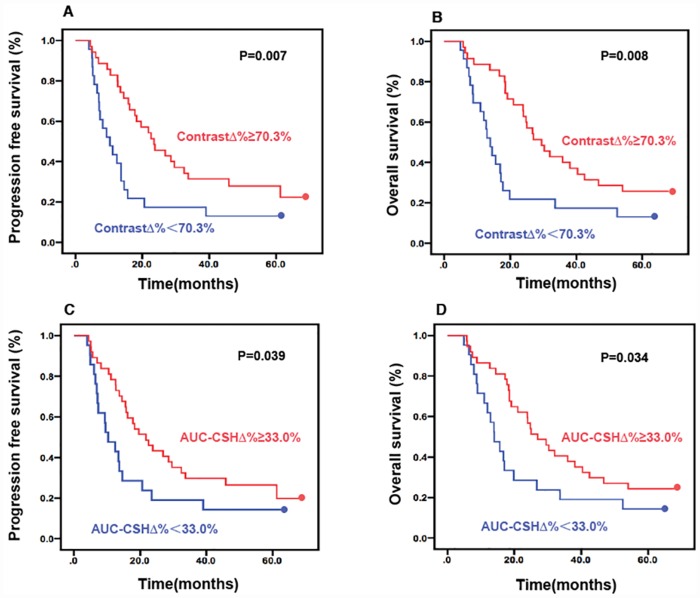
Compared with non-responders, responders showed significantly greater pre-treatment COV, contrast and MTV (AUC = 0.781, 0.804, 0.686, respectively). Receiver-operating-characteristic curve analysis showed that early change of tumor textural analysis serves as a response predictor with higher sensitivity (73.2%92.1%) and specificity (80.0%83.6%) than baseline parameters. Change in AUC-CSH and dissimilarity during CCRT could also predict response with optimal cut-off values (33.0% and 28.7%, respectively). The patients with greater changes in contrast and AUC-CSH had significantly higher 5-year OS (P = 0.008, P = 0.034) and PFS (P = 0.007, P = 0.039). In multivariate analysis, only change in contrast was found as the independent prognostic factor of PFS (HR 0.476, P = 0.021) and OS (HR 0.519, P = 0.015).
The metabolic tumor heterogeneity change during CCRT characterized by global and local scale textural features may be valuable for predicting treatment response and survival for patients with locally advanced NSCLC.
观察放化疗期间代谢性肿瘤异质性的早期变化,并确定其对局部晚期非小细胞肺癌(NSCLC)患者的预后价值。
2007年1月至2010年3月,纳入58例NSCLC患者,这些患者在接受40 Gy放疗并同步铂类化疗(CCRT)前后接受了18F-氟脱氧葡萄糖(18F-FDG)PET/CT检查。使用从标准化摄取值(SUV)直方图分析中提取的全局和局部纹理特征(变异系数[COV]、偏度、峰度、累积SUV直方图曲线下面积[AUC-CSH])以及归一化灰度共生矩阵(对比度、差异度、熵、同质性)来确定原发肿瘤的FDG摄取异质性。还评估了SUVmax和代谢肿瘤体积(MTV)。分析基线或治疗期间参数与肿瘤反应、无进展生存期(PFS)和总生存期(OS)之间的相关性。
与无反应者相比,反应者治疗前的COV、对比度和MTV显著更高(AUC分别为0.781、0.804、0.686)。受试者工作特征曲线分析表明,肿瘤纹理分析的早期变化作为反应预测指标,其敏感性(73.2%92.1%)和特异性(80.0%83.6%)高于基线参数。CCRT期间AUC-CSH和差异度的变化也可以通过最佳临界值(分别为33.0%和28.7%)预测反应。对比度和AUC-CSH变化较大的患者5年OS(P = 0.008,P = 0.034)和PFS(P = 0.007,P = 0.039)显著更高。在多因素分析中,仅对比度变化被发现是PFS(HR 0.476,P = 0.021)和OS(HR 0.519,P = 0.015)的独立预后因素。
以全局和局部纹理特征为特征的CCRT期间代谢性肿瘤异质性变化可能对预测局部晚期NSCLC患者的治疗反应和生存有价值。