Patharkar Osric Rahul, Macken Terra A, Walker John C
a Division of Biological Sciences and Interdisciplinary Plant Group, University of Missouri , Columbia , MO , USA.
Plant Signal Behav. 2016 Jul 2;11(7):e1199314. doi: 10.1080/15592324.2016.1199314.
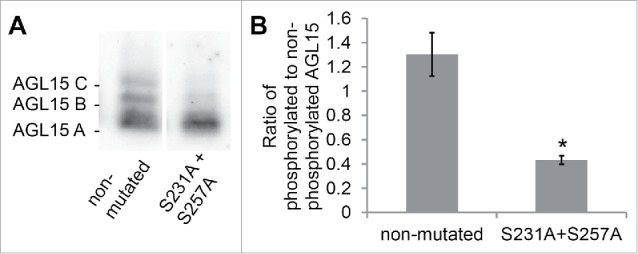
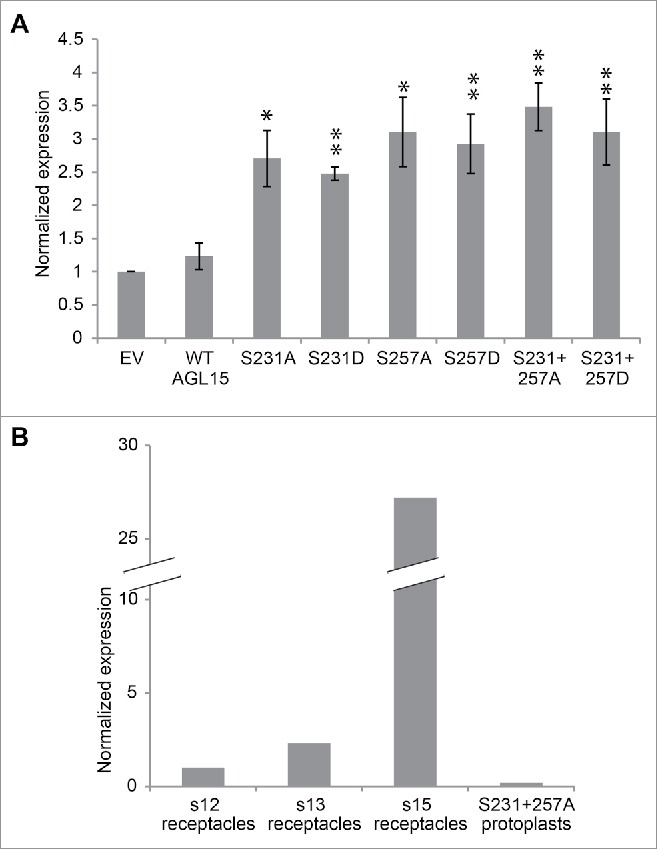
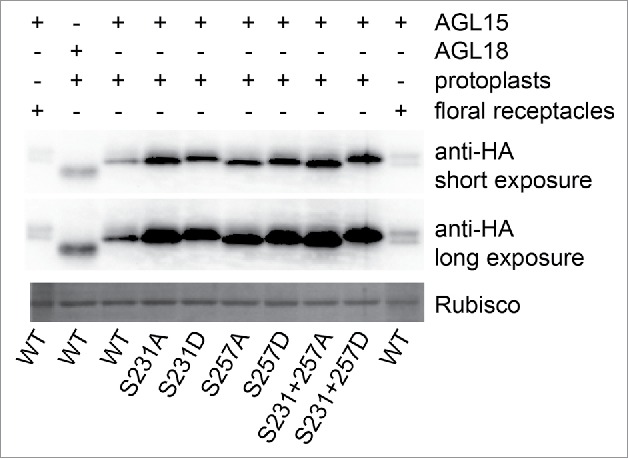
The large dynamic range of gene expression changes accompanying floral organ abscission can be explained by a molecular positive feedback loop that regulates the process. In short, a mitogen-activated protein kinase (MAPK) cascade, positioned genetically downstream from the abscission receptor HAESA (HAE), phosphorylates the transcription factor, AGAMOUS-like 15 (AGL15), allowing HAE to be expressed. However, it is unknown which residues of AGL15 are phosphorylated and precisely how phosphorylation alters AGL15 function. Here we report that serine 231 and 257 of AGL15 are phosphorylated in floral receptacles. Effects of phosphorylation on AGL15 are discussed.
伴随花器官脱落的基因表达变化的大动态范围可以通过调节该过程的分子正反馈环来解释。简而言之,一个有丝分裂原激活蛋白激酶(MAPK)级联反应,在遗传上位于脱落受体HAESA(HAE)的下游,使转录因子AGAMOUS样15(AGL15)磷酸化,从而使HAE得以表达。然而,尚不清楚AGL15的哪些残基被磷酸化,以及磷酸化究竟如何改变AGL15的功能。在此我们报告,AGL15的丝氨酸231和257在花托中被磷酸化。讨论了磷酸化对AGL15的影响。