He Jing, Zhou Mingxia, Chen Xinfeng, Yue Dongli, Yang Li, Qin Guohui, Zhang Zhen, Gao Qun, Wang Dan, Zhang Chaoqi, Huang Lan, Wang Liping, Zhang Bin, Yu Jane, Zhang Yi
Biotherapy Center, the First Affiliated Hospital of Zhengzhou University, Zhengzhou, Henan, 450052, China.
Department of Oncology, the First Affiliated Hospital of Zhengzhou University, Zhengzhou, Henan, 450052, China.
J Exp Clin Cancer Res. 2016 Jun 21;35(1):98. doi: 10.1186/s13046-016-0378-z.
Growing evidence suggests that SALL4 plays a vital role in tumor progression and metastasis. However, the molecular mechanism of SALL4 promoting esophageal squamous cell carcinoma (ESCC) remains to be elucidated.
The gene and protein expression profiles- were examined by using quantitative real-time PCR, immunohistochemistry and western blotting. Small hairpin RNA was used to evaluate the role of SALL4 both in cell lines and in animal models. Cell proliferation, apoptosis and invasion were assessed by CCK8, flow cytometry and transwell-matrigel assays. Sphere formation assay was used for cancer stem cell derivation and characterization.
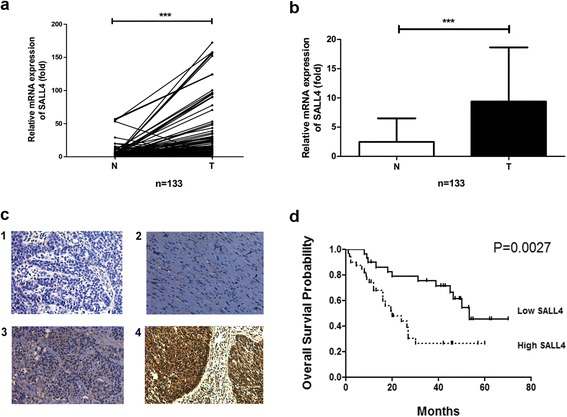
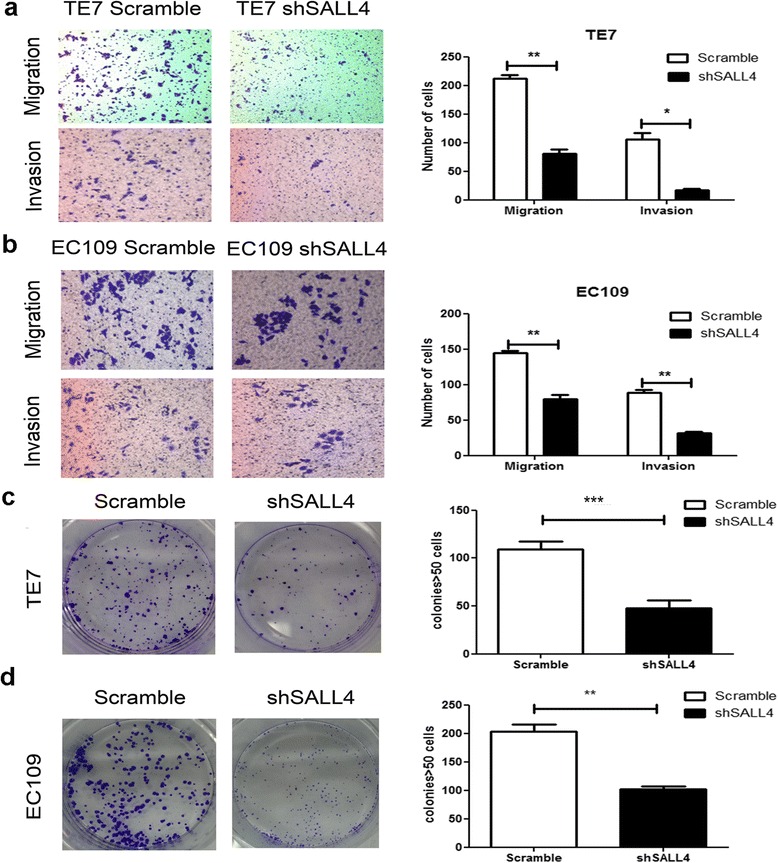
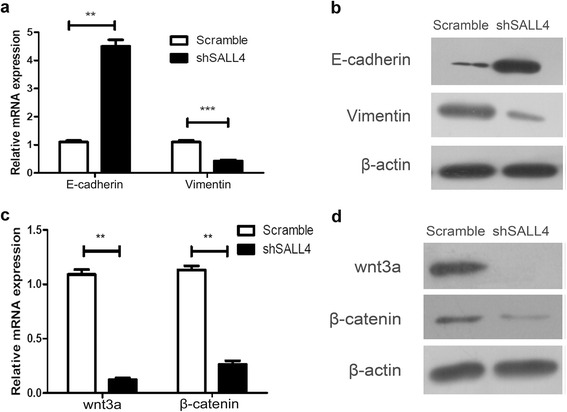
Our study showed that the transcription factor SALL4 was overexpressed in a majority of human ESCC tissues and closely correlated with a poor outcome. We established the lentiviral system using short hairpin RNA to knockdown SALL4 in TE7 and EC109 cells. Silencing of SALL4 inhibited the cell proliferation, induced apoptosis and the G1 phase arrest in cell cycle, decreased the ability of migration/invasion, clonogenicity and stemness in vitro. Besides, down-regulation of SALL4 enhanced the ESCC cells' sensitivity to cisplatin. Xenograft tumor models showed that silencing of SALL4 decreased the ability to form tumors in vivo. Furthermore, our study demonstrated that SALL4 played a vital role in modulating the stemness of ESCC cells via Wnt/β-catenin signaling pathway and in epithelial-mesenchymal transition.
Our results revealed that SALL4 might serve as a functional marker for ESCC cancer stem cell, a crucial marker for prognosis and an attractive candidate for target therapy of ESCC.
越来越多的证据表明,SALL4在肿瘤进展和转移中起着至关重要的作用。然而,SALL4促进食管鳞状细胞癌(ESCC)的分子机制仍有待阐明。
采用定量实时PCR、免疫组织化学和蛋白质印迹法检测基因和蛋白质表达谱。利用小发夹RNA评估SALL4在细胞系和动物模型中的作用。通过CCK8、流式细胞术和Transwell-基质胶实验评估细胞增殖、凋亡和侵袭能力。采用成球实验对癌症干细胞进行衍生和鉴定。
我们的研究表明,转录因子SALL4在大多数人ESCC组织中过表达,且与不良预后密切相关。我们建立了使用短发夹RNA的慢病毒系统,以敲低TE7和EC109细胞中的SALL4。沉默SALL4可抑制细胞增殖,诱导细胞凋亡和细胞周期中的G1期阻滞,降低体外迁移/侵袭、克隆形成和干性能力。此外,SALL4的下调增强了ESCC细胞对顺铂的敏感性。异种移植肿瘤模型显示,沉默SALL4可降低体内形成肿瘤的能力。此外,我们的研究表明,SALL4通过Wnt/β-连环蛋白信号通路在调节ESCC细胞干性和上皮-间质转化中起着至关重要的作用。
我们的结果表明,SALL4可能作为ESCC癌症干细胞的功能标志物、预后的关键标志物以及ESCC靶向治疗的有吸引力的候选物。