Oliveira-Nunes Maria Cecília, Assad Kahn Suzana, de Oliveira Barbeitas Ana Luiza, E Spohr Tania Cristina Leite de Sampaio, Dubois Luiz Gustavo Feijó, Ventura Matioszek Grasiella Maria, Querido William, Campanati Loraine, de Brito Neto José Marques, Lima Flavia Regina Souza, Moura-Neto Vivaldo, Carneiro Katia
Institute of Biomedical Sciences, Federal University of Rio de Janeiro, Av. Carlos Chagas Filho 373, F2-01, Rio de Janeiro, Rio de Janeiro 21941-902 Brazil.
Institute for Stem Cell Biology and Regenerative Medicine, Stanford University, 265 Campus Drive, Stanford, California 94305 USA ; Institute of Biomedical Sciences, Federal University of Rio de Janeiro, Av. Carlos Chagas Filho 373, F1-20, Rio de Janeiro, Rio de Janeiro 21941-902 Brazil.
Cancer Cell Int. 2016 Jun 17;16:46. doi: 10.1186/s12935-016-0324-3. eCollection 2016.
Glioblastoma (GBM) is the most common primary brain tumor presenting self-renewing cancer stem cells. The role of these cells on the development of the tumors has been proposed to recapitulate programs from embryogenesis. Recently, the embryonic transforming growth factor-β (TGF-β) protein Nodal has been shown to be reactivated upon tumor development; however, its availability in GBM cells has not been addressed so far. In this study, we investigated by an original approach the mechanisms that dynamically control both intra and extracellular Nodal availability during GBM tumorigenesis.
We characterized the dynamics of Nodal availability in both stem and more differentiated GBM cells through morphological analysis, immunofluorescence of Nodal protein and of early (EEA1 and Rab5) and late (Rab7 and Rab11) endocytic markers and Western Blot. Tukey's test was used to analyze the prevalent correlation of Nodal with different endocytic markers inside specific differentiation states, and Sidak's multiple comparisons test was used to compare the prevalence of Nodal/endocytic markers co-localization between two differentiation states of GBM cells. Paired t test was used to analyze the abundance of Nodal protein, in extra and intracellular media.
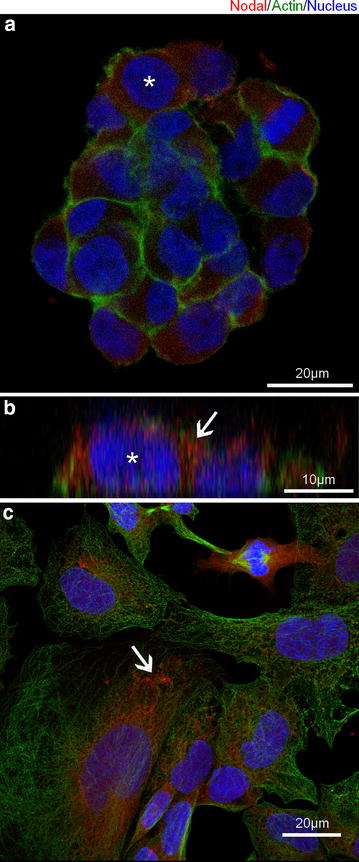
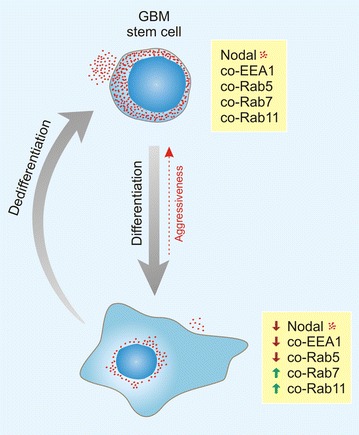
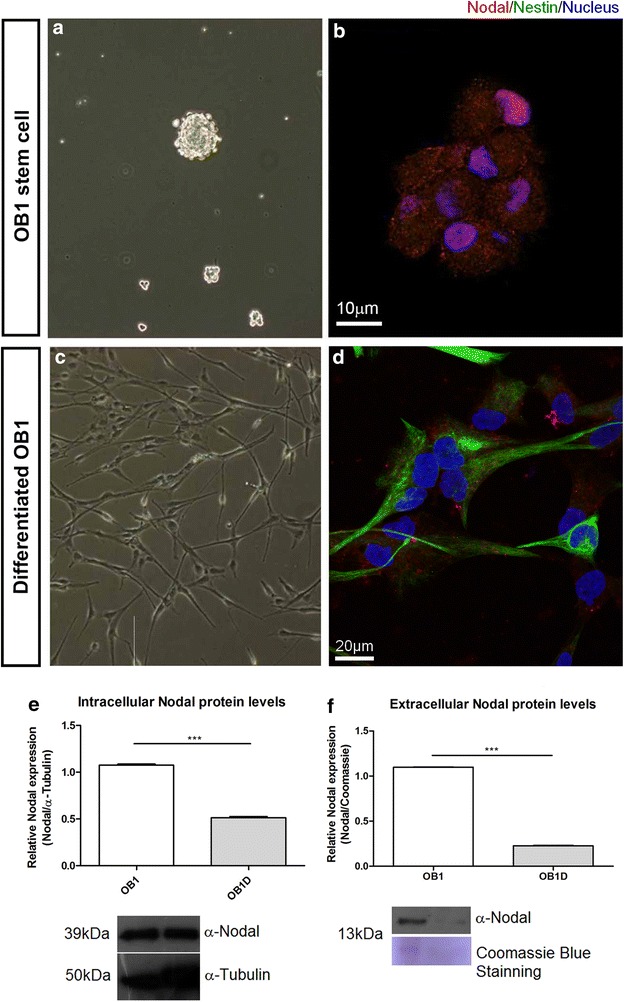
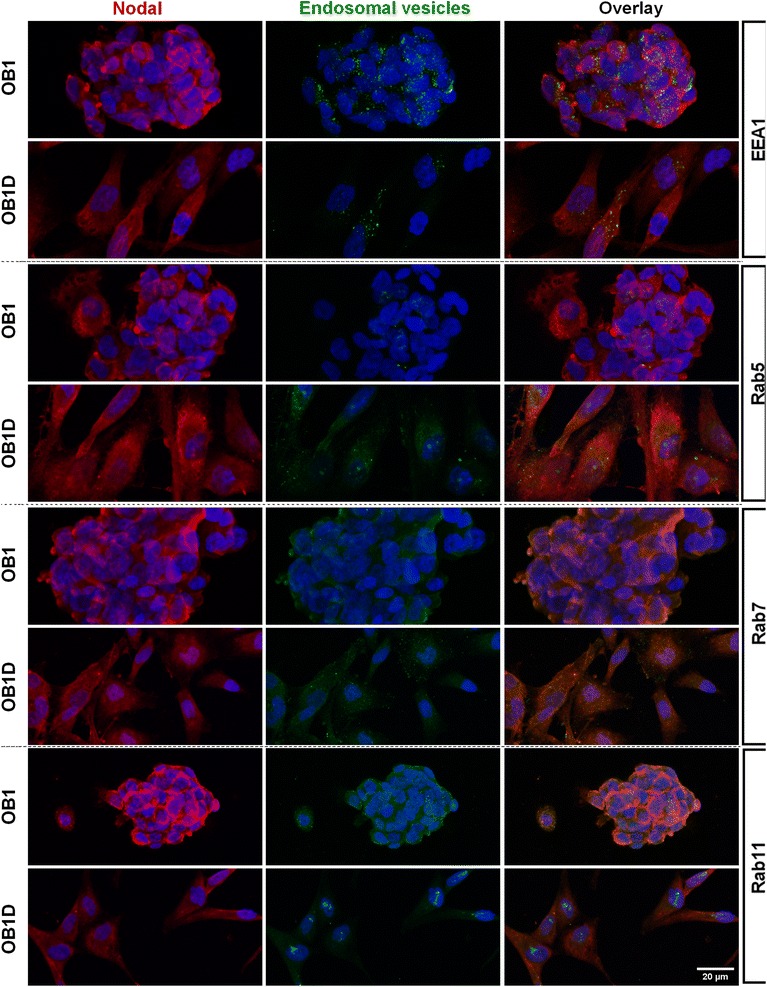
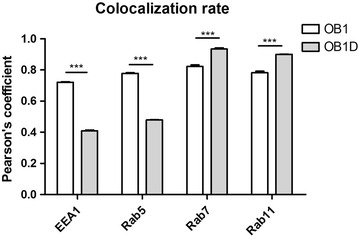
The cytoplasmic distribution of Nodal was dynamically regulated and strongly correlated with the differentiation status of GBM cells. While Nodal-positive vesicle-like particles were symmetrically distributed in GBM stem cells (GBMsc), they presented asymmetric perinuclear localization in more differentiated GBM cells (mdGBM). Strikingly, when subjected to dedifferentiation, the distribution of Nodal in mdGBM shifted to a symmetric pattern. Moreover, the availability of both intracellular and secreted Nodal were downregulated upon GBMsc differentiation, with cells becoming elongated, negative for Nodal and positive for Nestin. Interestingly, the co-localization of Nodal with endosomal vesicles also depended on the differentiation status of the cells, with Nodal seen more packed in EEA1/Rab5 + vesicles in GBMsc and more in Rab7/11 + vesicles in mdGBM.
Our results show for the first time that Nodal availability relates to GBM cell differentiation status and that it is dynamically regulated by an endocytic pathway during GBM tumorigenesis, shedding new light on molecular pathways that might emerge as putative targets for Nodal signaling in GBM therapy.
胶质母细胞瘤(GBM)是最常见的原发性脑肿瘤,存在自我更新的癌症干细胞。这些细胞在肿瘤发生发展中的作用被认为重现了胚胎发育过程中的程序。最近研究表明,胚胎转化生长因子-β(TGF-β)蛋白Nodal在肿瘤发生时会重新激活;然而,其在GBM细胞中的可用性至今尚未得到研究。在本研究中,我们采用一种全新的方法,研究了GBM肿瘤发生过程中动态控制细胞内和细胞外Nodal可用性的机制。
我们通过形态学分析、Nodal蛋白以及早期(EEA1和Rab5)和晚期(Rab7和Rab11)内吞标记物的免疫荧光以及蛋白质免疫印迹,对干性和分化程度更高的GBM细胞中Nodal可用性的动态变化进行了表征。采用Tukey检验分析特定分化状态下Nodal与不同内吞标记物的普遍相关性,采用Sidak多重比较检验比较GBM细胞两种分化状态之间Nodal/内吞标记物共定位的普遍性。采用配对t检验分析细胞外和细胞内培养基中Nodal蛋白的丰度。
Nodal的细胞质分布受到动态调节,且与GBM细胞的分化状态密切相关。Nodal阳性的囊泡样颗粒在GBM干细胞(GBMsc)中呈对称分布,而在分化程度更高的GBM细胞(mdGBM)中呈不对称的核周定位。引人注目的是,当发生去分化时,mdGBM中Nodal的分布转变为对称模式。此外,GBMsc分化后,细胞内和分泌的Nodal可用性均下调,细胞变长,Nodal呈阴性,巢蛋白呈阳性。有趣的是,Nodal与内体囊泡的共定位也取决于细胞的分化状态,在GBMsc中,Nodal更多地聚集在EEA1/Rab5 +囊泡中,而在mdGBM中则更多地聚集在Rab7/11 +囊泡中。
我们的结果首次表明,Nodal可用性与GBM细胞分化状态相关,并且在GBM肿瘤发生过程中通过内吞途径受到动态调节,这为GBM治疗中可能成为Nodal信号传导假定靶点的分子途径提供了新的线索。