Vieira Alexandre Cc, Chaves Luíse L, Pinheiro Marina, Ferreira Domingos, Sarmento Bruno, Reis Salette
UCIBIO, REQUIMTE, Chemistry Department, Faculty of Pharmacy, University of Porto, Porto, Portugal.
Laboratory of Pharmaceutical Technology, Department of Drug Sciences, Faculty of Pharmacy, University of Porto, Porto, Portugal.
Int J Nanomedicine. 2016 Jun 3;11:2601-17. doi: 10.2147/IJN.S104908. eCollection 2016.
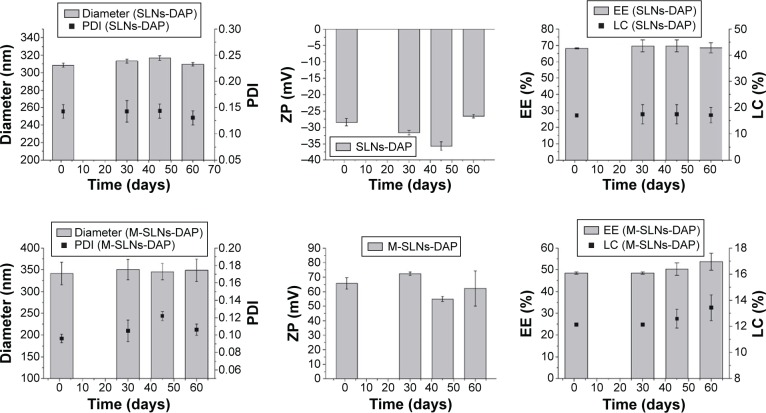
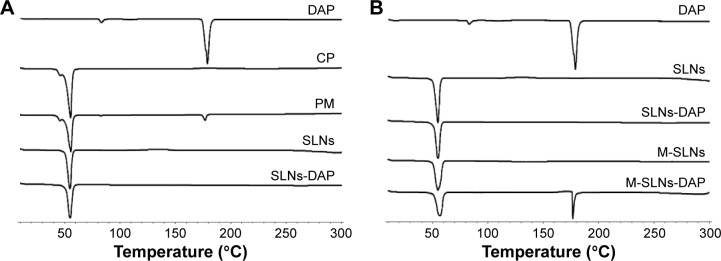
The aim of the present work was to develop and optimize surface-functionalized solid lipid nanoparticles (SLNs) for improvement of the therapeutic index of dapsone (DAP), with the application of a design of experiments. The formulation was designed to target intestinal microfold (M-cells) as a strategy to increase internalization of the drug by the infected macrophages. DAP-loaded SLNs and mannosylated SLNs (M-SLNs) were successfully developed by hot ultrasonication method employing a three-level, three-factor Box-Behnken design, after the preformulation study was carried out with different lipids. All the formulations were systematically characterized regarding their diameter, polydispersity index (PDI), zeta potential (ZP), entrapment efficiency, and loading capacity. They were also subjected to morphological studies using transmission electron microscopy, in vitro release study, infrared analysis (Fourier transform infrared spectroscopy), calorimetry studies (differential scanning calorimetry), and stability studies. The diameter of SLNs, SLN-DAP, M-SLNs, and M-SLN-DAP was approximately 300 nm and the obtained PDI was <0.2, confirming uniform populations. Entrapment efficiency and loading capacity were approximately 50% and 12%, respectively. Transmission electron microscopy showed spherical shape and nonaggregated nanoparticles. Fourier transform infrared spectroscopy was used to confirm the success of mannose coating process though Schiff's base formation. The variation of the ZP between uncoated (approximately -30 mV) and mannosylated formulations (approximately +60 mV) also confirmed the successful coating process. A decrease in the enthalpy and broadening of the lipid melting peaks of the differential scanning calorimetry thermograms are consistent with the nanostructure of the SLNs. Moreover, the drug release was pH-sensitive, with a faster drug release at acidic pH than at neutral pH. Storage stability for the formulations for at least 8 weeks is expected, since they maintain the original characteristics of diameter, PDI, and ZP. These results pose a strong argument that the developed formulations can be explored as a promising carrier for treating leprosy with an innovative approach to target DAP directly to M-cells.
本研究的目的是通过实验设计来开发和优化表面功能化的固体脂质纳米粒(SLNs),以提高氨苯砜(DAP)的治疗指数。该制剂旨在靶向肠道微皱褶细胞(M细胞),作为增加感染巨噬细胞对药物摄取的一种策略。在对不同脂质进行处方前研究后,采用三级三因素Box-Behnken设计,通过热超声法成功制备了载DAP的SLNs和甘露糖基化SLNs(M-SLNs)。对所有制剂的粒径、多分散指数(PDI)、zeta电位(ZP)、包封率和载药量进行了系统表征。还使用透射电子显微镜进行了形态学研究、体外释放研究、红外分析(傅里叶变换红外光谱)、量热研究(差示扫描量热法)和稳定性研究。SLNs、SLN-DAP、M-SLNs和M-SLN-DAP的粒径约为300 nm,获得的PDI<0.2,证实群体均匀。包封率和载药量分别约为50%和12%。透射电子显微镜显示纳米粒呈球形且无聚集。傅里叶变换红外光谱用于通过席夫碱形成来确认甘露糖包衣过程的成功。未包衣制剂(约-30 mV)和甘露糖基化制剂(约+60 mV)之间ZP的变化也证实了包衣过程的成功。差示扫描量热法热谱图中脂质熔融峰的焓降低和变宽与SLNs的纳米结构一致。此外,药物释放对pH敏感,在酸性pH下的药物释放比在中性pH下更快。预计这些制剂至少可储存8周,因为它们保持了粒径、PDI和ZP的原始特性。这些结果有力地表明,所开发的制剂可作为一种有前景的载体,采用创新方法将DAP直接靶向M细胞来治疗麻风病。