Laboratory of Chemical Biology and Institute of Complex Molecular Systems, Department of Biomedical Engineering, Eindhoven University of Technology, Den Dolech 2, 5612, AZ, Eindhoven, The Netherlands.
Angew Chem Int Ed Engl. 2016 Jul 25;55(31):8899-903. doi: 10.1002/anie.201602807. Epub 2016 Jun 29.
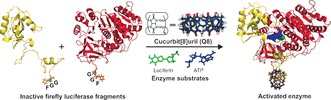
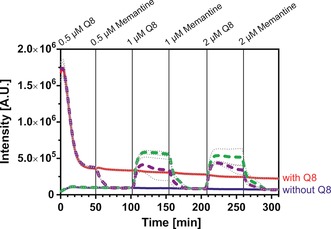
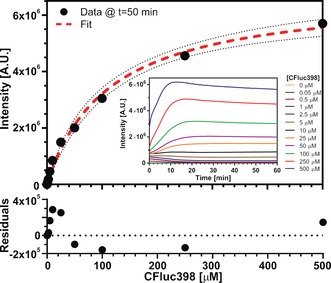
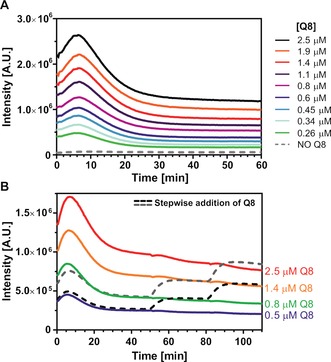
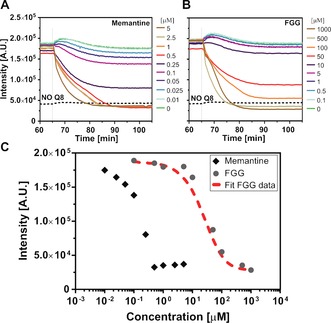
Supramolecular split-enzyme complementation restores enzymatic activity and allows for on-off switching. Split-luciferase fragment pairs were provided with an N-terminal FGG sequence and screened for complementation through host-guest binding to cucurbit[8]uril (Q8). Split-luciferase heterocomplex formation was induced in a Q8 concentration dependent manner, resulting in a 20-fold upregulation of luciferase activity. Supramolecular split-luciferase complementation was fully reversible, as revealed by using two types of Q8 inhibitors. Competition studies with the weak-binding FGG peptide revealed a 300-fold enhanced stability for the formation of the ternary heterocomplex compared to binding of two of the same fragments to Q8. Stochiometric binding by the potent inhibitor memantine could be used for repeated cycling of luciferase activation and deactivation in conjunction with Q8, providing a versatile module for in vitro supramolecular signaling networks.
超分子分裂酶互补恢复酶活性并允许开-关切换。将带有 N 端 FGG 序列的分裂荧光素酶片段对进行筛选,以通过主-客体结合到瓜环[8]脲(Q8)进行互补。分裂荧光素酶异源复合物的形成呈 Q8 浓度依赖性诱导,导致荧光素酶活性上调 20 倍。超分子分裂荧光素酶互补是完全可逆的,这可以通过使用两种类型的 Q8 抑制剂来证明。与弱结合的 FGG 肽的竞争研究表明,与两个相同片段与 Q8 的结合相比,形成三元异源复合物的稳定性增强了 300 倍。强效抑制剂美金刚的计量结合可用于与 Q8 一起重复循环激活和失活荧光素酶,为体外超分子信号网络提供了一个通用模块。