Mebratu Yohannes A, Smith Kevin R, Agga Getahun E, Tesfaigzi Yohannes
COPD Program, Lovelace Respiratory Research Institute, 2425 Ridgecrest Drive SE, Albuquerque, NM, 87108, USA.
Agricultural Research Service, U.S. Department of Agriculture, R, Clay Center, Nebraska, USA.
Respir Res. 2016 Jul 1;17(1):75. doi: 10.1186/s12931-016-0392-x.
The length of time for cigarette smoke (CS) exposure to cause emphysema in mice is drastically reduced when CS exposure is combined with viral infection. However, the extent of inflammatory responses and lung pathologies of mice exposed to CS and infected with influenza A virus (IAV), respiratory syncytial virus (RSV), or treated with the viral derivative dsRNA (polyinosine-polycytidylic acid [poly (I:C)] have not been compared.
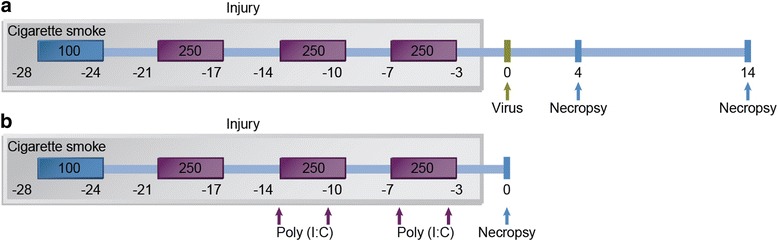
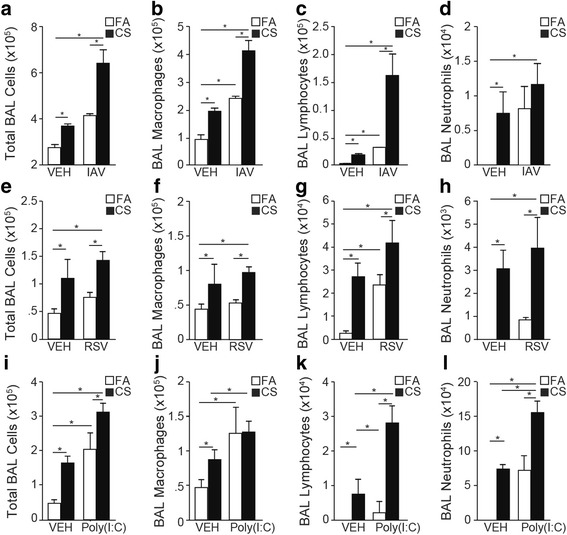
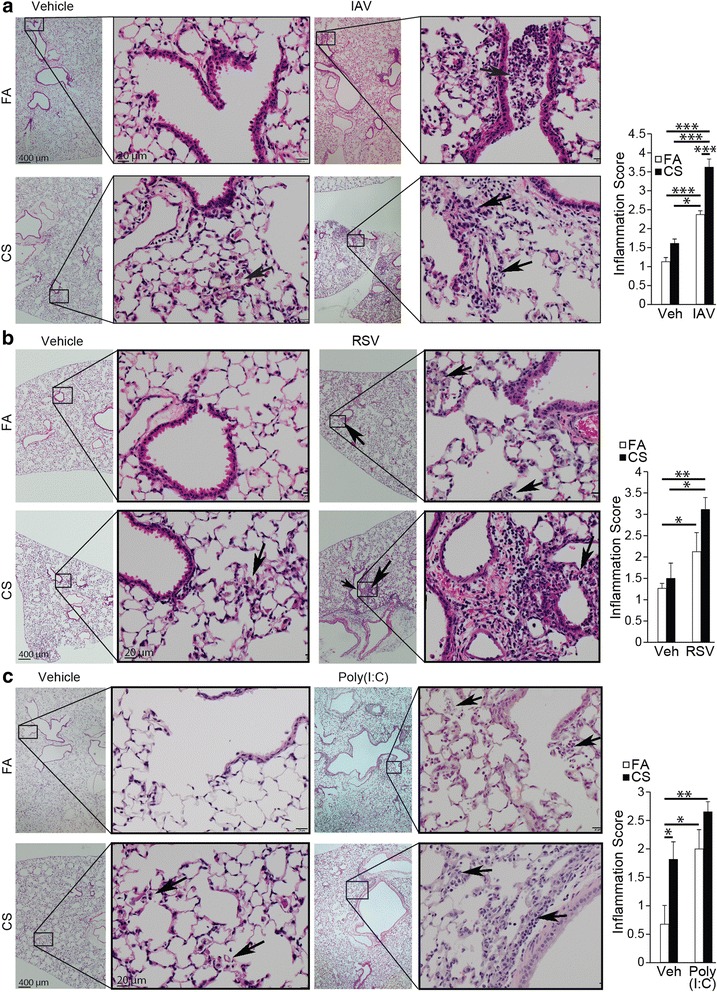
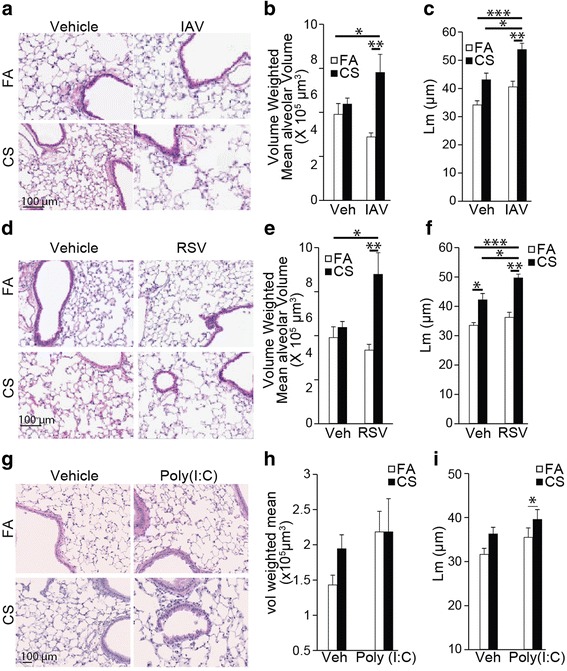
Mice were exposed to CS or filtered air for 4 weeks and received a single dose of vehicle, AV, or RSV infection and extent of inflammation and emphysema was evaluated 14 d later. In another set of experiments, mice were instilled with poly (I:C) twice a week during the third and fourth weeks of CS exposure and immediately analyzed for extent of inflammation and lung pathologies.
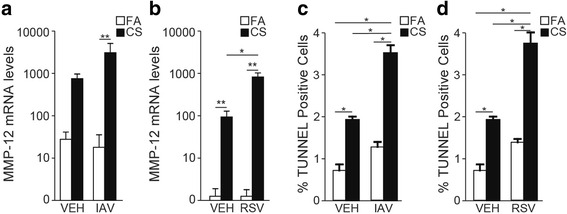
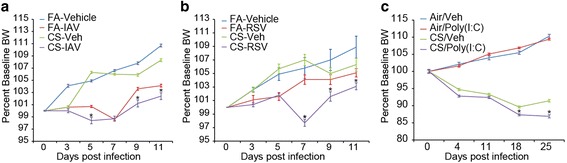
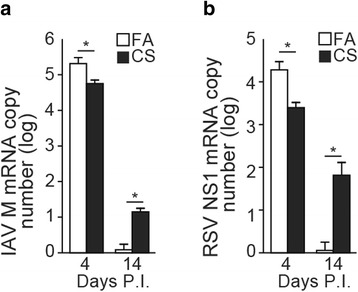
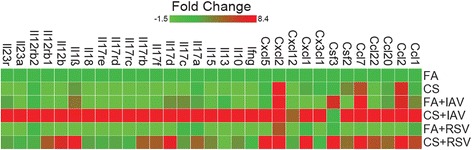
In CS-exposed mice, inflammation was characterized mainly by macrophages, lymphocytes, and neutrophils after IAV infection, mainly by lymphocytes, and neutrophils after RSV infection, and mainly by lymphocytes and neutrophils after poly (I:C) instillations. Despite increased inflammation, extent of emphysema by poly (I:C) was very mild; but was robust and similar for both IAV and RSV infections with enhanced MMP-12 mRNA expression and TUNEL positivity. Both IAV and RSV infections increased the levels of IL-17, IL-1β, IL-12b, IL-18, IL-23a, Ccl-2, Ccl-7 mRNAs in the lungs of CS-exposed mice with IAV causing more increases than RSV.
CS-induced inflammatory responses and extent of emphysematous changes differ depending on the type of viral infection. These animal models may be useful to study the mechanisms by which different viruses exacerbate CS-induced inflammation and emphysema.
当香烟烟雾(CS)暴露与病毒感染相结合时,CS暴露导致小鼠肺气肿的时间会大幅缩短。然而,暴露于CS并感染甲型流感病毒(IAV)、呼吸道合胞病毒(RSV)或用病毒衍生物双链RNA(聚肌苷酸-聚胞苷酸[聚(I:C)])处理的小鼠的炎症反应程度和肺部病理情况尚未进行比较。
将小鼠暴露于CS或过滤空气中4周,接受单次载体、IAV或RSV感染,14天后评估炎症和肺气肿程度。在另一组实验中,在CS暴露的第三周和第四周,每周给小鼠滴注两次聚(I:C),并立即分析炎症程度和肺部病理情况。
在暴露于CS的小鼠中,IAV感染后炎症主要以巨噬细胞、淋巴细胞和中性粒细胞为特征,RSV感染后主要以淋巴细胞和中性粒细胞为特征,聚(I:C)滴注后主要以淋巴细胞和中性粒细胞为特征。尽管炎症增加,但聚(I:C)导致的肺气肿程度非常轻微;但IAV和RSV感染导致的肺气肿程度都很严重且相似,伴有MMP-12 mRNA表达增强和TUNEL阳性。IAV和RSV感染均增加了暴露于CS的小鼠肺中IL-17、IL-1β、IL-12b、IL-18、IL-23a、Ccl-2、Ccl-7 mRNA的水平,IAV导致的增加比RSV更多。
CS诱导的炎症反应和肺气肿变化程度因病毒感染类型而异。这些动物模型可能有助于研究不同病毒加剧CS诱导的炎症和肺气肿的机制。