van Beek Janko, de Graaf Miranda, Xia Ming, Jiang Xi, Vinjé Jan, Beersma Mathias, de Bruin Erwin, van de Vijver David, Holwerda Melle, van Houten Marlies, Buisman Annemarie M, van Binnendijk Rob, Osterhaus Albert D M E, van der Klis Fiona, Vennema Harry, Koopmans Marion P G
Department of Viroscience, Erasmus Medical Center, 's-Gravendijkwal 230, 3015 CE Rotterdam, The Netherlands.
Centre for Infectious Diseases Research, Diagnostics and Screening, National Institute of Public Health and the Environment, Antonie van Leeuwenhoeklaan 9, 3721 MA Bilthoven, The Netherlands.
J Gen Virol. 2016 Sep;97(9):2255-2264. doi: 10.1099/jgv.0.000533. Epub 2016 Jun 30.
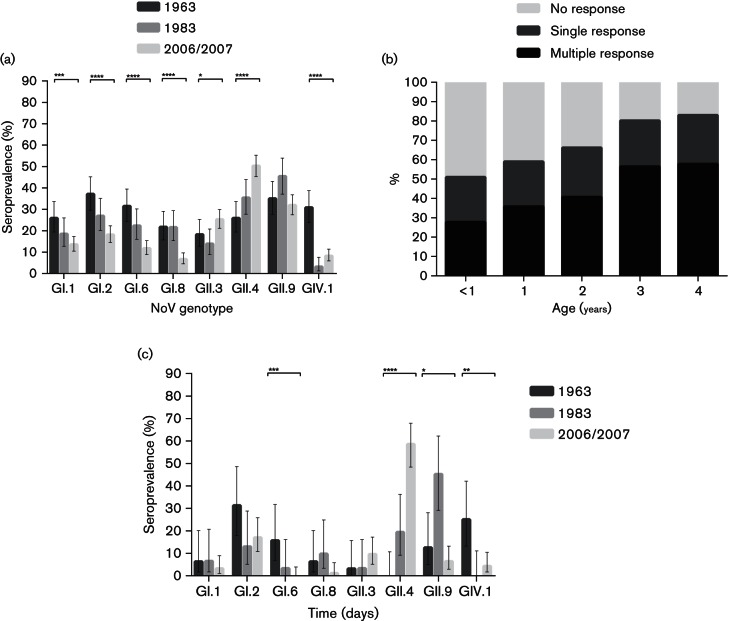
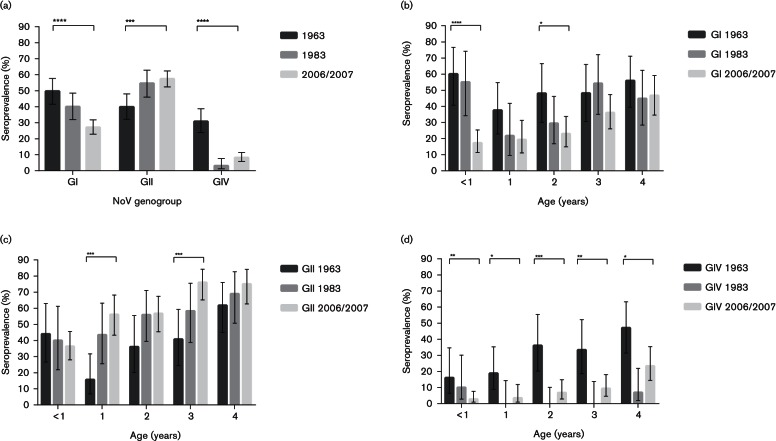
Noroviruses are a major cause of acute gastroenteritis worldwide and are a genetically diverse group of viruses. Since 2002, an increasing number of norovirus outbreaks have been reported globally, but it is not clear whether this increase has been caused by a higher awareness or reflects the emergence of new genogroup II genotype 4 (GII.4) variants. The hypothesis that norovirus prevalence has increased post-2002 and is related to the emergence of GII.4 is tested in this study. Sera collected from children aged <5 years of three Dutch cross-sectional population based cohorts in 1963, 1983 and 2006/2007 (n=143, n=130 and n=376, respectively) were tested for specific serum IgG by protein array using antigens to GII.4 and a range of other antigens representing norovirus GI, GII and GIV genotypes. The protein array was validated by paired sera of norovirus infected patients and supernatants of B-cell cultures with single epitope specificity. Evidence for norovirus infection was found to be common among Dutch children in each cohort, but the prevalence towards different genotypes changed over time. At the genogroup level, GI seroprevalence decreased significantly between 1963 and 2006/2007, while a significant increase of GII and, in particular, specific antibodies of the genotype GII.4 was detected in the 2006/2007 cohort. There were no children with only GII.4 antibodies in the 1963 cohort. This study shows that the high GII.4 norovirus incidence in very young children is a recent phenomenon. These findings are of importance for vaccine development and trials that are currently focusing mostly on GII.4 viruses.
诺如病毒是全球急性胃肠炎的主要病因,是一组基因多样的病毒。自2002年以来,全球报告的诺如病毒暴发事件越来越多,但尚不清楚这种增加是由于认知度提高还是反映了新的基因II组4型(GII.4)变体的出现。本研究检验了2002年后诺如病毒流行率上升且与GII.4出现有关的假设。分别从1963年、1983年以及2006/2007年荷兰三个基于横断面人群的队列中收集年龄小于5岁儿童的血清(分别为n = 143、n = 130和n = 376),使用针对GII.4的抗原以及一系列代表诺如病毒GI、GII和GIV基因型的其他抗原,通过蛋白质芯片检测特异性血清IgG。该蛋白质芯片通过诺如病毒感染患者的配对血清以及具有单表位特异性的B细胞培养上清液进行验证。结果发现,诺如病毒感染的证据在每个队列的荷兰儿童中都很常见,但不同基因型的流行率随时间变化。在基因组水平上,1963年至2006/2007年间,GI血清阳性率显著下降,而在2006/2007年队列中检测到GII血清阳性率显著上升,尤其是GII.4基因型的特异性抗体显著增加。1963年队列中没有仅携带GII.