Koumbi Lemonica, Pollicino Teresa, Raimondo Giovanni, Kumar Naveenta, Karayiannis Peter, Khakoo Salim I
Department of Medicine, Hepatology and Gastroenterology Section, Imperial College, St. Mary's Campus, London, UK (Lemonia Koumbi, Naveenta Kumar).
Department of Pediatric, Gynecologic, Microbiologic, and Biomedical Sciences, University Hospital of Messina, Messina, Italy (Teresa Pollicino).
Ann Gastroenterol. 2016 Jul-Sep;29(3):348-57. doi: 10.20524/aog.2016.0036. Epub 2016 Apr 25.
Hepatitis B virus (HBV) is accounting for over one million deaths annually due to immune-mediated chronic liver damage. Natural killer (NK) cells are abundant in the liver and contribute in HBV persistence. NK cytotoxic effects are controlled by signals from activating and inhibitory receptors. HBV may circumvent host antiviral immunity via the regulation of NK receptors and their ligands. We investigated the effect of viral replication and HBeAg mutations on NK mediators expression in the livers of chronic HBV (CHB) patients and in cell cultures.
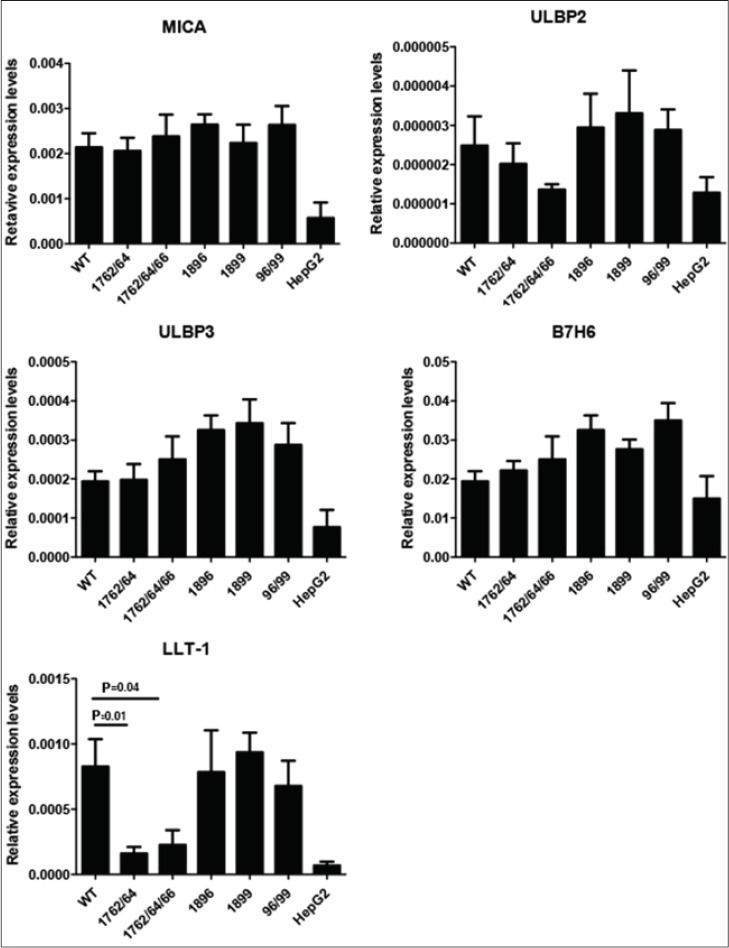
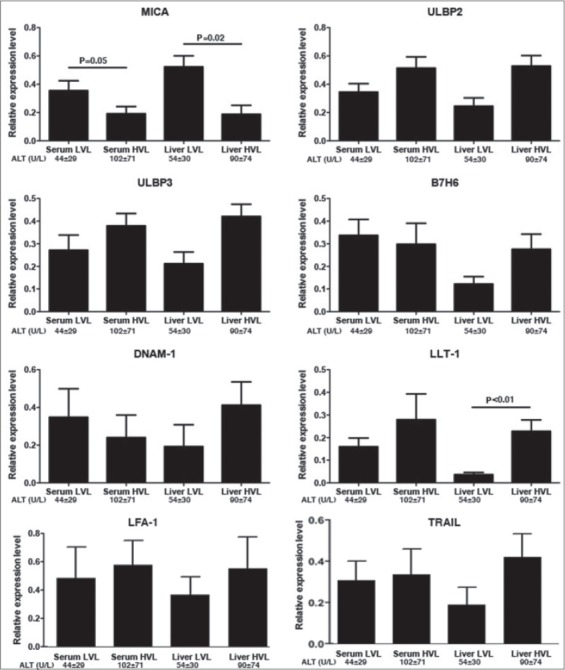
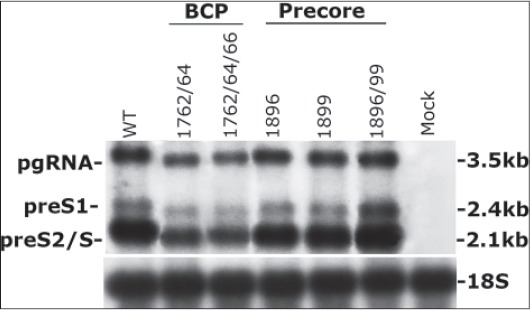
HBV monomers bearing hotspot mutations in the basal core promoter and precore region were transfected into HepG2 cells using a plasmid-free assay. Serum viremia and liver HBV RNA were measured in 19 CHB patients. The expression of HBV RNA and of NKG2D ligands, B7H6, DNAX accessory molecule-1, lectin-like transcript 1 (LLT1), LFA-1 and TRAIL was measured in the livers of CHB patients and transfected cells.
In general, high HBV replication in CHB patients and cell lines upregulated the mRNA of all NK cell ligands and particularly the inhibitory NK cell ligand, LLT1. The exception was the NKG2D ligand, MICA, that was significantly decreased in patients with high serum viremia and intrahepatic HBV RNA levels.
HBV replication has differential effects on NK cell ligands suggesting a potential escape mechanisms through up-regulation of LLT1 and down-regulation of MICA. A general trend towards upregulating NK cell ligands can be counteracted by decreasing MICA and hence weakening NK surveillance.
乙肝病毒(HBV)每年导致超过100万人因免疫介导的慢性肝损伤而死亡。自然杀伤(NK)细胞在肝脏中大量存在,并在HBV持续存在中起作用。NK细胞的细胞毒性作用受激活受体和抑制受体信号的控制。HBV可能通过调节NK受体及其配体来规避宿主抗病毒免疫。我们研究了病毒复制和HBeAg突变对慢性HBV(CHB)患者肝脏及细胞培养物中NK介质表达的影响。
使用无质粒检测法将在核心启动子和前核心区域带有热点突变的HBV单体转染到HepG2细胞中。检测了19例CHB患者的血清病毒血症和肝脏HBV RNA。检测了CHB患者肝脏及转染细胞中HBV RNA、NKG2D配体、B7H6、DNAX辅助分子-1、凝集素样转录本1(LLT1)、淋巴细胞功能相关抗原-1(LFA-1)和肿瘤坏死因子相关凋亡诱导配体(TRAIL)的表达。
总体而言,CHB患者和细胞系中高HBV复制上调了所有NK细胞配体的mRNA,尤其是抑制性NK细胞配体LLT1。例外的是NKG2D配体MICA,在血清病毒血症高和肝内HBV RNA水平高的患者中显著降低。
HBV复制对NK细胞配体有不同影响,提示通过上调LLT1和下调MICA可能存在潜在的逃逸机制。降低MICA从而削弱NK监测可抵消上调NK细胞配体的总体趋势。