Sadosky Alesia, Parsons Bruce, Emir Birol, Nieshoff Edward C
Pfizer Inc., New York, NY, USA.
Rehabilitation Institute of Michigan, Detroit, MI, USA.
J Pain Res. 2016 Jun 15;9:405-16. doi: 10.2147/JPR.S97770. eCollection 2016.
Characterizing relationships between pain relief and function can inform patient management decisions. This analysis explored graphically the relationship between pain relief and functional improvement in patients with neuropathic pain associated with spinal cord injury in two clinical trials of pregabalin.
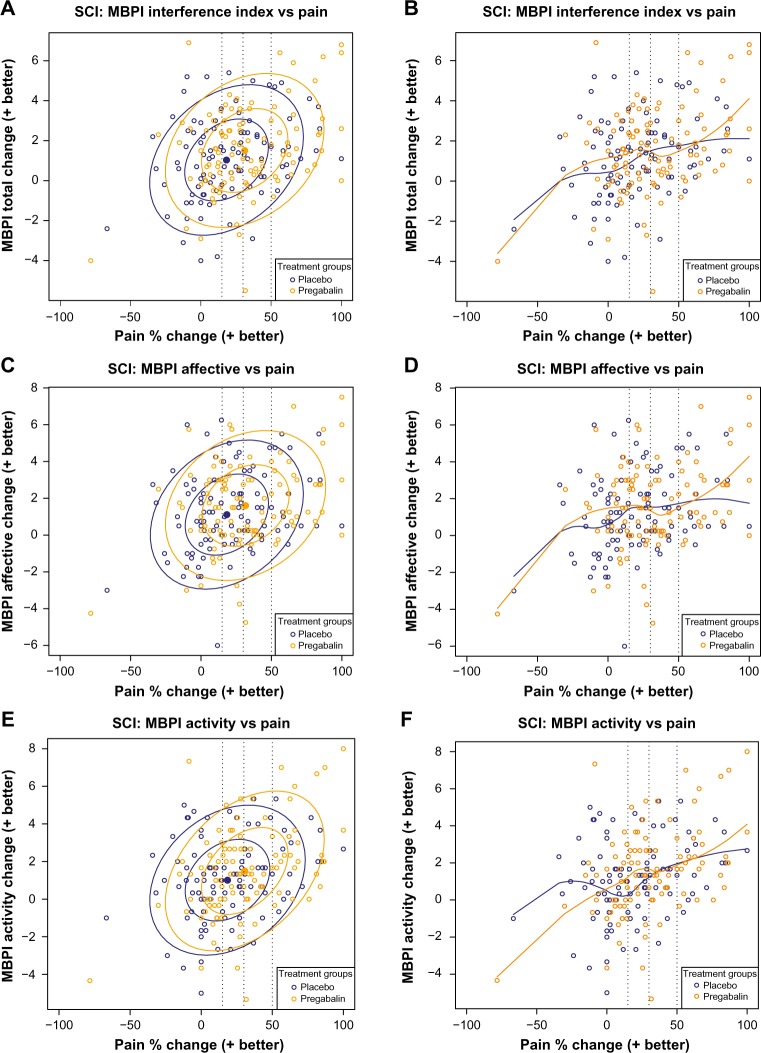
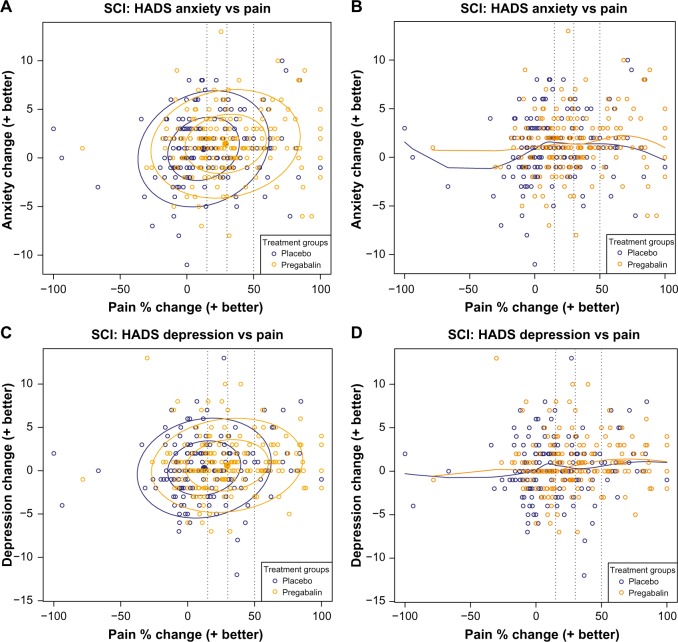
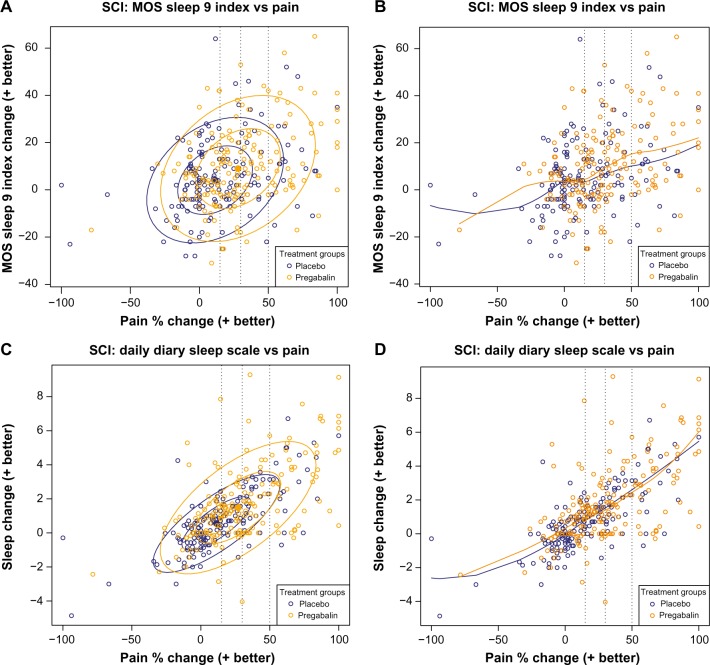
This was a post hoc analysis of two randomized, double-blind, clinical trials in patients who were treated with pregabalin (n=181) or placebo (n=172) for neuropathic pain associated with spinal cord injury. The bivariate relationship between percent pain relief and absolute change in the functional outcomes with placebo and pregabalin was evaluated graphically using scatter plots, and loess curves illustrated the extent of the relationship between pain and function. Linear trend analysis evaluated the statistical significance of these relationships using Initiative on Methods, Measurement, and Pain Assessment in Clinical Trials (IMMPACT)-based thresholds of pain reduction (<15%, 15% <30%, 30% to <50%, and ≥50%). Outcome measures included modified Brief Pain Inventory pain interference with function in one of the studies and the Medical Outcomes Study Sleep Scale (an 11-point Numeric Rating Scale) and the Hospital Anxiety and Depression Scale (HADS) for the pooled studies.
Data ellipses showed a shift with pregabalin relative to placebo toward greater improvement with increasing pain relief for all outcome measures except HADS. Loess curves suggested a relationship between increased pain relief and improved function except for HADS, with the clearest relationship observed for sleep. Linear trend analysis showed significant relationships between pain and Medical Outcomes Study Sleep Scale (P<0.0001) and between pain and function on the modified Brief Pain Inventory Interference Index and most individual items (P<0.05).
Greater functional improvements were generally achieved at higher levels of clinically significant pain reduction. Pregabalin resulted in shifts from placebo toward greater functional improvement with greater pain relief.
明确疼痛缓解与功能之间的关系可为患者管理决策提供依据。本分析在两项普瑞巴林治疗脊髓损伤相关性神经病理性疼痛的临床试验中,以图表形式探究了疼痛缓解与功能改善之间的关系。
这是一项对两项随机、双盲临床试验的事后分析,这些试验中,181例患者接受普瑞巴林治疗,172例患者接受安慰剂治疗,以缓解脊髓损伤相关性神经病理性疼痛。使用散点图以图形方式评估了安慰剂组和普瑞巴林组疼痛缓解百分比与功能结局绝对变化之间的双变量关系,局部加权回归曲线(loess曲线)说明了疼痛与功能之间关系的程度。线性趋势分析使用基于临床试验中方法、测量和疼痛评估倡议(IMMPACT)的疼痛减轻阈值(<15%、15%至<30%、30%至<50%和≥50%)评估这些关系的统计学意义。结局指标包括一项研究中的改良简明疼痛问卷疼痛对功能的干扰,以及汇总研究中的医学结局研究睡眠量表(11点数字评定量表)和医院焦虑抑郁量表(HADS)。
除HADS外,对于所有结局指标,数据椭圆显示普瑞巴林组相对于安慰剂组随着疼痛缓解增加而向更大改善方向偏移。除HADS外,局部加权回归曲线表明疼痛缓解增加与功能改善之间存在关系,睡眠方面的关系最为明显。线性趋势分析显示疼痛与医学结局研究睡眠量表之间存在显著关系(P<0.0001),疼痛与改良简明疼痛问卷干扰指数及大多数单项上的功能之间也存在显著关系(P<0.05)。
在临床上显著减轻疼痛的较高水平时,通常能实现更大的功能改善。普瑞巴林使患者从安慰剂组转向随着疼痛缓解增加而有更大功能改善的状态。