Wilson M E, O'Halloran H, VanderVeen D, Roarty J, Plager D A, Markwardt K, Gedif K, Lambert S R
Storm Eye Institute, Medical University of South Carolina, Charleston, SC, USA.
Rady Children's Hospital, San Diego, CA, USA.
Eye (Lond). 2016 Sep;30(9):1187-94. doi: 10.1038/eye.2016.132. Epub 2016 Jul 1.
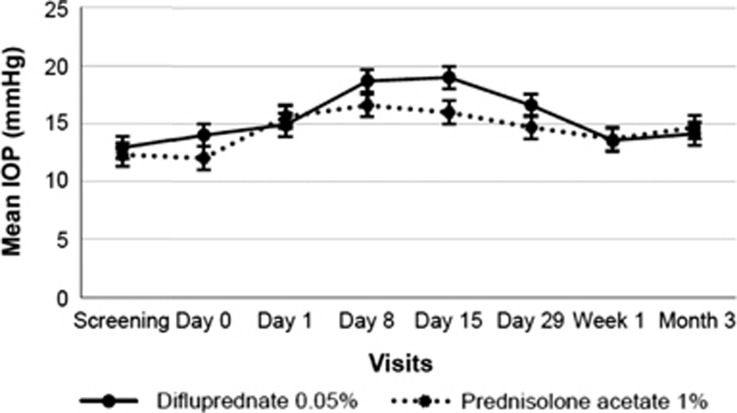
PurposeTo evaluate safety and efficacy of difluprednate 0.05% ophthalmic emulsion for treatment of postoperative inflammation after cataract surgery in pediatric patients.MethodsThis was a phase 3B, multicentre, randomized, double-masked, active-controlled study of patients aged 0-3 years who underwent uncomplicated cataract surgery in one eye, with/without intraocular lens implantation. Patients were randomized to receive difluprednate 0.05% four times daily or prednisolone acetate 1% for 14 days post surgery, followed by tapering for 14 days. Safety included evaluation of adverse events. Primary efficacy was the proportion of patients with an anterior cell grade of 0 (no cells) at day 14; secondary efficacy was a global inflammation score.ResultsForty patients were randomized to each treatment group. Adverse drug reactions included corneal oedema (difluprednate 0.5%, n=1; prednisolone acetate 1%, n=0) and increased intraocular pressure or ocular hypertension (n=2/group). Mean intraocular pressure values during treatment were 2-3 mm Hg higher with difluprednate 0.05% compared with prednisolone acetate 1%; mean values were similar between groups by the first week after treatment cessation. At 2 weeks post surgery, the incidence of complete clearing of anterior chamber cells was similar between groups (difluprednate 0.05%, n=30 (78.9%); prednisolone acetate 1%, n=31 (77.5%). Compared with prednisolone acetate 1%, approximately twice as many difluprednate 0.05%-treated patients had a global inflammation assessment score indicating no inflammation on day 1 (n=12 (30.8%) vs n=7 (17.5%) and day 8 (n=18 (48.7%) vs n=10 (25.0%).ConclusionsDifluprednate 0.05% four times daily showed safety and efficacy profiles similar to prednisolone acetate 1% four times daily in children 0-3 years undergoing cataract surgery.
评估0.05%地氟泼尼龙眼用乳剂治疗小儿白内障手术后炎症的安全性和有效性。
这是一项3B期、多中心、随机、双盲、活性对照研究,研究对象为年龄在0至3岁、单眼接受无并发症白内障手术(有或无人工晶状体植入)的患者。患者被随机分为两组,一组术后14天每天4次使用0.05%地氟泼尼龙,另一组每天4次使用1%醋酸泼尼松龙,之后逐渐减量使用14天。安全性评估包括不良事件评估。主要疗效指标为术后第14天前房细胞分级为0(无细胞)的患者比例;次要疗效指标为总体炎症评分。
每个治疗组随机分配了40名患者。药物不良反应包括角膜水肿(0.05%地氟泼尼龙组,n = 1;1%醋酸泼尼松龙组,n = 0)和眼压升高或高眼压(每组n = 2)。与1%醋酸泼尼松龙相比,0.05%地氟泼尼龙治疗期间的平均眼压值高2至3 mmHg;停药后第一周两组平均值相似。术后2周,两组前房细胞完全清除的发生率相似(0.05%地氟泼尼龙组,n = 30(78.9%);1%醋酸泼尼松龙组,n = 31(77.5%)。与1%醋酸泼尼松龙相比,0.05%地氟泼尼龙治疗的患者中,在第1天(n = 12(30.8%)对n = 7(17.5%))和第8天(n = 18(48.7%)对n = 10(25.0%))总体炎症评估评分显示无炎症的患者数量约为两倍。
对于接受白内障手术的0至3岁儿童,每天4次使用0.05%地氟泼尼龙的安全性和有效性与每天4次使用1%醋酸泼尼松龙相似。