Hung Ming-Szu, Lung Jr-Hau, Lin Yu-Ching, Fang Yu-Hung, Hsieh Meng-Jer, Tsai Ying-Huang
aDivision of Thoracic Oncology, Department of Pulmonary and Critical Care Medicine, Chang Gung Memorial Hospital, Chiayi Branch, Puzi City bDepartment of Medicine, College of Medicine, Chang Gung University, Taoyuan cDepartment of Respiratory Care, Chang Gung University of Science and Technology, Chiayi Campus, Chiayi dDepartment of Medical Research, Chang Gung Memorial Hospital, Chiayi Branch, Puzi City eDivision of Pulmonary Infection and Critical Care, Department of Pulmonary and Critical Care Medicine, Chang Gung Memorial Hospital, Chiayi Branch, Puzi City fDepartment of Respiratory Care, College of Medicine, Chang Gung University, Taoyuan, Taiwan, ROC.
Medicine (Baltimore). 2016 Jun;95(26):e3991. doi: 10.1097/MD.0000000000003991.
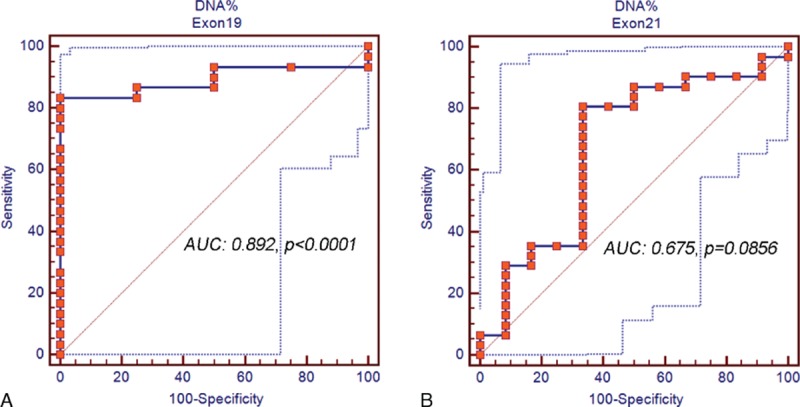
This study aimed to elucidate the association of the content of mutant epidermal growth factor receptor (EGFR) deoxyribonucleic acid (DNA) with the treatment response to EGFR-tyrosine kinase inhibitor (TKI) and survival in patients with lung cancer.This retrospective cohort study included 77 lung adenocarcinoma patients with common EGFR mutations from December 2012 to February 2015. The content of mutant EGFR DNA in lung cancer tissues was determined using an Amplification Refractory Mutation System. The association of the amount of mutant EGFR DNA with treatment response, the clinical variables, and the progression-free survival (PFS) after EGFR-TKI therapy were evaluated.Using the amount of mutant EGR DNA above 4.77% as the cut-off value, the sensitivity to predict EGFR-TKI responder is 82.0% and the specificity is 75.0% (area under the curve [AUC]: 0.734, P = 0.003). The high content of mutant EGFR DNA is an independent factor associated with the response to EGFR-TKIs (odds ratio: 13.07, 95% confidence interval [CI]: 3.23-52.11, P = 0.0003). A significantly longer PFS was observed in the group with the high content of mutant EGFR DNA (26.3 months, 95% CI: 12.2-26.3) compared with the low content of mutant EGFR DNA groups (12.3 months, 95% CI: 5.7-14.8, P = 0.0155). A better predictive value of the content of mutant EGFR DNA was noted in patients with exon 19 deletions (AUC: 0.892, P < 0.0001) than exon 21 L858R mutations (AUC: 0.675, P = 0.0856).Our results show that the content of mutant EGFR DNA is associated with the clinical response to EGFR-TKIs, especially in patients with exon 19 deletions mutation.
本研究旨在阐明肺癌患者中突变型表皮生长因子受体(EGFR)脱氧核糖核酸(DNA)含量与EGFR酪氨酸激酶抑制剂(TKI)治疗反应及生存情况之间的关联。这项回顾性队列研究纳入了2012年12月至2015年2月期间77例具有常见EGFR突变的肺腺癌患者。采用扩增阻滞突变系统测定肺癌组织中突变型EGFR DNA的含量。评估突变型EGFR DNA含量与治疗反应、临床变量以及EGFR-TKI治疗后无进展生存期(PFS)之间的关联。以突变型EGR DNA含量高于4.77%作为截断值,预测EGFR-TKI反应者的敏感性为82.0%,特异性为75.0%(曲线下面积[AUC]:0.734,P = 0.003)。突变型EGFR DNA含量高是与EGFR-TKIs反应相关的独立因素(比值比:13.07,95%置信区间[CI]:3.23 - 52.11,P = 0.0003)。与突变型EGFR DNA含量低的组(12.3个月,95% CI:5.7 - 14.8,P = 0.0155)相比,突变型EGFR DNA含量高的组观察到显著更长的PFS(26.3个月,95% CI:12.2 - 26.3)。与外显子21 L858R突变(AUC:0.675,P = 0.0856)相比,外显子19缺失的患者中突变型EGFR DNA含量具有更好的预测价值(AUC:0.892,P < 0.0001)。我们的结果表明,突变型EGFR DNA含量与EGFR-TKIs的临床反应相关,尤其是在外显子19缺失突变的患者中。