Margas Wojciech, Ferron Laurent, Nieto-Rostro Manuela, Schwartz Arnold, Dolphin Annette C
Department of Neuroscience, Physiology and Pharmacology, University College London, London WC1E 6BT, UK.
Department of Neuroscience, Physiology and Pharmacology, University College London, London WC1E 6BT, UK
Philos Trans R Soc Lond B Biol Sci. 2016 Aug 5;371(1700). doi: 10.1098/rstb.2015.0430.
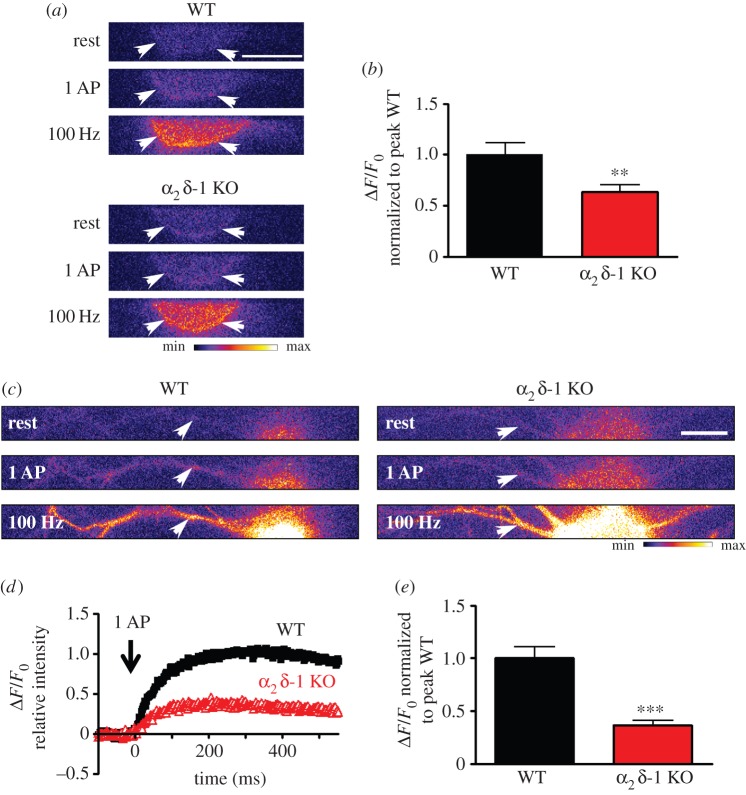
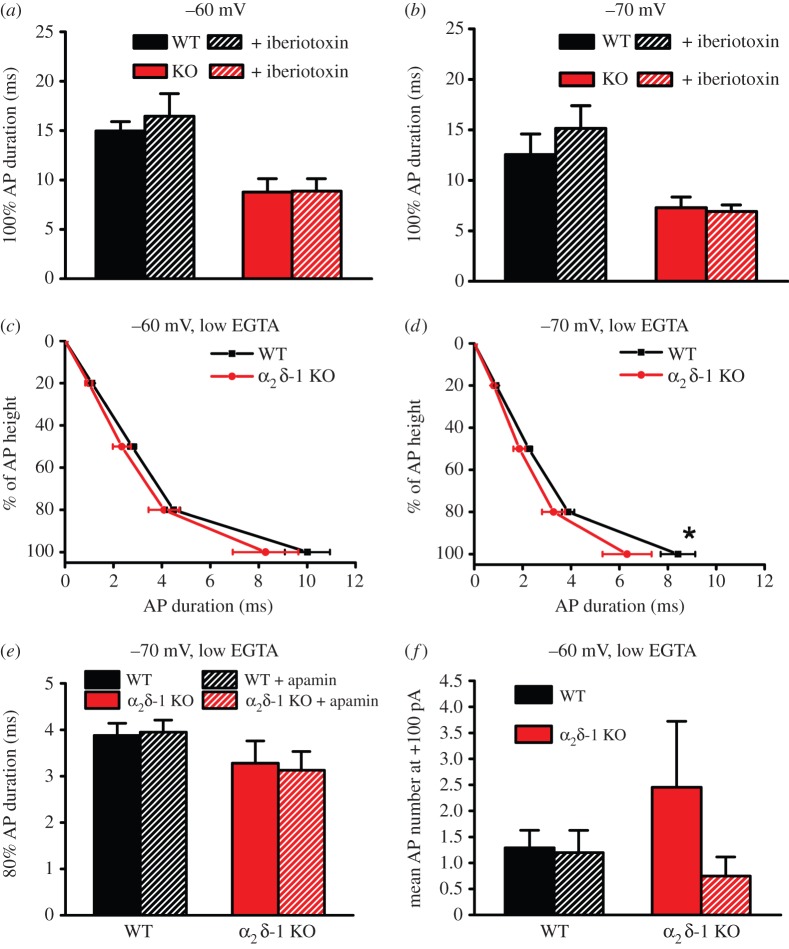
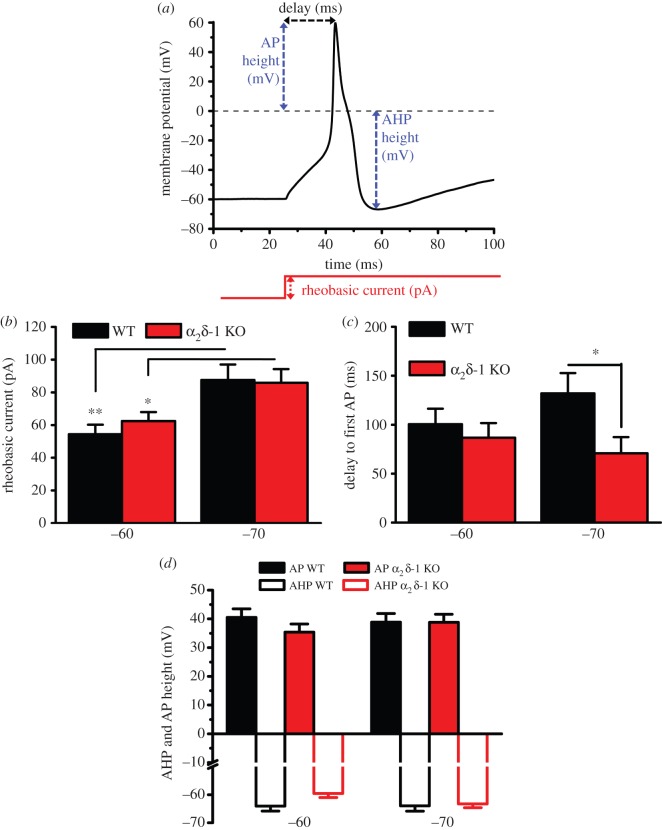
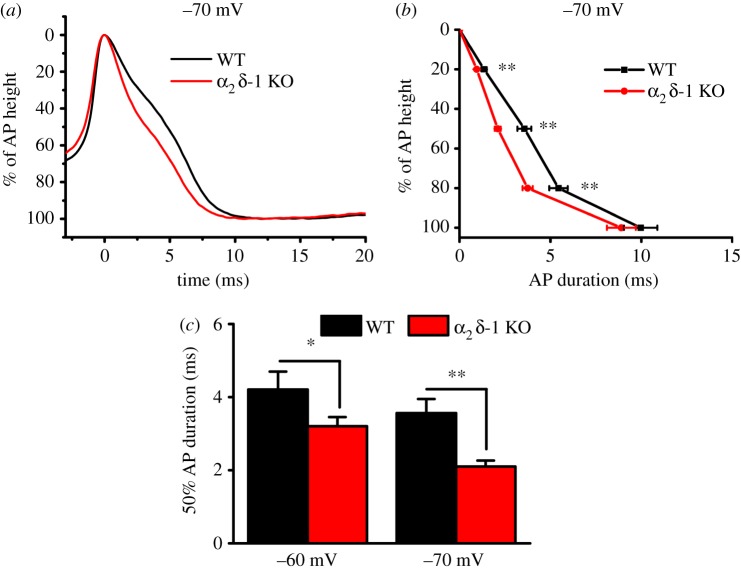
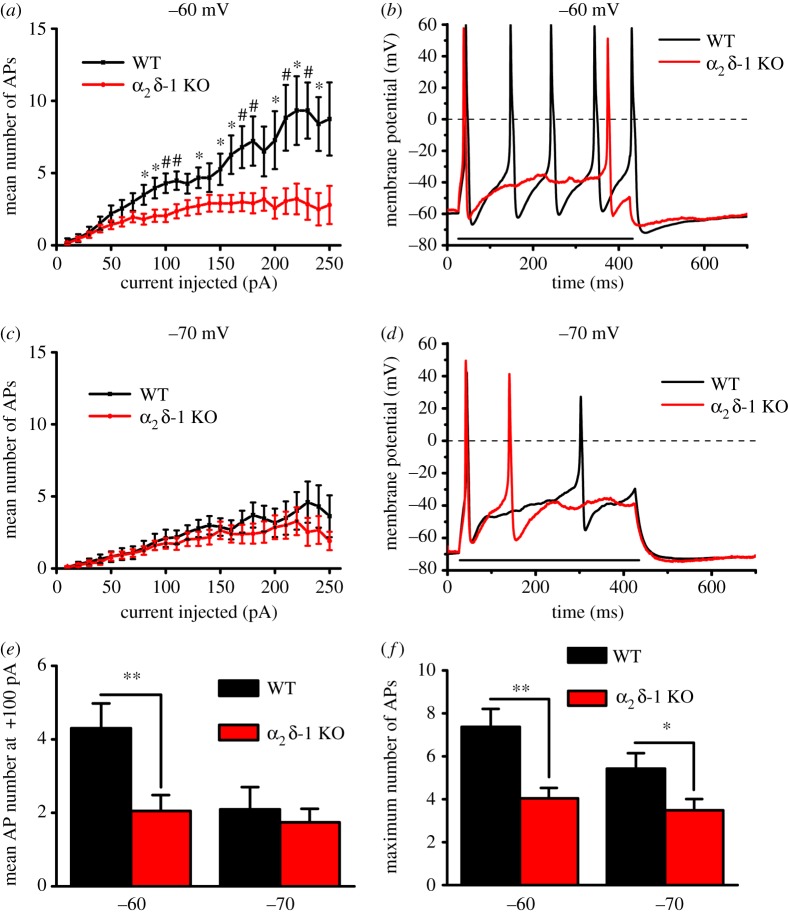
Gene deletion of the voltage-gated calcium channel auxiliary subunit α2δ-1 has been shown previously to have a cardiovascular phenotype, and a reduction in mechano- and cold sensitivity, coupled with delayed development of neuropathic allodynia. We have also previously shown that dorsal root ganglion (DRG) neuron calcium channel currents were significantly reduced in α2δ-1 knockout mice. To extend our findings in these sensory neurons, we have examined here the properties of action potentials (APs) in DRG neurons from α2δ-1 knockout mice in comparison to their wild-type (WT) littermates, in order to dissect how the calcium channels that are affected by α2δ-1 knockout are involved in setting the duration of individual APs and their firing frequency. Our main findings are that there is reduced Ca(2+) entry on single AP stimulation, particularly in the axon proximal segment, reduced AP duration and reduced firing frequency to a 400 ms stimulation in α2δ-1 knockout neurons, consistent with the expected role of voltage-gated calcium channels in these events. Furthermore, lower intracellular Ca(2+) buffering also resulted in reduced AP duration, and a lower frequency of AP firing in WT neurons, mimicking the effect of α2δ-1 knockout. By contrast, we did not obtain any consistent evidence for the involvement of Ca(2+)-activation of large conductance calcium-activated potassium (BK) and small conductance calcium-activated potassium (SK) channels in these events. In conclusion, the reduced Ca(2+) elevation as a result of single AP stimulation is likely to result from the reduced duration of the AP in α2δ-1 knockout sensory neurons.This article is part of the themed issue 'Evolution brings Ca(2+) and ATP together to control life and death'.
先前的研究表明,电压门控钙通道辅助亚基α2δ-1的基因缺失具有心血管表型,机械敏感性和冷敏感性降低,同时神经性异常性疼痛的发展延迟。我们之前还表明,α2δ-1基因敲除小鼠的背根神经节(DRG)神经元钙通道电流显著降低。为了扩展我们在这些感觉神经元中的研究结果,我们在此研究了α2δ-1基因敲除小鼠DRG神经元与野生型(WT)同窝小鼠相比的动作电位(AP)特性,以剖析受α2δ-1基因敲除影响的钙通道如何参与设定单个AP的持续时间及其发放频率。我们的主要发现是,在α2δ-1基因敲除神经元中,单次AP刺激时Ca(2+)内流减少,特别是在轴突近端段,AP持续时间缩短,对400 ms刺激的发放频率降低,这与电压门控钙通道在这些事件中的预期作用一致。此外,较低的细胞内Ca(2+)缓冲也导致WT神经元的AP持续时间缩短和AP发放频率降低,模拟了α2δ-1基因敲除的效果。相比之下,我们没有获得任何一致的证据表明大电导钙激活钾(BK)通道和小电导钙激活钾(SK)通道的Ca(2+)激活参与了这些事件。总之,α2δ-1基因敲除感觉神经元中单次AP刺激导致的Ca(2+)升高减少可能是由于AP持续时间缩短所致。本文是主题为“进化将Ca(2+)和ATP聚集在一起以控制生死”的特刊的一部分。