Kim Kwang Hyun, Yoon Hyun Suk, Yoon Hana, Chung Woo Sik, Sim Bong Suk, Ryu Dong-Ryeol, Lee Dong Hyeon
Department of Urology, Ewha Womans University School of Medicine, Seoul, Korea.
Department of Internal Medicine, Ewha Womans University School of Medicine, Seoul, Korea.
PLoS One. 2016 Jul 6;11(7):e0158220. doi: 10.1371/journal.pone.0158220. eCollection 2016.
To investigate the serial changes of metabolic acidosis and identify associated risk factors in patients who underwent radical cystectomy and ileal neobladder.
From January 2010 to August 2014, 123 patients who underwent radical cystectomy and ileal neobladder reconstruction for bladder cancer were included in this study. Metabolic acidosis was defined as a serum bicarbonate level less than 22 mEq/L and impaired renal function was defined as a GFR <50ml/min. The presence of metabolic acidosis was evaluated at 1 month, 1 year, and 2 years after surgery. Multivariate logistic regression analysis was conducted to identify risk factors associated with development of metabolic acidosis.
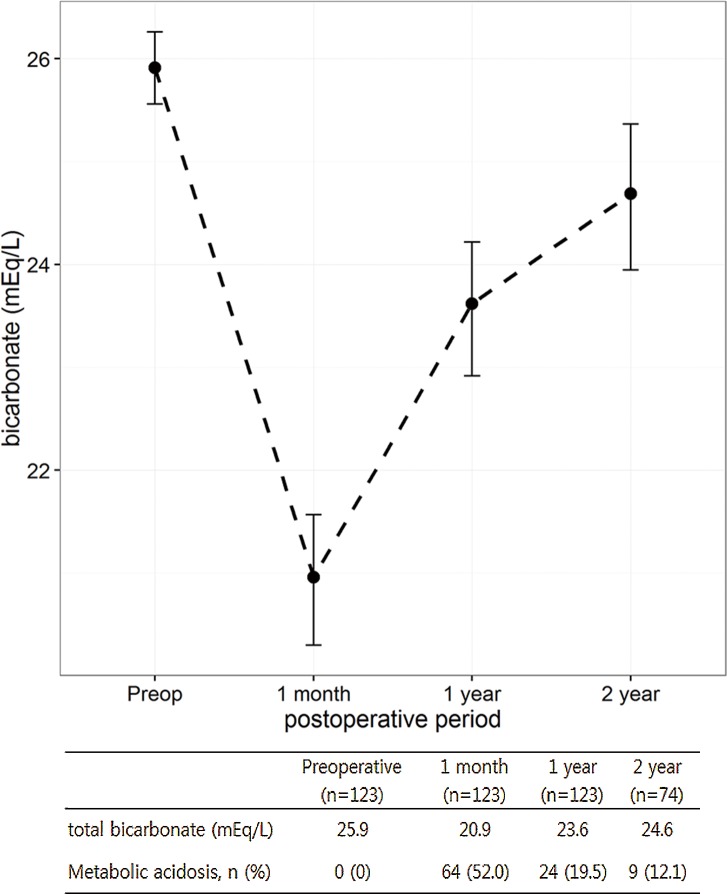
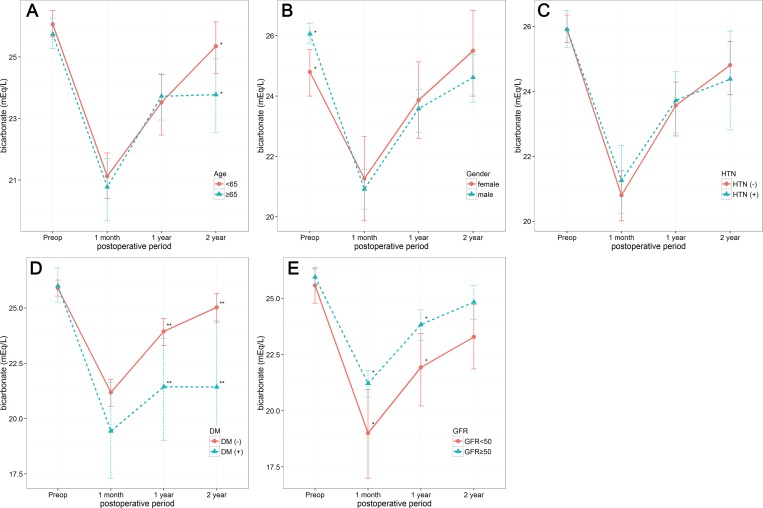
Metabolic acidosis was observed in 52%, 19.5%, and 7.3% of patients at 1 month, 1 year, and 2 years after surgery, respectively. At 1 month after surgery, impaired renal function was the only independent risk factor associated with metabolic acidosis (OR 3.87, P = 0.046). At 1 year after surgery, diabetes was the only independent risk factor associated with metabolic acidosis (OR 5.68, P = 0.002). At 2 years post-surgery, both age and diabetes were significant risk factors associated with metabolic acidosis.
Approximately, half of patients experienced metabolic acidosis one month after ileal neobladder reconstruction. Preoperative impaired renal function was the most significant risk factor for developing metabolic acidosis in the early postoperative period. However, the incidence of metabolic acidosis decreased to less than 20% 1 year after surgery, and diabetes was an independent risk factor during this period.
探讨接受根治性膀胱切除术及回肠新膀胱术患者代谢性酸中毒的系列变化,并确定相关危险因素。
2010年1月至2014年8月,本研究纳入了123例因膀胱癌接受根治性膀胱切除术及回肠新膀胱重建术的患者。代谢性酸中毒定义为血清碳酸氢盐水平低于22 mEq/L,肾功能损害定义为肾小球滤过率(GFR)<50ml/min。在术后1个月、1年和2年评估代谢性酸中毒的存在情况。进行多因素逻辑回归分析以确定与代谢性酸中毒发生相关的危险因素。
术后1个月、1年和2年分别有52%、19.5%和7.3%的患者出现代谢性酸中毒。术后1个月,肾功能损害是与代谢性酸中毒相关的唯一独立危险因素(比值比[OR] 3.87,P = 0.046)。术后1年,糖尿病是与代谢性酸中毒相关的唯一独立危险因素(OR 5.68,P = 0.002)。术后2年,年龄和糖尿病都是与代谢性酸中毒相关的显著危险因素。
大约一半的患者在回肠新膀胱重建术后1个月出现代谢性酸中毒。术前肾功能损害是术后早期发生代谢性酸中毒的最显著危险因素。然而,术后1年代谢性酸中毒的发生率降至20%以下,在此期间糖尿病是一个独立危险因素。