• 文献检索
  • 文档翻译
  • 深度研究
  • 学术资讯
  • Suppr Zotero 插件Zotero 插件
  • 邀请有礼
  • 套餐&价格
  • 历史记录
应用&插件
Suppr Zotero 插件Zotero 插件浏览器插件Mac 客户端Windows 客户端微信小程序
定价
高级版会员购买积分包购买API积分包
服务
文献检索文档翻译深度研究API 文档MCP 服务
关于我们
关于 Suppr公司介绍联系我们用户协议隐私条款
关注我们

Suppr 超能文献

核心技术专利:CN118964589B侵权必究
粤ICP备2023148730 号-1Suppr @ 2026

文献检索

告别复杂PubMed语法,用中文像聊天一样搜索,搜遍4000万医学文献。AI智能推荐,让科研检索更轻松。

立即免费搜索

文件翻译

保留排版,准确专业,支持PDF/Word/PPT等文件格式,支持 12+语言互译。

免费翻译文档

深度研究

AI帮你快速写综述,25分钟生成高质量综述,智能提取关键信息,辅助科研写作。

立即免费体验

双任务下楼梯过程中的目光转移。

Gaze shifts during dual-tasking stair descent.

作者信息

Miyasike-daSilva Veronica, McIlroy William E

机构信息

Center for Physical Ergonomics, Liberty Mutual Research Institute for Safety, 71 Frankland Road, Hopkinton, MA, 01748, USA.

Department of Kinesiology, University of Waterloo, Waterloo, Canada.

出版信息

Exp Brain Res. 2016 Nov;234(11):3233-3243. doi: 10.1007/s00221-016-4721-6. Epub 2016 Jul 11.

DOI:10.1007/s00221-016-4721-6
PMID:27401474
原文链接:https://pmc.ncbi.nlm.nih.gov/articles/PMC5071366/
Abstract

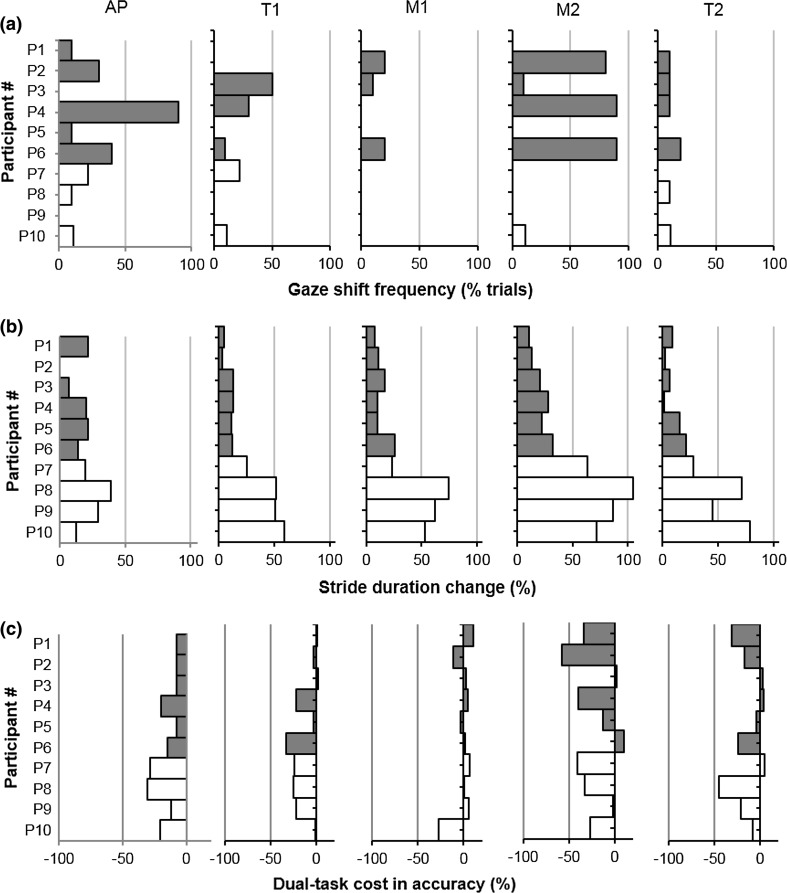
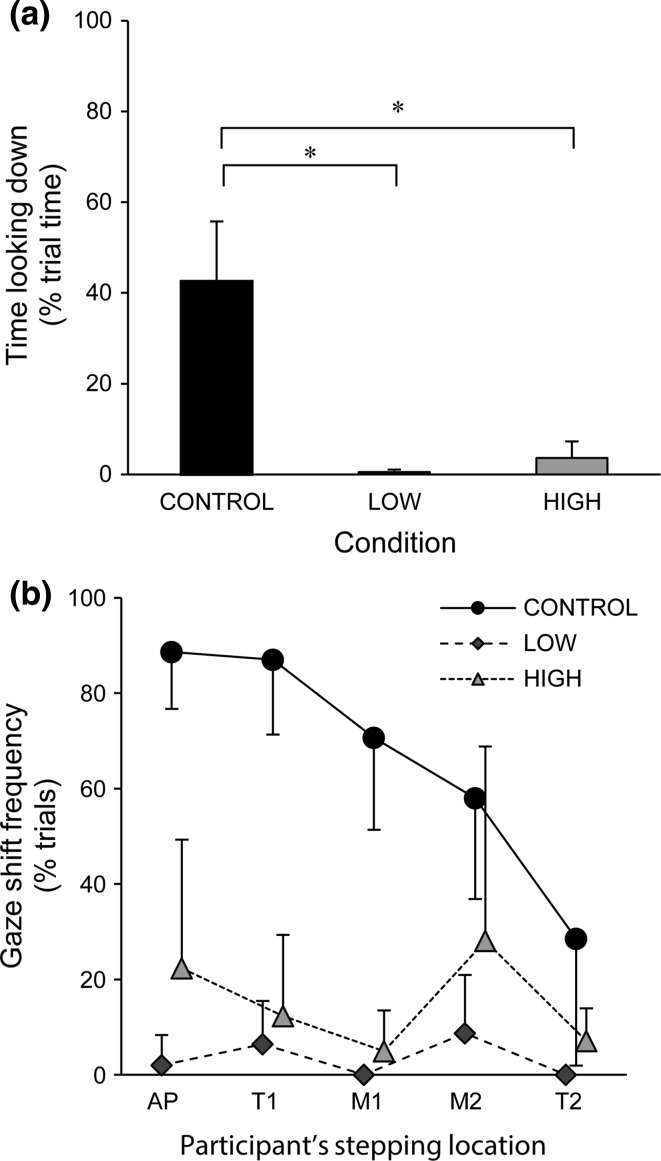
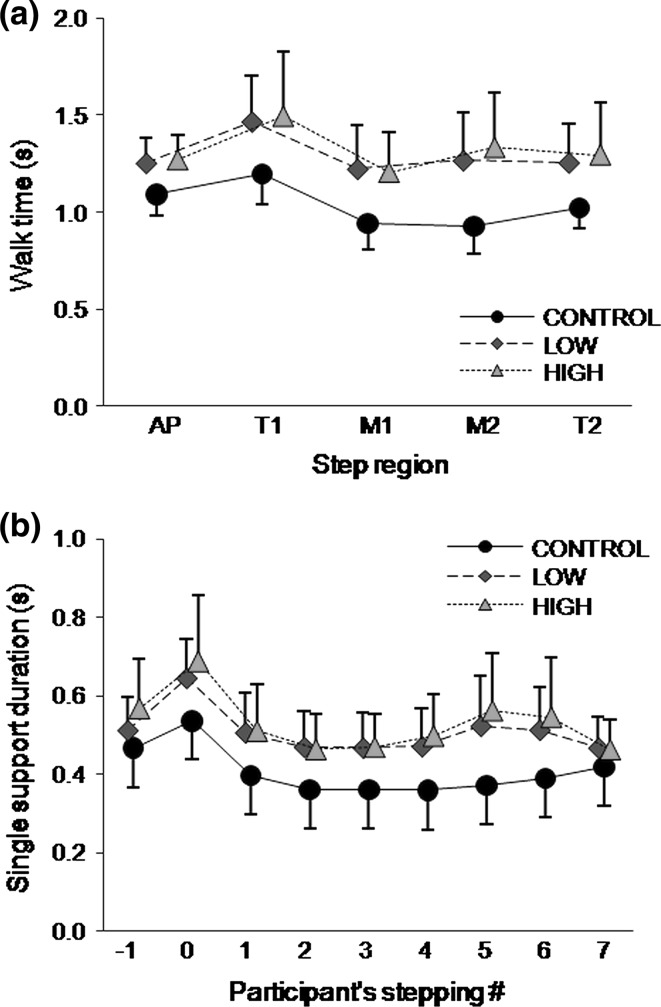
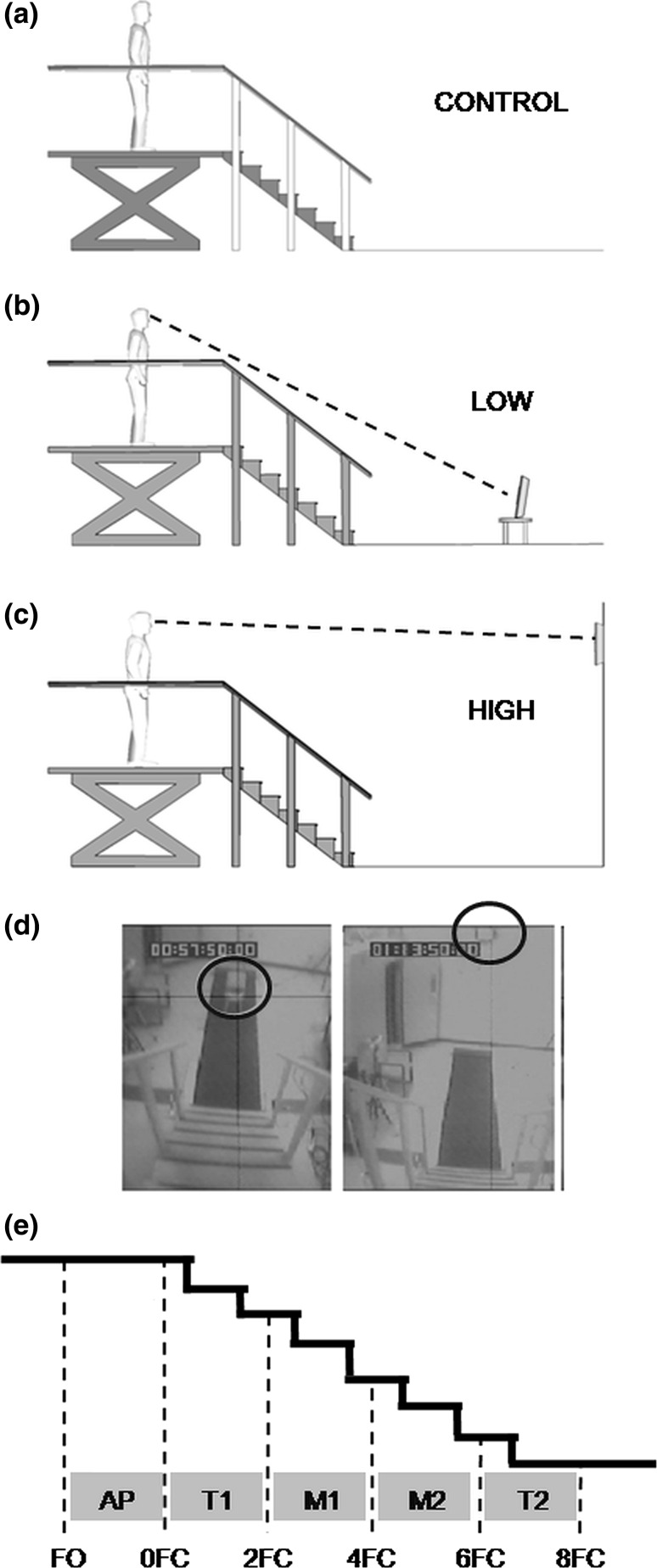
To investigate the role of vision in stair locomotion, young adults descended a seven-step staircase during unrestricted walking (CONTROL), and while performing a concurrent visual reaction time (RT) task displayed on a monitor. The monitor was located at either 3.5 m (HIGH) or 0.5 m (LOW) above ground level at the end of the stairway, which either restricted (HIGH) or facilitated (LOW) the view of the stairs in the lower field of view as participants walked downstairs. Downward gaze shifts (recorded with an eye tracker) and gait speed were significantly reduced in HIGH and LOW compared with CONTROL. Gaze and locomotor behaviour were not different between HIGH and LOW. However, inter-individual variability increased in HIGH, in which participants combined different response characteristics including slower walking, handrail use, downward gaze, and/or increasing RTs. The fastest RTs occurred in the midsteps (non-transition steps). While gait and visual task performance were not statistically different prior to the top and bottom transition steps, gaze behaviour and RT were more variable prior to transition steps in HIGH. This study demonstrated that, in the presence of a visual task, people do not look down as often when walking downstairs and require minimum adjustments provided that the view of the stairs is available in the lower field of view. The middle of the stairs seems to require less from executive function, whereas visual attention appears a requirement to detect the last transition via gaze shifts or peripheral vision.

摘要

为研究视觉在上下楼梯运动中的作用,年轻成年人在自由行走(对照组)时以及在执行显示器上显示的同时进行的视觉反应时间(RT)任务时,走下一段有七级台阶的楼梯。显示器位于楼梯末端地面以上3.5米(高)或0.5米(低)处,当参与者下楼时,这一位置会限制(高)或便于(低)他们对楼梯下部视野的观察。与对照组相比,高组和低组的向下注视转移(用眼动仪记录)和步速均显著降低。高组和低组之间的注视和运动行为没有差异。然而,高组个体间的变异性增加,其中参与者表现出不同的反应特征,包括行走速度减慢、使用扶手、向下注视和/或反应时间增加。最快的反应时间出现在台阶中间(非过渡台阶)。虽然在顶部和底部过渡台阶之前,步态和视觉任务表现没有统计学差异,但在高组中,过渡台阶之前的注视行为和反应时间更具变异性。这项研究表明,在存在视觉任务的情况下,人们下楼时向下看的频率较低,并且只要楼梯在下部视野中可见,就只需进行最小程度的调整。楼梯中间似乎对执行功能的要求较低,而视觉注意力似乎是通过注视转移或周边视觉检测最后一个过渡所需的条件。
https://cdn.ncbi.nlm.nih.gov/pmc/blobs/4ae3/5071366/5425a9437bb6/221_2016_4721_Fig4_HTML.jpg
https://cdn.ncbi.nlm.nih.gov/pmc/blobs/4ae3/5071366/1e89fa1b8506/221_2016_4721_Fig1_HTML.jpg
https://cdn.ncbi.nlm.nih.gov/pmc/blobs/4ae3/5071366/2830e2da44bb/221_2016_4721_Fig2_HTML.jpg
https://cdn.ncbi.nlm.nih.gov/pmc/blobs/4ae3/5071366/5fcc51f0a697/221_2016_4721_Fig3_HTML.jpg
https://cdn.ncbi.nlm.nih.gov/pmc/blobs/4ae3/5071366/5425a9437bb6/221_2016_4721_Fig4_HTML.jpg
https://cdn.ncbi.nlm.nih.gov/pmc/blobs/4ae3/5071366/1e89fa1b8506/221_2016_4721_Fig1_HTML.jpg
https://cdn.ncbi.nlm.nih.gov/pmc/blobs/4ae3/5071366/2830e2da44bb/221_2016_4721_Fig2_HTML.jpg
https://cdn.ncbi.nlm.nih.gov/pmc/blobs/4ae3/5071366/5fcc51f0a697/221_2016_4721_Fig3_HTML.jpg
https://cdn.ncbi.nlm.nih.gov/pmc/blobs/4ae3/5071366/5425a9437bb6/221_2016_4721_Fig4_HTML.jpg

相似文献

1
Gaze shifts during dual-tasking stair descent.双任务下楼梯过程中的目光转移。
Exp Brain Res. 2016 Nov;234(11):3233-3243. doi: 10.1007/s00221-016-4721-6. Epub 2016 Jul 11.
2
Where do we look when we walk on stairs? Gaze behaviour on stairs, transitions, and handrails.我们在走楼梯时会看向哪里?楼梯、楼梯过渡和楼梯扶手处的注视行为。
Exp Brain Res. 2011 Mar;209(1):73-83. doi: 10.1007/s00221-010-2520-z. Epub 2010 Dec 25.
3
A role for the lower visual field information in stair climbing.下视野信息在爬楼梯中的作用。
Gait Posture. 2019 May;70:162-167. doi: 10.1016/j.gaitpost.2019.02.033. Epub 2019 Feb 27.
4
Does it really matter where you look when walking on stairs? Insights from a dual-task study.当你走楼梯时,真的很在意你看哪里吗?来自一项双重任务研究的见解。
PLoS One. 2012;7(9):e44722. doi: 10.1371/journal.pone.0044722. Epub 2012 Sep 6.
5
Patients with chronic peripheral vestibular hypofunction compared to healthy subjects exhibit differences in gaze and gait behaviour when walking on stairs and ramps.与健康受试者相比,慢性外周前庭功能减退患者在楼梯和坡道上行走时,其注视和步态行为存在差异。
PLoS One. 2017 Dec 18;12(12):e0189037. doi: 10.1371/journal.pone.0189037. eCollection 2017.
6
The division of visual attention affects the transition point from level walking to stair descent in healthy, active older adults.视觉注意力的分配会影响健康、活跃的老年人从平地行走过渡到楼梯下降的转折点。
Exp Gerontol. 2014 Feb;50:26-33. doi: 10.1016/j.exger.2013.11.007. Epub 2013 Nov 27.
7
How far ahead do we look when required to step on specific locations in the travel path during locomotion?在移动过程中,当需要踩在行进路径上的特定位置时,我们会提前看多远?
Exp Brain Res. 2003 Jan;148(1):133-8. doi: 10.1007/s00221-002-1246-y. Epub 2002 Nov 9.
8
Gaze behavior of young and older adults during stair walking.年轻人和老年人在上下楼梯行走时的注视行为。
J Mot Behav. 2009 Jul;41(4):357-65. doi: 10.3200/JMBR.41.4.357-366.
9
Keep your head down: Maintaining gait stability in challenging conditions.低头前行:在挑战性条件下保持步态稳定。
Hum Mov Sci. 2020 Oct;73:102676. doi: 10.1016/j.humov.2020.102676. Epub 2020 Sep 18.
10
(Un-) coupling gaze and attention outside central vision.在中央视觉之外(解)耦凝视与注意力。
J Vis. 2010 Sep 15;10(11):13. doi: 10.1167/10.11.13.

引用本文的文献

1
When knowing the activity is not enough to predict gaze.当仅凭活动不足以预测注视时。
J Vis. 2024 Jul 2;24(7):6. doi: 10.1167/jov.24.7.6.
2
The effect of visual sensory interference during multitask obstacle crossing in younger and older adults.视觉感官干扰对年轻和老年成年人多任务障碍穿越的影响。
PLoS One. 2024 May 16;19(5):e0302838. doi: 10.1371/journal.pone.0302838. eCollection 2024.
3
Risky behavior during stair descent for young adults: Differences in men versus women.年轻人在楼梯下降过程中的危险行为:男性与女性的差异。

本文引用的文献

1
Effect of dual task type on gait and dynamic stability during stair negotiation at different inclinations.双任务类型对不同坡度楼梯通行时步态和动态稳定性的影响。
Gait Posture. 2016 Jan;43:114-9. doi: 10.1016/j.gaitpost.2015.09.009. Epub 2015 Sep 15.
2
Is the size of the useful field of view affected by postural demands associated with standing and stepping?有用视野的大小是否受到与站立和跨步相关的姿势需求的影响?
Neurosci Lett. 2014 Apr 30;566:27-31. doi: 10.1016/j.neulet.2014.02.031. Epub 2014 Feb 26.
3
Lower-extremity kinematics and postural stability during stair negotiation: effects of two cognitive tasks.
PLoS One. 2023 Jul 26;18(7):e0288438. doi: 10.1371/journal.pone.0288438. eCollection 2023.
4
Where do people look when walking up and down familiar staircases?当人们在熟悉的楼梯上上下下时,他们会看向哪里?
J Vis. 2023 Jan 3;23(1):7. doi: 10.1167/jov.23.1.7.
5
Peripheral vision in real-world tasks: A systematic review.真实世界任务中的周边视觉:系统综述。
Psychon Bull Rev. 2022 Oct;29(5):1531-1557. doi: 10.3758/s13423-022-02117-w. Epub 2022 May 17.
6
Falls in young adults: The effect of sex, physical activity, and prescription medications.年轻人跌倒:性别、身体活动和处方药物的影响。
PLoS One. 2021 Apr 22;16(4):e0250360. doi: 10.1371/journal.pone.0250360. eCollection 2021.
7
Mind Your Step: the Effects of Mobile Phone Use on Gaze Behavior in Stair Climbing.小心脚下:使用手机对爬楼梯时注视行为的影响。
J Technol Behav Sci. 2017;2(3):109-120. doi: 10.1007/s41347-017-0022-6. Epub 2017 Nov 28.
8
The influence of visual flow and perceptual load on locomotion speed.视觉流和知觉负荷对运动速度的影响。
Atten Percept Psychophys. 2018 Jan;80(1):69-81. doi: 10.3758/s13414-017-1417-3.
上下楼梯过程中的下肢运动学和姿势稳定性:两项认知任务的影响
Clin Biomech (Bristol). 2014 Jan;29(1):40-6. doi: 10.1016/j.clinbiomech.2013.11.006. Epub 2013 Nov 13.
4
The division of visual attention affects the transition point from level walking to stair descent in healthy, active older adults.视觉注意力的分配会影响健康、活跃的老年人从平地行走过渡到楼梯下降的转折点。
Exp Gerontol. 2014 Feb;50:26-33. doi: 10.1016/j.exger.2013.11.007. Epub 2013 Nov 27.
5
Does it really matter where you look when walking on stairs? Insights from a dual-task study.当你走楼梯时,真的很在意你看哪里吗?来自一项双重任务研究的见解。
PLoS One. 2012;7(9):e44722. doi: 10.1371/journal.pone.0044722. Epub 2012 Sep 6.
6
Where do we look when we walk on stairs? Gaze behaviour on stairs, transitions, and handrails.我们在走楼梯时会看向哪里?楼梯、楼梯过渡和楼梯扶手处的注视行为。
Exp Brain Res. 2011 Mar;209(1):73-83. doi: 10.1007/s00221-010-2520-z. Epub 2010 Dec 25.
7
The use of peripheral vision to guide perturbation-evoked reach-to-grasp balance-recovery reactions.利用周边视觉引导因受干扰而产生的伸手抓握平衡恢复反应。
Exp Brain Res. 2010 Nov;207(1-2):105-18. doi: 10.1007/s00221-010-2434-9. Epub 2010 Oct 19.
8
Walking down memory lane: where walkers look as they descend stairs provides hints about how they control their walking behavior.漫步记忆长廊:步行者下楼梯时的目光方向为了解他们如何控制行走行为提供了线索。
Am J Psychol. 2009 Winter;122(4):425-30.
9
Utility of peripheral visual cues in planning and controlling adaptive gait.周边视觉线索在规划和控制适应性步态中的作用
Optom Vis Sci. 2010 Jan;87(1):21-7. doi: 10.1097/OPX.0b013e3181c1d547.
10
Age affects the attentional demands of stair ambulation: evidence from a dual-task approach.年龄影响上下楼梯行走时的注意力需求:来自双任务法的证据。
Phys Ther. 2009 Oct;89(10):1080-8. doi: 10.2522/ptj.20080187. Epub 2009 Aug 6.