Zuo Jian, Jiang Hui, Zhu Yan-Hong, Wang Ya-Qin, Zhang Wen, Luan Jia-Jie
Department of Pharmacy, Yijishan Hospital, Wannan Medical College, Wuhu 241000, China; Anhui Provincial Engineering Technology Research Center of Polysaccharides Drugs, Wuhu 241000, China.
Department of Pharmacy, Yijishan Hospital, Wannan Medical College, Wuhu 241000, China.
Evid Based Complement Alternat Med. 2016;2016:2018704. doi: 10.1155/2016/2018704. Epub 2016 Jun 15.
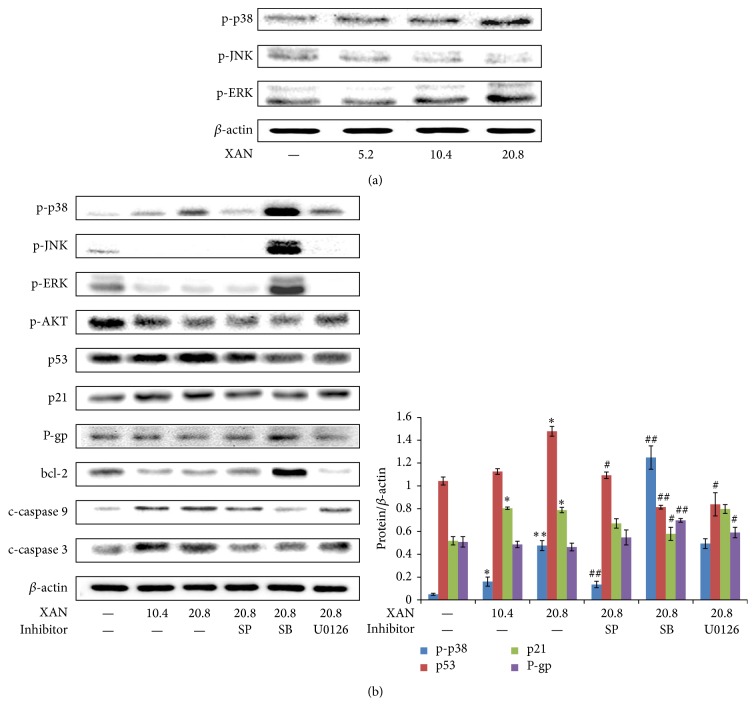
1,7-Dihydroxy-3,4-dimethoxyxanthone (XAN) is a bioactive compound isolated from Securidaca inappendiculata Hassk. and validated with antiproliferative activities on a panel of cancer cell lines. This study was designed to investigate its growth inhibitory effects on multidrug resistance (MDR) non-small cell lung carcinoma (NSCLC) cell line A549/Taxol and explore the possible linkage between modulation of MAPKs and the bioactivities. Its growth inhibitory potency on the cells was estimated by MTT assay, and flow cytometric analysis was employed to investigate its potential cell cycle arrest and proapoptosis effects. Expressions of hallmark proteins were assessed by Western-Blot method. The results showed A549/Taxol cells were sensitive to XAN. XAN inhibited the proliferation of A549/Taxol cells in the time and concentration dependent manners. It acted as a potent inducer of apoptosis and cell cycle arrest in the cells. Western-Blot investigation validated the proapoptosis and cell cycle arrest activities of XAN and the potential of MDR reversion. Upregulation of p38 by XAN, which accounted for the cell cycle arrest at G2 phase, and the downregulation of ERK associated with the proapoptosis activity were also revealed. Further analysis found p53 may be the central role mediated the bioactivities of MAPKs in A549/Taxol cells. Based on these evidences, a conclusion has been deduced that XAN could be a potential agent for MDR NSCLC therapy targeting specifically MAPKs.
1,7 - 二羟基 - 3,4 - 二甲氧基呫吨酮(XAN)是从无柄蝉翼藤中分离出的一种生物活性化合物,并已在一组癌细胞系上验证了其抗增殖活性。本研究旨在探讨其对多药耐药(MDR)非小细胞肺癌(NSCLC)细胞系A549/Taxol的生长抑制作用,并探索丝裂原活化蛋白激酶(MAPKs)的调节与生物活性之间的可能联系。通过MTT法评估其对细胞的生长抑制效力,并采用流式细胞术分析研究其潜在的细胞周期阻滞和促凋亡作用。通过蛋白质免疫印迹法评估标志性蛋白的表达。结果表明A549/Taxol细胞对XAN敏感。XAN以时间和浓度依赖性方式抑制A549/Taxol细胞的增殖。它是细胞凋亡和细胞周期阻滞的有效诱导剂。蛋白质免疫印迹研究验证了XAN的促凋亡和细胞周期阻滞活性以及多药耐药逆转的潜力。还揭示了XAN上调p38导致细胞周期阻滞在G2期,以及下调与促凋亡活性相关的细胞外信号调节激酶(ERK)。进一步分析发现p53可能是介导A549/Taxol细胞中MAPKs生物活性的核心因子。基于这些证据,得出结论:XAN可能是一种针对MAPKs的多药耐药NSCLC治疗的潜在药物。