Sztatelman Olga, Łabuz Justyna, Hermanowicz Paweł, Banaś Agnieszka Katarzyna, Bażant Aneta, Zgłobicki Piotr, Aggarwal Chhavi, Nadzieja Marcin, Krzeszowiec Weronika, Strzałka Wojciech, Gabryś Halina
Department of Plant Biotechnology, Faculty of Biochemistry, Biophysics and Biotechnology, Jagiellonian University, Gronostajowa 7, 30-387 Krakow, Poland Institute of Biochemistry and Biophysics, Polish Academy of Sciences, Pawińskiego 5a, 02-106 Warsaw, Poland
Department of Plant Biotechnology, Faculty of Biochemistry, Biophysics and Biotechnology, Jagiellonian University, Gronostajowa 7, 30-387 Krakow, Poland Malopolska Centre of Biotechnology, Jagiellonian University, Gronostajowa 7A, 30-387 Krakow, Poland.
J Exp Bot. 2016 Sep;67(17):4963-78. doi: 10.1093/jxb/erw265. Epub 2016 Jul 12.
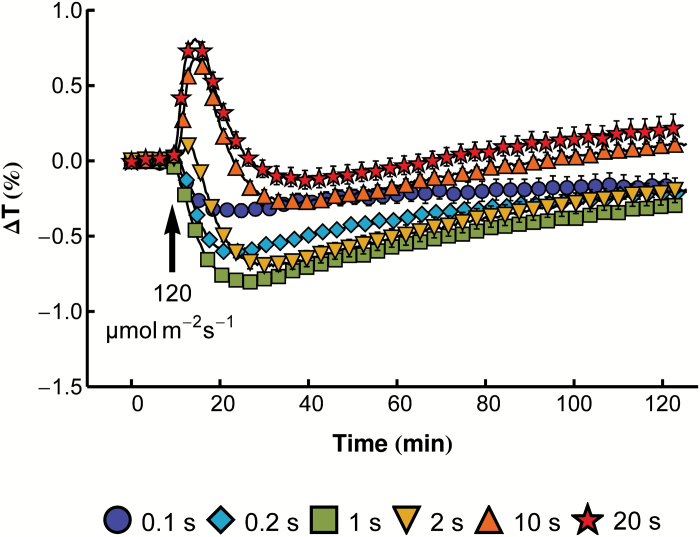
Phototropins are plant photoreceptors which regulate numerous responses to blue light, including chloroplast relocation. Weak blue light induces chloroplast accumulation, whereas strong light leads to an avoidance response. Two Arabidopsis phototropins are characterized by different light sensitivities. Under continuous light, both can elicit chloroplast accumulation, but the avoidance response is controlled solely by phot2. As well as continuous light, brief light pulses also induce chloroplast displacements. Pulses of 0.1s and 0.2s of fluence rate saturating the avoidance response lead to transient chloroplast accumulation. Longer pulses (up to 20s) trigger a biphasic response, namely transient avoidance followed by transient accumulation. This work presents a detailed study of transient chloroplast responses in Arabidopsis. Phototropin mutants display altered chloroplast movements as compared with the wild type: phot1 is characterized by weaker responses, while phot2 exhibits enhanced chloroplast accumulation, especially after 0.1s and 0.2s pulses. To determine the cause of these differences, the abundance and phosphorylation levels of both phototropins, as well as the interactions between phototropin molecules are examined. The formation of phototropin homo- and heterocomplexes is the most plausible explanation of the observed phenomena. The physiological consequences of this interplay are discussed, suggesting the universal character of this mechanism that fine-tunes plant reactions to blue light. Additionally, responses in mutants of different protein phosphatase 2A subunits are examined to assess the role of protein phosphorylation in signaling of chloroplast movements.
向光素是植物光感受器,可调节对蓝光的多种反应,包括叶绿体重新定位。弱蓝光诱导叶绿体积累,而强光则导致回避反应。两种拟南芥向光素具有不同的光敏感性。在持续光照下,两者都能引发叶绿体积累,但回避反应仅由向光素2控制。除了持续光照外,短暂的光脉冲也会诱导叶绿体移位。0.1秒和0.2秒的光通量脉冲使回避反应达到饱和,会导致叶绿体短暂积累。较长的脉冲(长达20秒)会引发双相反应,即短暂回避后接着短暂积累。这项工作对拟南芥中叶绿体的短暂反应进行了详细研究。与野生型相比,向光素突变体表现出叶绿体运动的改变:向光素1的特点是反应较弱,而向光素2则表现出增强的叶绿体积累,尤其是在0.1秒和0.2秒的脉冲之后。为了确定这些差异的原因,研究了两种向光素的丰度和磷酸化水平,以及向光素分子之间的相互作用。向光素同二聚体和异二聚体的形成是对观察到的现象最合理的解释。讨论了这种相互作用的生理后果,表明这种微调植物对蓝光反应的机制具有普遍性。此外,还研究了不同蛋白磷酸酶2A亚基突变体的反应,以评估蛋白质磷酸化在叶绿体运动信号传导中的作用。