Kasi Pashtoon M, Kotani Daisuke, Cecchini Michael, Shitara Kohei, Ohtsu Atsushi, Ramanathan Ramesh K, Hochster Howard S, Grothey Axel, Yoshino Takayuki
Division of Medical Oncology, Mayo Clinic, 200 First St SW, Rochester, 55905, MN, USA.
Department of Gastrointestinal Oncology, National Cancer Center Hospital East, Kashiwa, Chiba, Japan.
BMC Cancer. 2016 Jul 13;16:467. doi: 10.1186/s12885-016-2491-y.
TAS-102 (trifluridine and tipiracil hydrochloride; a novel combination oral nucleoside anti-tumor agent) has recently received regulatory approval for patients with refractory metastatic colorectal cancer (mCRC). Internal review of data at a single-institution showed a trend towards better overall survival (OS) for patients who experienced chemotherapy-induced neutropenia at 1-month (CIN-1-month). To explore this finding further, a cohort study was designed based on outcome data from three centers in United States and one from Japan.
CIN-1-month after starting TAS-102 was defined by the Common Terminology Criteria for Adverse Events (CTCAE), version 4.03 as a neutrophil count decrease of ≥ grade 2 (absolute neutrophil count < 1500/mm(3)). Patients had confirmed mCRC that was refractory to standard therapies. Patient demographics and clinical characteristics were compared between patients with CIN-1-month (CIN-1-month positive) versus those who did not have CIN-1-month (CIN-1-month negative); with the median progression-free survival (PFS) and OS were calculated using the Kaplan-Meier method, and differences evaluated using the Log-rank test.
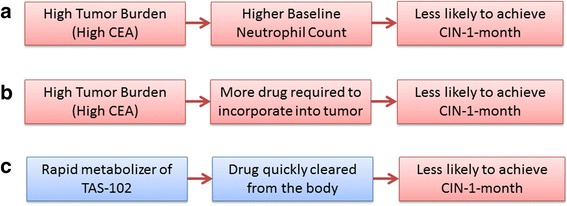
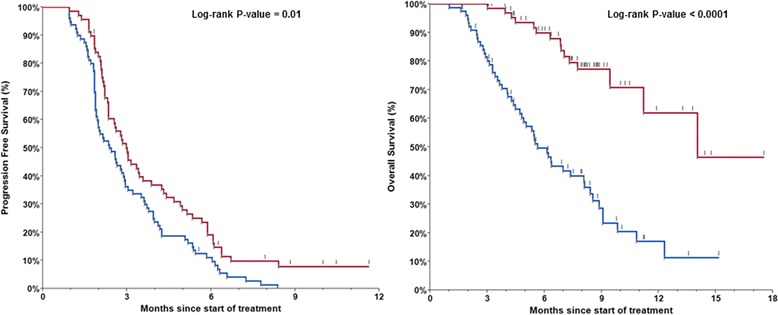
Our cohort study had a total of 149 patients with data regarding their neutrophil assessment at 1-month mark. Patients who developed ≥ grade 2 CIN-1-month had a both longer PFS (median 3.0 months versus 2.4 months; Log-rank P-value = 0.01), as well as OS (14.0 versus 5.6 months; Log-rank P-value < 0.0001). Only CIN-1-month (adjusted HR: 0.21 (95 % CI: 0.11-0.38) and higher baseline CEA levels (adjusted HR: 2.00 (95 % CI: 1.22-3.35) were noted to be independent predictors of OS. Furthermore, the CIN-1-month was noted to be a statistically significantly predictor of OS over a wide range of cutoffs.
Our observations are novel and hypothesis generating. Neutropenia after starting TAS-102 was associated with better prognosis in patients with refractory mCRC. It can be postulated that the dosage of TAS-102 potentially may need to be increased to achieve better outcomes in patients not experiencing any neutropenia. Further pharmacologic investigations should help elucidate these issues.
TAS-102(曲氟尿苷和盐酸替匹嘧啶;一种新型口服核苷类抗肿瘤药物)最近已获得难治性转移性结直肠癌(mCRC)患者的监管批准。一家机构的内部数据审查显示,在1个月时经历化疗引起的中性粒细胞减少(CIN-1个月)的患者总生存期(OS)有改善趋势。为了进一步探究这一发现,基于美国三个中心和日本一个中心的结果数据设计了一项队列研究。
根据不良事件通用术语标准(CTCAE)第4.03版,将开始使用TAS-102后1个月的CIN定义为中性粒细胞计数下降≥2级(绝对中性粒细胞计数<1500/mm³)。患者确诊为对标准疗法难治的mCRC。比较了CIN-1个月的患者(CIN-1个月阳性)和未出现CIN-1个月的患者(CIN-1个月阴性)的患者人口统计学和临床特征;使用Kaplan-Meier方法计算中位无进展生存期(PFS)和OS,并使用对数秩检验评估差异。
我们的队列研究共有149例患者有1个月时中性粒细胞评估的数据。出现≥2级CIN-1个月的患者PFS更长(中位3.0个月对2.4个月;对数秩P值=0.01),OS也更长(14.0对5.6个月;对数秩P值<0.0001)。仅CIN-1个月(调整后HR:0.21(95%CI:0.11-0.38))和更高的基线癌胚抗原(CEA)水平(调整后HR:2.00(95%CI:1.22-3.35))被发现是OS的独立预测因素。此外,在广泛的临界值范围内,CIN-1个月被发现是OS的统计学显著预测因素。
我们的观察结果新颖且能产生假设。开始使用TAS-102后出现的中性粒细胞减少与难治性mCRC患者的更好预后相关。可以推测,对于未出现任何中性粒细胞减少的患者,可能需要增加TAS-而进一步的药理学研究应有助于阐明这些问题。 102的剂量以获得更好的结果药研究应有助于阐明这些问题。