Patel Priyesh A, Liang Li, Khazanie Prateeti, Hammill Bradley G, Fonarow Gregg C, Yancy Clyde W, Bhatt Deepak L, Curtis Lesley H, Hernandez Adrian F
From the Duke Clinical Research Institute, Durham, NC (P.A.P., L.L., P.K., B.G.H., L.H.C., A.F.H.); Ronald Reagan University of California Los Angeles Medical Center (G.C.F.); Division of Cardiology, Department of Medicine, Northwestern University Feinberg School of Medicine, Chicago, IL (C.W.Y.); Brigham and Women's Hospital Heart & Vascular Center, Harvard Medical School, Boston, MA (D.L.B.); and Duke University Medical Center, Durham, NC (A.F.H.).
Circ Heart Fail. 2016 Jul;9(7). doi: 10.1161/CIRCHEARTFAILURE.115.002638.
Diabetes mellitus, heart failure (HF), and chronic kidney disease are common comorbidities, but overall use and safety of antihyperglycemic medications (AHMs) among patients with these comorbidities are poorly understood.
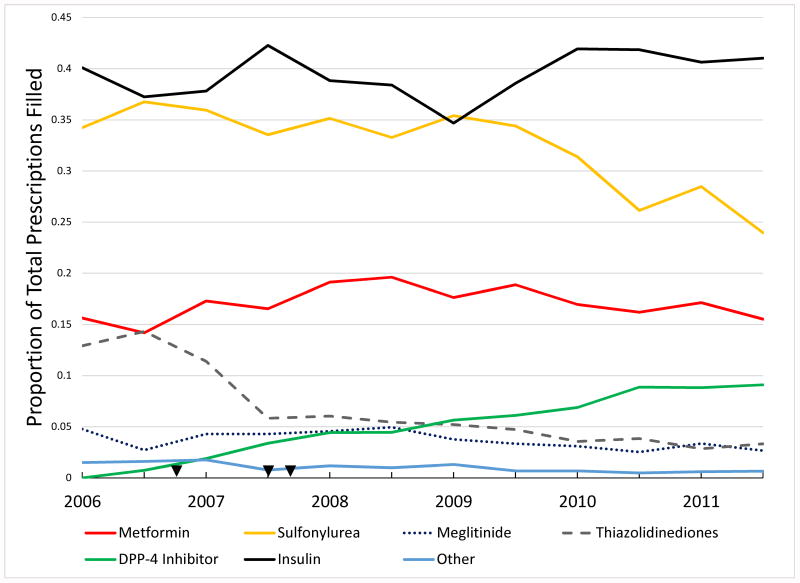
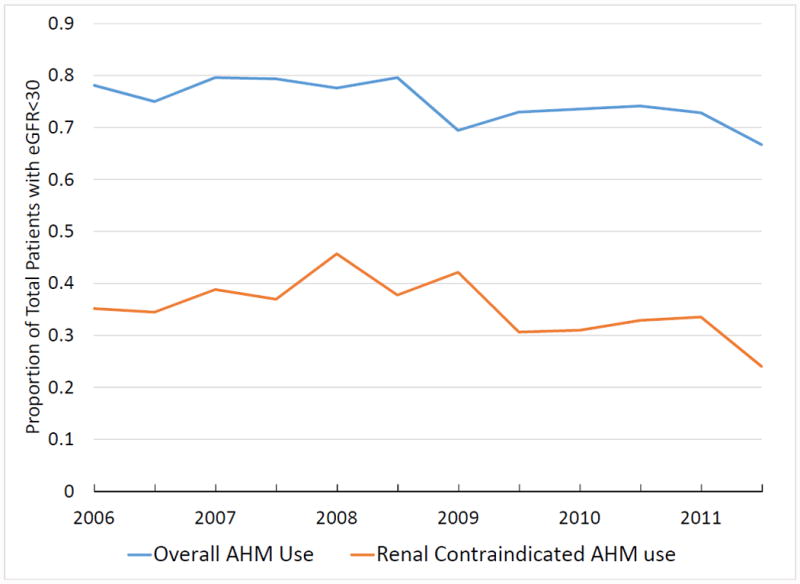
Using Get With the Guidelines-Heart Failure and linked Medicare Part D data, we assessed AHM use within 90 days of hospital discharge among HF patients with diabetes mellitus discharged from Get With the Guidelines-Heart Failure hospitals between January 1, 2006, and October 1, 2011. We further summarized use by renal function and assessed renal contraindicated AHM use for patients with estimated glomerular filtration rate <30 mL/min/1.73m(2). Among 8791 patients meeting inclusion criteria, the median age was 77 (interquartile range 71-83), 62.3% were female, median body mass index was 29.7 (interquartile range 25.5-35.3), median hemoglobin A1c was 6.8 (interquartile range 6.2-7.8), and 34% had ejection fraction <40%. 74.9% of patients filled a prescription for an AHM, with insulin (39.5%), sulfonylureas (32.4%), and metformin (17%) being the most commonly used AHMs. Insulin use was higher and sulfonylurea/metformin use was lower among patients with lower renal function classes. Among 1512 patients with estimated glomerular filtration rate <30 mL/min/1.73m(2), 35.4% filled prescriptions for renal contraindicated AHMs per prescribing information, though there was a trend toward lower renal contraindicated AHM use over time (Cochran-Mantel-Haenszel row-mean score test P=0.048). Although use of other AHMs was low overall, thiazolidinediones were used in 6.6% of HF patients, and dipeptidyl peptidase-4 inhibitors were used in 5.1%, with trends for decreasing thiazolidinedione use and increased dipeptidyl peptidase-4 inhibitor use over time (P<0.001).
Treatment of diabetes mellitus in patients with HF and chronic kidney disease is complex, and these patients are commonly treated with renal contraindicated AHMs, including over 6% receiving a thiazolidinedione, despite known concerns regarding HF. More research regarding safety and efficacy of various AHMs among HF patients is needed.
糖尿病、心力衰竭(HF)和慢性肾脏病是常见的合并症,但对于患有这些合并症的患者使用抗高血糖药物(AHM)的总体情况及安全性,人们了解甚少。
利用“遵循指南-心力衰竭”(Get With the Guidelines-Heart Failure)以及与之关联的医疗保险D部分数据,我们评估了2006年1月1日至2011年10月1日期间从“遵循指南-心力衰竭”医院出院的糖尿病合并HF患者在出院后90天内使用AHM的情况。我们进一步按肾功能总结了用药情况,并评估了估算肾小球滤过率<30 mL/min/1.73m²的患者使用肾脏禁忌AHM的情况。在8791例符合纳入标准的患者中,年龄中位数为77岁(四分位间距71 - 83岁),女性占62.3%,体重指数中位数为29.7(四分位间距25.5 - 35.3),糖化血红蛋白A1c中位数为6.8(四分位间距6.2 - 7.8),34%的患者射血分数<40%。74.9%的患者开具了AHM处方,其中胰岛素(39.5%)、磺脲类药物(32.4%)和二甲双胍(17%)是最常用的AHM。肾功能分级较低的患者中胰岛素使用较多,磺脲类/二甲双胍使用较少。在1512例估算肾小球滤过率<30 mL/min/1.73m²的患者中,根据处方信息,35.4%的患者开具了肾脏禁忌AHM处方,不过随着时间推移肾脏禁忌AHM的使用有减少趋势( Cochr an-Mantel-Haenszel行均数得分检验P = 0.048)。虽然其他AHM的总体使用量较低,但噻唑烷二酮类药物在6.6%的HF患者中使用,二肽基肽酶-4抑制剂在5.1%的患者中使用,随着时间推移噻唑烷二酮类药物使用有减少趋势,二肽基肽酶-4抑制剂使用有增加趋势(P<0.001)。
HF和慢性肾脏病患者的糖尿病治疗较为复杂,这些患者常使用肾脏禁忌的AHM,包括超过6%的患者接受了噻唑烷二酮类药物治疗,尽管已知其对HF存在风险。需要对HF患者中各种AHM的安全性和有效性开展更多研究。