Liljegren Mikkel Meyn, de Muinck Eric Jacques, Trosvik Pål
Centre for Ecological and Evolutionary Synthesis, Dept. of Biosciences, University of Oslo, Oslo, Norway.
PLoS One. 2016 Jul 14;11(7):e0159232. doi: 10.1371/journal.pone.0159232. eCollection 2016.
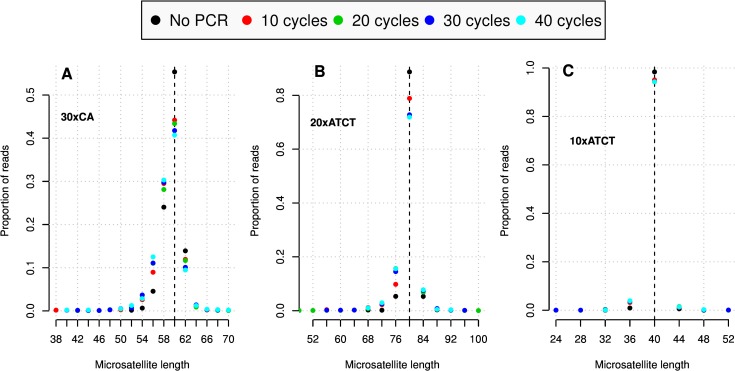
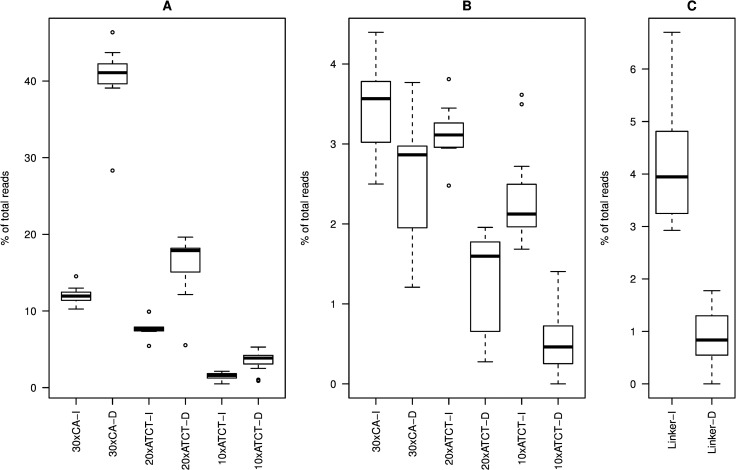
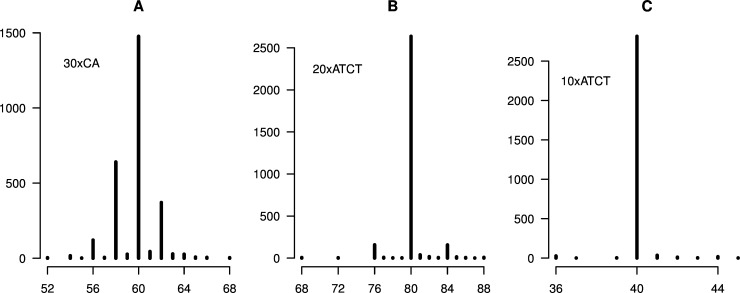
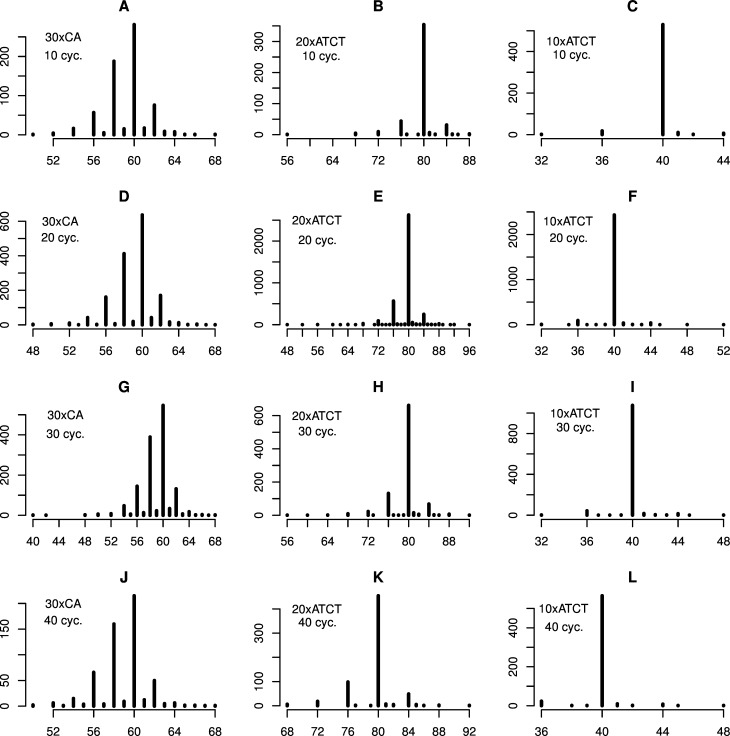
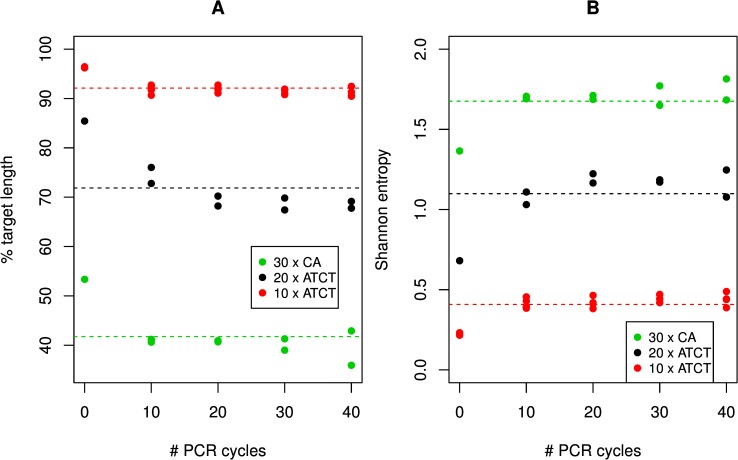
Microsatellites are DNA sequences consisting of repeated, short (1-6 bp) sequence motifs that are highly mutable by enzymatic slippage during replication. Due to their high intrinsic variability, microsatellites have important applications in population genetics, forensics, genome mapping, as well as cancer diagnostics and prognosis. The current analytical standard for microsatellites is based on length scoring by high precision electrophoresis, but due to increasing efficiency next-generation sequencing techniques may provide a viable alternative. Here, we evaluated single molecule real time (SMRT) sequencing, implemented in the PacBio series of sequencing apparatuses, as a means of microsatellite length scoring. To this end we carried out multiplexed SMRT sequencing of plasmid-carried artificial microsatellites of varying structure under different pre-sequencing PCR regimes. For each repeat structure, reads corresponding to the target length dominated. We found that pre-sequencing amplification had large effects on scoring accuracy and error distribution relative to controls, but that the effects of the number of amplification cycles were generally weak. In line with expectations enzymatic slippage decreased proportionally with microsatellite repeat unit length and increased with repetition number. Finally, we determined directional mutation trends, showing that PCR and SMRT sequencing introduced consistent but opposing error patterns in contraction and expansion of the microsatellites on the repeat motif and single nucleotide level.
微卫星是由重复的短(1 - 6个碱基对)序列基序组成的DNA序列,在复制过程中因酶促滑动而具有高度可变性。由于其高度的内在变异性,微卫星在群体遗传学、法医学、基因组作图以及癌症诊断和预后方面具有重要应用。目前微卫星的分析标准基于高精度电泳的长度评分,但由于下一代测序技术效率的提高,可能提供一种可行的替代方法。在这里,我们评估了在PacBio系列测序设备中实施的单分子实时(SMRT)测序,作为微卫星长度评分的一种手段。为此,我们在不同的预测序PCR条件下,对携带不同结构质粒的人工微卫星进行了多重SMRT测序。对于每种重复结构,对应目标长度的读数占主导。我们发现,相对于对照,预测序扩增对评分准确性和错误分布有很大影响,但扩增循环数的影响通常较弱。符合预期的是,酶促滑动与微卫星重复单元长度成比例下降,并随重复次数增加。最后,我们确定了定向突变趋势,表明PCR和SMRT测序在重复基序和单核苷酸水平上微卫星的收缩和扩展中引入了一致但相反的错误模式。