Institute of Pharmacology and Experimental Therapeutics, Faculty of Medicine, University of Coimbra, 3000-548 Coimbra, Portugal; Institute for Biomedical Imaging and Life Sciences, Faculty of Medicine, University of Coimbra, 3000-548 Coimbra, Portugal; Sorbonne Universités, Université Pierre et Marie Curie, Unité Mixte de Recherche (UMR) S 1127, Institut National de la Santé et de la Recherche Médicale U 1127, Centre National de la Recherche Scientifique UMR 7225, and Institut du Cerveau et de la Moelle épinière, 75013 Paris, France.
Sorbonne Universités, Université Pierre et Marie Curie, Unité Mixte de Recherche (UMR) S 1127, Institut National de la Santé et de la Recherche Médicale U 1127, Centre National de la Recherche Scientifique UMR 7225, and Institut du Cerveau et de la Moelle épinière , 75013 Paris, France.
eNeuro. 2016 Jul 11;3(3). doi: 10.1523/ENEURO.0141-16.2016. eCollection 2016 May-Jun.
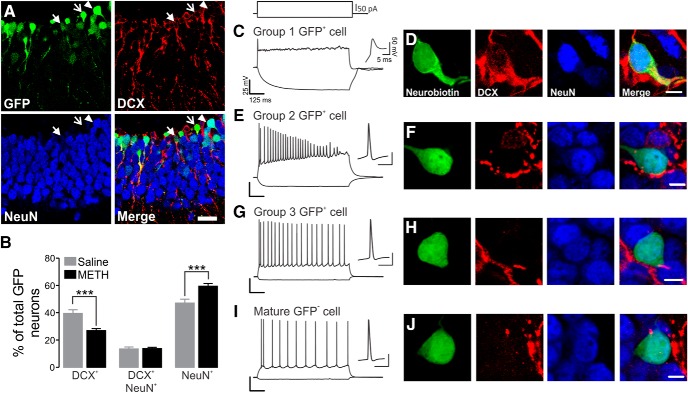
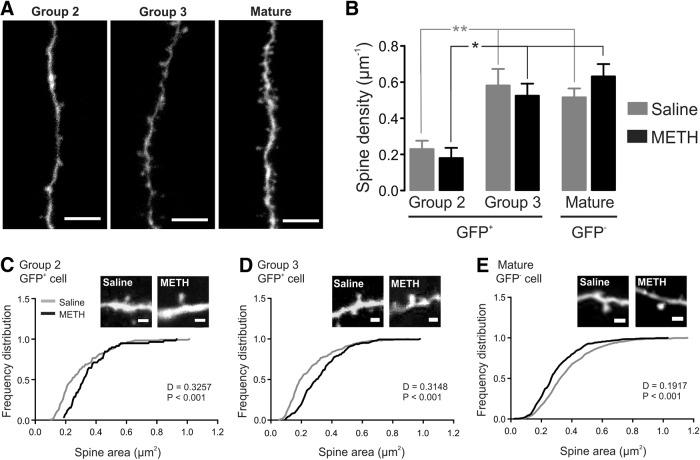
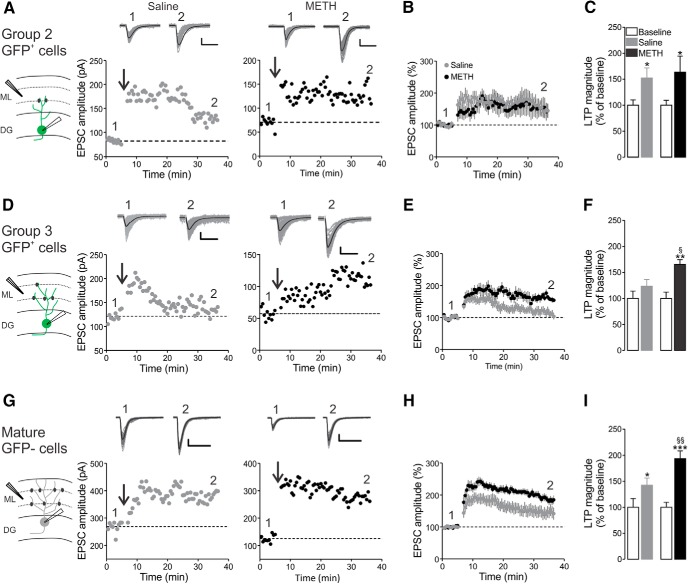
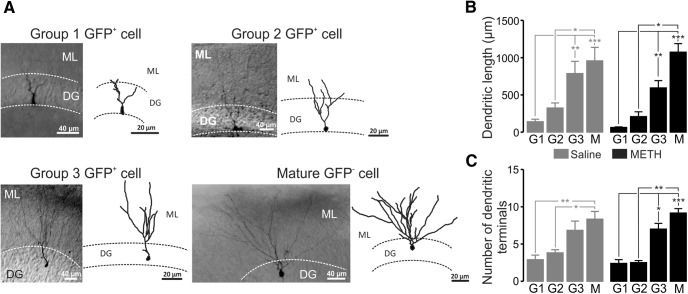
Methamphetamine (METH) is a psychostimulant, affecting hippocampal function with disparate cognitive effects, which depends on the dose and time of administration, ranging from improvement to impairment of memory. Importantly, in the United States, METH is approved for the treatment of attention deficit hyperactivity disorder. Modifications of long-term plasticity of synapses originating from the entorhinal cortex onto dentate granule cells (DGCs) have been proposed to underlie cognitive alterations similar to those seen in METH users. However, the effects of METH on synaptic plasticity of the dentate gyrus are unknown. Here, we investigated the impact of long-term administration of METH (2 mg/kg/d) on neurogenesis and synaptic plasticity of immature and mature DGCs of juvenile mice. We used a mouse model of neurogenesis (the G42 line of GAD67-GFP), in which GFP is expressed by differentiating young DGCs. METH treatment enhanced the differentiation of GFP(+) cells, as it increased the fraction of GFP(+) cells expressing the neuronal marker NeuN, and decreased the amount of immature DGCs coexpressing doublecortin. Interestingly, METH did not change the magnitude of long-term potentiation (LTP) in more immature neurons, but facilitated LTP induction in more differentiated GFP(+) and strengthened plasticity in mature GFP(-) DGCs. The METH-induced facilitation of LTP in GFP(+) neurons was accompanied with spine enlargement. Our results reveal a specific action of long-term use of METH in the long-term plasticity of excitatory synapses onto differentiating DGCs and might have important implications toward the understanding of the synaptic basis of METH-induced cognitive alterations.
甲基苯丙胺(METH)是一种精神兴奋剂,会影响海马体功能,产生不同的认知效应,具体取决于剂量和给药时间,从改善到损害记忆。重要的是,在美国,METH 被批准用于治疗注意力缺陷多动障碍。有人提出,源自内侧隔核到齿状回颗粒细胞(DGC)的突触长时程可塑性的改变可能是导致 METH 使用者出现认知改变的基础。然而,METH 对齿状回突触可塑性的影响尚不清楚。在这里,我们研究了长期给予 METH(2mg/kg/d)对幼年小鼠未成熟和成熟 DGC 的神经发生和突触可塑性的影响。我们使用了一种神经发生的小鼠模型(GAD67-GFP 的 G42 系,其中 GFP 由分化中的年轻 DGC 表达)。METH 处理增强了 GFP(+)细胞的分化,因为它增加了表达神经元标志物 NeuN 的 GFP(+)细胞的比例,并减少了同时表达双皮质素的未成熟 DGC 的数量。有趣的是,METH 并没有改变更不成熟神经元中长时程增强(LTP)的幅度,但促进了更分化的 GFP(+)神经元中 LTP 的诱导,并增强了成熟 GFP(-)DGC 的可塑性。METH 诱导的 GFP(+)神经元 LTP 易化伴随着棘突增大。我们的结果揭示了长期使用 METH 对分化中的 DGC 上兴奋性突触的长时程可塑性的特定作用,这可能对理解 METH 诱导的认知改变的突触基础具有重要意义。