Takahashi Noriyoshi, Yamamoto Takaya, Matsushita Haruo, Sugawara Toshiyuki, Kubozono Masaki, Umezawa Rei, Ishikawa Yojiro, Kozumi Maiko, Katagiri Yu, Tasaka Syun, Takeda Kazuya, Takeda Ken, Dobashi Suguru, Jingu Keiichi
Department of Radiation Oncology, Tohoku University Graduate School of Medicine, 1-1 Seiryo-machi, Aoba-ku, Sendai, 980-8574, Japan
Department of Radiation Oncology, Tohoku University Graduate School of Medicine, 1-1 Seiryo-machi, Aoba-ku, Sendai, 980-8574, Japan.
J Radiat Res. 2016 Nov;57(6):655-661. doi: 10.1093/jrr/rrw048. Epub 2016 Jul 15.
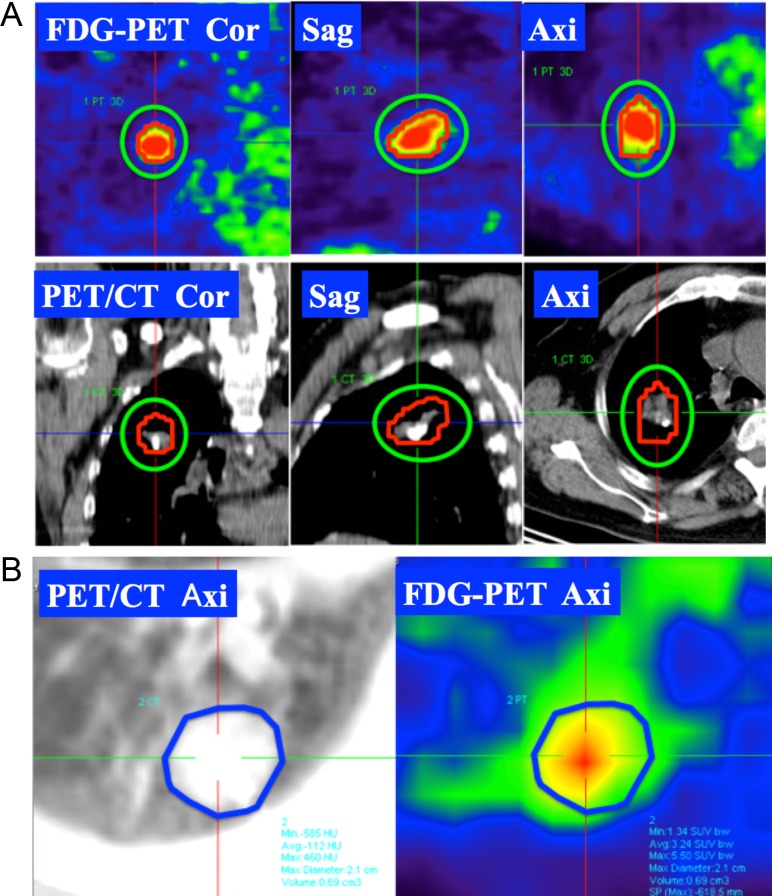
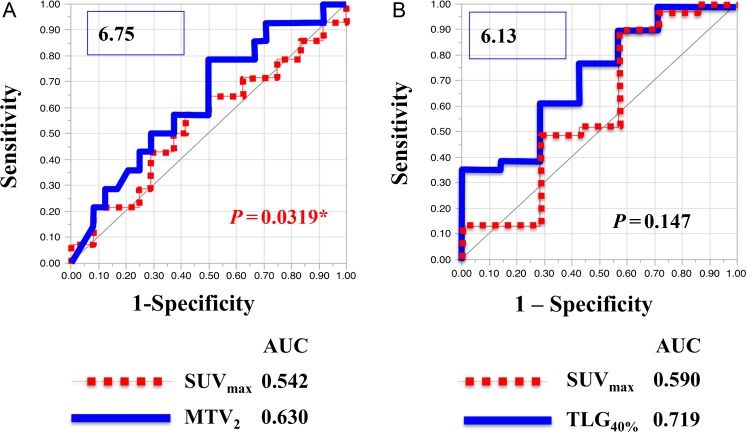
The aim of this study was to determine whether metabolic tumor volume (MTV) and total lesion glycolysis (TLG) are associated with outcomes in Stage I lung cancer patients treated with stereotactic body radiation therapy (SBRT). Thirty-eight patients underwent [F] fluorodeoxyglucose positron emission tomography/computed tomography (F-FDG-PET/CT) within 60 days before SBRT at our institution between January 2001 and December 2011. The maximum standardized uptake value (SUV), MTV, MTV, MTV, TLG, TLG and TLG were calculated. Prognostic factors for overall survival (OS) and local control (LC) were analyzed using Cox's proportional hazards model, and survival curves were calculated using the Kaplan-Meier method. Receiver operating characteristics (ROC) curves of PET parameters for OS and LC were calculated. The median follow-up period for survivors was 37.7 months. Three-year OS and LC rates were 56.4% and 70.5%, respectively, and 5-year OS and LC rates were 36.8% and 70.5%, respectively. In univariate analyses, tumor diameter (P = 0.019), single dose ≥10 Gy (P = 0.017), MTV (P = 0.030) and MTV (P = 0.048) were significant predictors for OS. Tumor diameter (P < 0.001), single dose ≥10 Gy (P = 0.007), SUV (P = 0.035), MTV (P < 0.001), MTV (P = 0.003), MTV (P = 0.017), TLG (P < 0.001), TLG (P = 0.001) and TLG (P = 0.003) were significant predictors for LC. SUVmax was not a significant predictor for OS. We made the ROC curves at PET parameters, and the largest area under the curve value for OS was MTV and for LC was TLG Tumor diameter, single dose ≥10 Gy, MTV2 and MTV are prognostic factors for OS and LC rates and MTV is a better prognostic factor for OS than other PET parameters.
本研究的目的是确定代谢肿瘤体积(MTV)和总病变糖酵解(TLG)是否与接受立体定向体部放射治疗(SBRT)的I期肺癌患者的预后相关。2001年1月至2011年12月期间,38例患者在我院接受SBRT前60天内进行了[F]氟脱氧葡萄糖正电子发射断层扫描/计算机断层扫描(F-FDG-PET/CT)。计算了最大标准化摄取值(SUV)、MTV、MTV、MTV、TLG、TLG和TLG。使用Cox比例风险模型分析总生存(OS)和局部控制(LC)的预后因素,并使用Kaplan-Meier方法计算生存曲线。计算了PET参数对OS和LC的受试者工作特征(ROC)曲线。幸存者的中位随访期为37.7个月。三年OS率和LC率分别为56.4%和70.5%,五年OS率和LC率分别为36.8%和70.5%。在单因素分析中,肿瘤直径(P = 0.019)、单次剂量≥10 Gy(P = 0.017)、MTV(P = 0.030)和MTV(P = 0.048)是OS的显著预测因素。肿瘤直径(P < 0.001)、单次剂量≥10 Gy(P = 0.007)、SUV(P = 0.035)、MTV(P < 0.001)、MTV(P = 0.003)、MTV(P = 0.017)、TLG(P < 0.001)、TLG(P = 0.001)和TLG(P = 0.003)是LC的显著预测因素。SUVmax不是OS的显著预测因素。我们绘制了PET参数的ROC曲线,OS的曲线下面积最大值是MTV,LC的是TLG。肿瘤直径、单次剂量≥10 Gy、MTV2和MTV是OS和LC率的预后因素,并且MTV是比其他PET参数更好的OS预后因素。