Peloso Gina M, Lange Leslie A, Varga Tibor V, Nickerson Deborah A, Smith Joshua D, Griswold Michael E, Musani Solomon, Polfus Linda M, Mei Hao, Gabriel Stacey, Quarells Rakale Collins, Altshuler David, Boerwinkle Eric, Daly Mark J, Neale Benjamin, Correa Adolfo, Reiner Alex P, Wilson James G, Kathiresan Sekar
From the Department of Biostatistics, Boston University School of Public Health, Boston, MA (G.M.P.); Center for Human Genetic Research (G.M.P., S.K.) and Analytic and Translational Genetics Unit, Massachusetts General Hospital, Boston, MA (M.J.D., B.N.); Program in Medical and Population Genetics, Broad Institute, Cambridge, MA (G.M.P., S.G., D.A., M.J.D., B.N., S.K.); Department of Genetics, University of North Carolina, Chapel Hill, NC (L.A.L.); Genetic and Molecular Epidemiology Unit, Department of Clinical Sciences, Lund University, Malmö, Sweden (T.V.V.); Department of Genome Sciences, University of Washington, Seattle, WA (D.A.N., J.D.S.); Center of Biostatistics & Bioinformatics (M.E.G., H.M.), Department of Medicine (S.M.), Department of Pediatrics & Medicine (A.C.), and Department of Physiology & Biophysics (J.G.W.), University of Mississippi Medical Center, Jackson, MS; Human Genetics Center, University of Texas Health Science Center, Houston, TX (L.M.P., E.B.); Cardiovascular Research Institute, Morehouse School of Medicine, Atlanta, GA (R.C.Q.); Department of Medicine, Harvard Medical School, Boston, MA (D.A., S.K.); and Department of Epidemiology, University of Washington School of Public Health, Seattle, WA (A.P.R.).
Circ Cardiovasc Genet. 2016 Aug;9(4):368-74. doi: 10.1161/CIRCGENETICS.116.001410. Epub 2016 Jul 15.
The correlation of null alleles with human phenotypes can provide insight into gene function in humans. In individuals of African ancestry, we set out to identify null and damaging missense variants, and test these variants for association with a range of cardiovascular phenotypes.
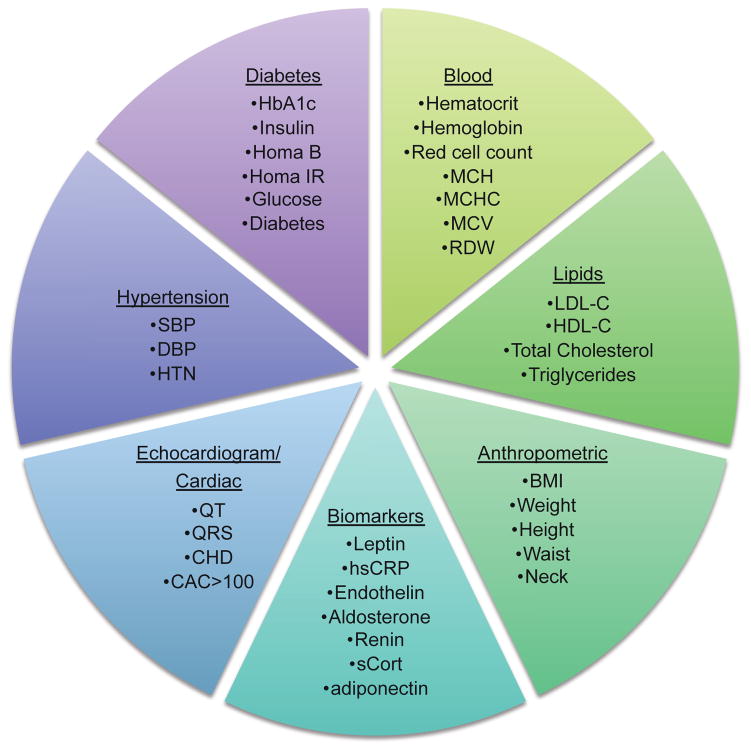
We performed whole-exome sequencing in 3223 black individuals from the Jackson Heart Study and found a total of 729 666 variant sites with minor allele frequency <5%, including 17 263 null variants and 49 929 missense variants predicted to be damaging by in silico algorithms. We tested null and damaging missense variants within each gene for association with 36 cardiovascular traits. We found 3 associations that met our prespecified level of significance (α=1.1×10(-7)). Null and damaging missense variants in PCSK9 were associated with 36 mg/dL lower low-density lipoprotein cholesterol (P=3×10(-21)). Three individuals in their 50s with complete PCSK9 deficiency (each compound heterozygote for PCSK9 p.Y142X and p.C679X) were identified, with one having a coronary artery calcification score in the 83rd percentile despite a low-density lipoprotein cholesterol of 32 mg/dL. A damaging missense variant in HBQ1 (p.G52A) was associated with a 2 pg/cell lower mean corpuscular hemoglobin (P=9×10(-13)) and rare damaging missense variants in VPS13A with higher red blood cell distribution width (P=9.9×10(-8)).
A limited number of null/damaging alleles with a large effect on cardiovascular traits were detectable in ≈3000 black individuals.
无效等位基因与人类表型的相关性可为深入了解人类基因功能提供线索。在非洲裔个体中,我们旨在鉴定无效和有害的错义变异,并测试这些变异与一系列心血管表型的关联性。
我们对来自杰克逊心脏研究的3223名黑人个体进行了全外显子组测序,共发现729666个次要等位基因频率<5%的变异位点,其中包括17263个无效变异和49929个经计算机算法预测为有害的错义变异。我们测试了每个基因内的无效和有害错义变异与36种心血管特征的关联性。我们发现3种关联符合我们预先设定的显著性水平(α=1.1×10⁻⁷)。前蛋白转化酶枯草溶菌素9(PCSK9)中的无效和有害错义变异与低密度脂蛋白胆固醇水平降低36mg/dL相关(P=3×10⁻²¹)。我们鉴定出3名50多岁的PCSK9完全缺乏个体(均为PCSK9 p.Y142X和p.C679X的复合杂合子),其中1名个体尽管低密度脂蛋白胆固醇水平为32mg/dL,但冠状动脉钙化评分处于第83百分位。血红蛋白β1(HBQ1)中的一个有害错义变异(p.G52A)与平均红细胞血红蛋白降低2pg/细胞相关(P=9×10⁻¹³),而液泡分选蛋白13A(VPS13A)中的罕见有害错义变异与红细胞分布宽度增加相关(P=9.9×10⁻⁸)。
在约3000名黑人个体中可检测到数量有限但对心血管特征有较大影响的无效/有害等位基因。