Watson Ryan J, Adjei Jones, Saewyc Elizabeth, Homma Yuko, Goodenow Carol
University of British Columbia, Vancouver, British Columbia, Canada, V6T 2B5.
School of Nursing, Mukogawa Women's University, Japan.
Int J Eat Disord. 2017 Jan;50(1):22-31. doi: 10.1002/eat.22576. Epub 2016 Jul 18.
Disordered eating has decreased for all youth over time, but studies have not focused specifically on lesbian, gay, and bisexual (LGB) youth. Research has found that LGB youth report disordered eating behaviors more often compared to their heterosexual counterparts, but no studies have documented trends over time for LGB youth and considered whether these disparities are narrowing or widening across sexual orientation groups.
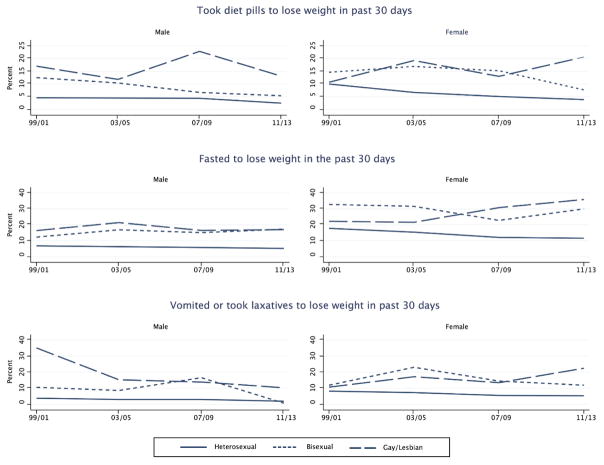
We use pooled data from the 1999 to 2013 Massachusetts Youth Risk Behavior Surveys (N = 26,002) to investigate trends in purging, fasting, and using diet pills to lose or control weight for heterosexual and sexual minority youth. We used crosstabs, logistic regression, and interactions in regression models, stratified by sex.
The prevalence of disordered eating has decreased on all three measures across nearly all groups of heterosexual and sexual minority youth. However, we found disparities in reported disordered eating behaviors for LGB youth persisted across all survey years, with LGB students reporting significantly higher prevalence of disordered eating than heterosexuals. The disparities in fasting to control weight widened between the first and last survey waves between lesbian adolescents and heterosexual females.
The significant reductions over time in prevalence of disordered eating among some youth are encouraging, but the disparities remain. Indeed, the increasing prevalence of fasting, diet pill use, and purging to control weight among lesbians may warrant targeted prevention and intervention programs. © 2016 Wiley Periodicals, Inc. (Int J Eat Disord 2017; 50:22-31).
随着时间推移,所有青少年的饮食失调情况都有所减少,但研究尚未特别关注女同性恋、男同性恋和双性恋(LGB)青少年。研究发现,与异性恋青少年相比,LGB青少年报告饮食失调行为的频率更高,但尚无研究记录LGB青少年随时间的变化趋势,也未考虑这些差异在不同性取向群体中是在缩小还是扩大。
我们使用1999年至2013年马萨诸塞州青少年风险行为调查的汇总数据(N = 26,002),调查异性恋和性少数群体青少年在催吐、禁食和使用减肥药来减轻或控制体重方面的趋势。我们在回归模型中使用列联表、逻辑回归和交互作用,并按性别分层。
几乎所有异性恋和性少数群体青少年在这三项指标上的饮食失调患病率都有所下降。然而,我们发现LGB青少年报告的饮食失调行为差异在所有调查年份中都持续存在,LGB学生报告的饮食失调患病率显著高于异性恋学生。在第一次和最后一次调查期间,女同性恋青少年和异性恋女性在通过禁食控制体重方面的差异有所扩大。
一些青少年饮食失调患病率随时间的显著下降令人鼓舞,但差异仍然存在。事实上,女同性恋者中通过禁食、使用减肥药和催吐来控制体重的患病率不断上升,可能需要有针对性的预防和干预项目。© 2016威利期刊公司(《国际进食障碍杂志》2017年;50:22 - 31)