Wang Dong, Li Chengbo, Zhang Yuan, Wang Min, Jiang Nan, Xiang Lin, Li Ting, Roberts Thomas M, Zhao Jean J, Cheng Hailing, Liu Pixu
Cancer Institute, The Second Hospital of Dalian Medical University, Institute of Cancer Stem Cell, Dalian Medical University, Dalian 116044, China; Department of Histology and Embryology, Binzhou Medical University, Yantai 264000, China.
Department of Obstetrics & Gynecology, The Second Hospital of Dalian Medical University, Dalian 116044, China.
Gynecol Oncol. 2016 Sep;142(3):548-56. doi: 10.1016/j.ygyno.2016.07.092. Epub 2016 Jul 15.
Combined inhibition of PI3K and PARP has been shown to be effective in the treatment of preclinical models of breast cancer and prostate cancer independent of BRCA or PIK3CA mutational status. However, the knowledge about this combination treatment in ovarian cancer is limited. The aim of this study was to evaluate the therapeutic effect of PI3K inhibitor BKM120 and PARP inhibitor Olaparib on ovarian cancer cell lines bearing wild-type PIK3CA genes.
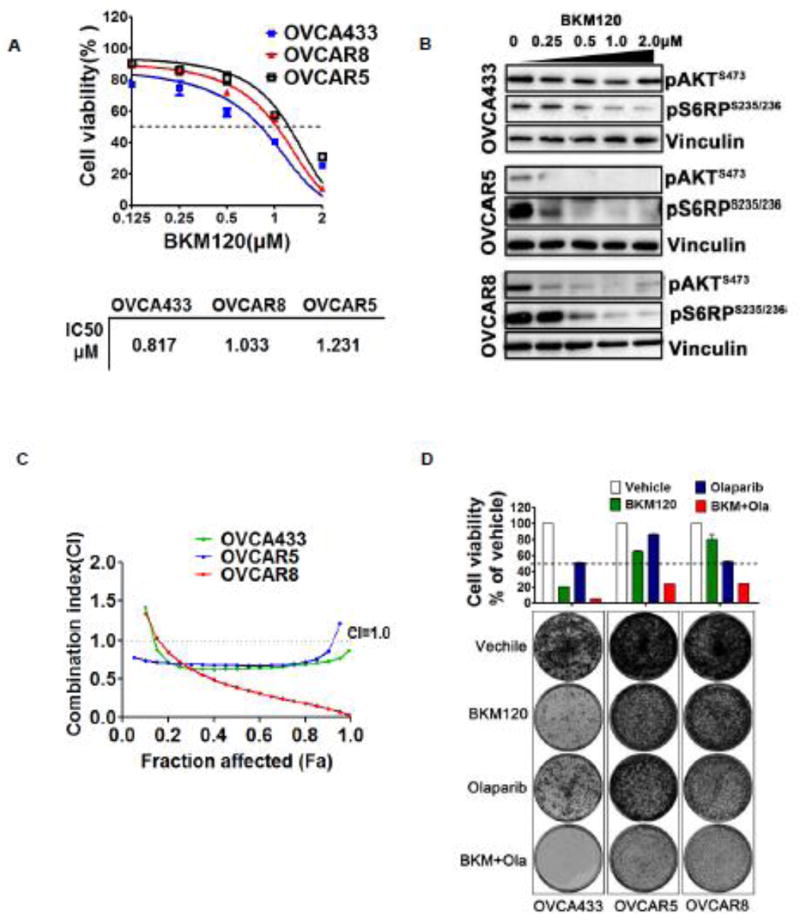
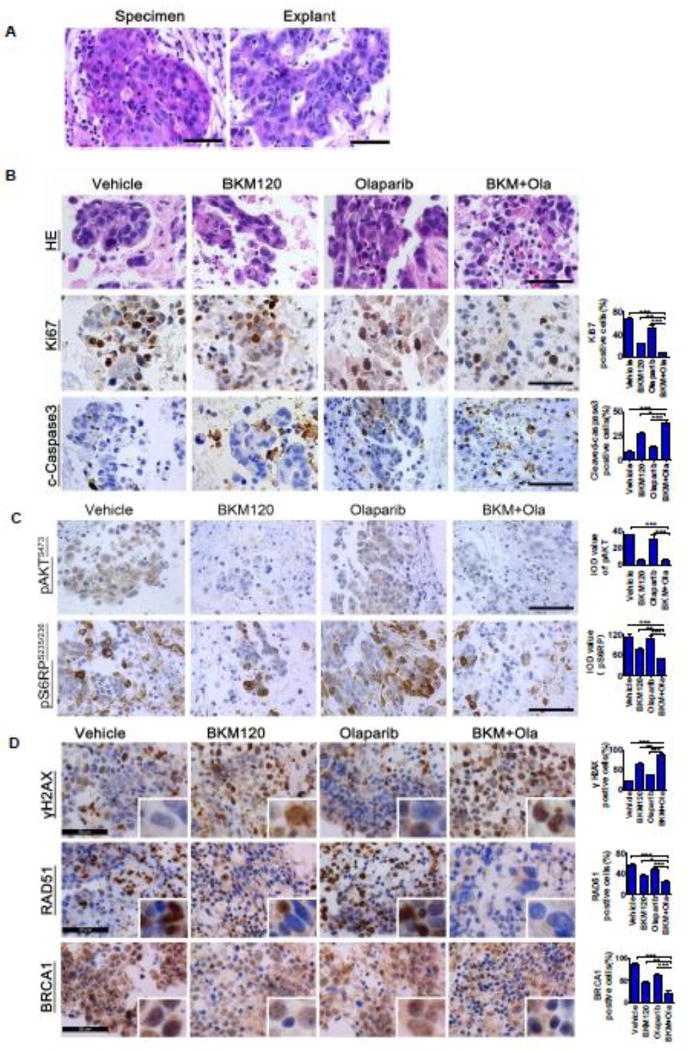
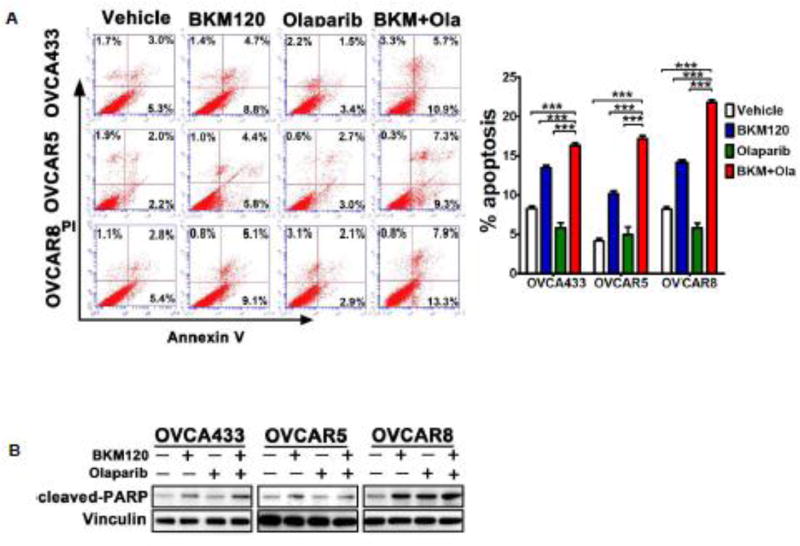
We exposed three wild-type PIK3CA ovarian cancer cell lines to a PI3K inhibitor BKM120 and/or a PARP inhibitor Olaparib. The effect of BKM120 as a single-agent or in combination with Olaparib was evaluated by Cell Count Kit (CCK8) assay, immunoblotting, comet assay, flow cytometry and immunofluorescence staining assay. The combination indexes for synergistic effect on cell viability were calculated with the Chou-Talalay method. Ex vivo cultured ovarian cancer tissues from patients were analyzed by histological and immunohistochemical analyses.
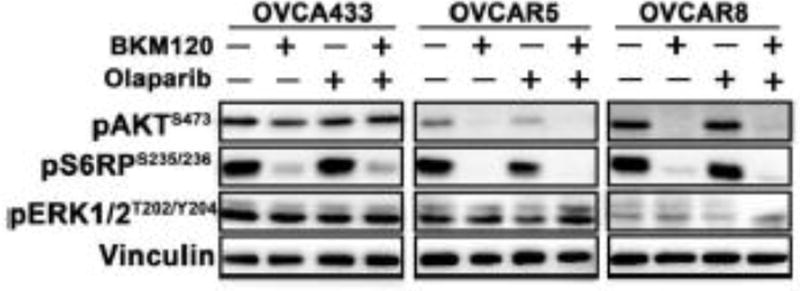
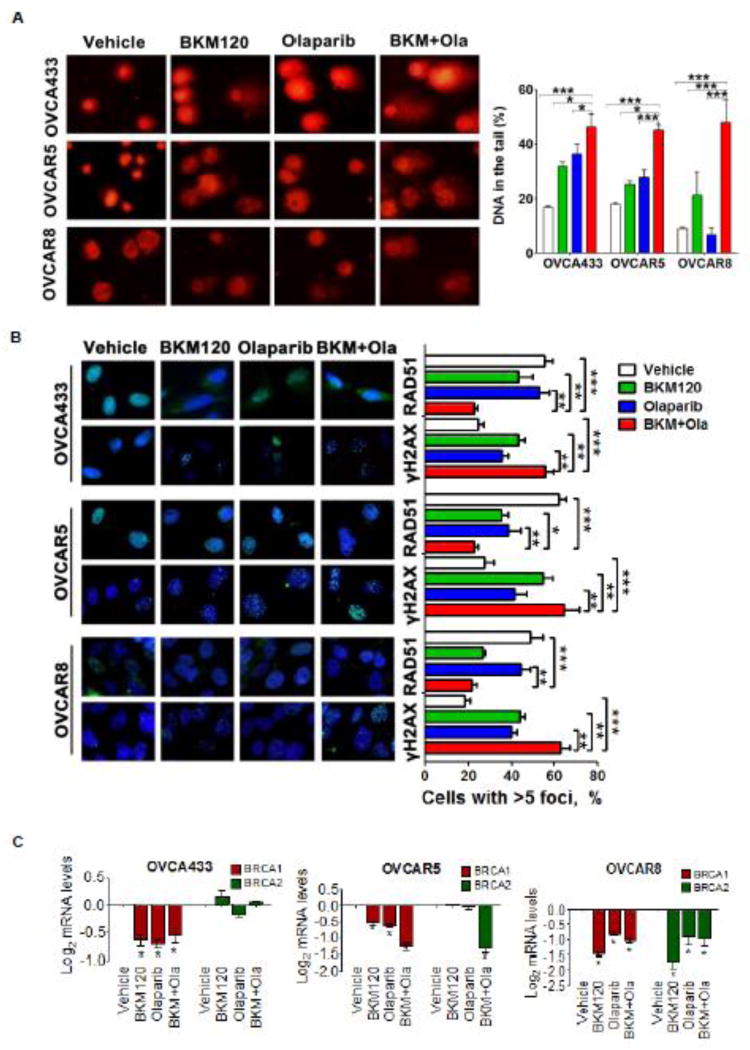
Combined inhibition of PI3K and PARP effectively synergized to block the growth of three wild-type PIK3CA ovarian cancer cell lines and explants of a primary ovarian tumor specimen. Mechanistically, dual blockade of PI3K and PARP in these ovarian cancer cell lines resulted in substantially attenuated PI3K/AKT/mTOR signaling, impaired DNA damage response and deficient homologous recombination repair, with remarkable BRCA downregulation.
The combined use of PI3K inhibitor BKM120 and PARP inhibitor Olaparib may be effective in ovarian cancers with a broader spectrum of cancer-associated genetic alterations but not limited to those with mutant PIK3CA or BRCA genes. BRCA downregulation may be a potential biomarker for the effective response to the proposed combination treatment.
已证明联合抑制PI3K和PARP在治疗乳腺癌和前列腺癌的临床前模型中有效,且与BRCA或PIK3CA突变状态无关。然而,关于这种联合治疗在卵巢癌中的知识有限。本研究的目的是评估PI3K抑制剂BKM120和PARP抑制剂奥拉帕尼对携带野生型PIK3CA基因的卵巢癌细胞系的治疗效果。
我们将三种野生型PIK3CA卵巢癌细胞系暴露于PI3K抑制剂BKM120和/或PARP抑制剂奥拉帕尼。通过细胞计数试剂盒(CCK8)检测、免疫印迹、彗星试验、流式细胞术和免疫荧光染色试验评估BKM120单药或与奥拉帕尼联合使用的效果。采用Chou-Talalay方法计算对细胞活力的协同作用的联合指数。对患者的离体培养卵巢癌组织进行组织学和免疫组织化学分析。
联合抑制PI3K和PARP有效地协同阻断了三种野生型PIK3CA卵巢癌细胞系和一个原发性卵巢肿瘤标本外植体的生长。机制上,在这些卵巢癌细胞系中双重阻断PI3K和PARP导致PI3K/AKT/mTOR信号通路显著减弱、DNA损伤反应受损和同源重组修复缺陷,同时BRCA明显下调。
PI3K抑制剂BKM120和PARP抑制剂奥拉帕尼联合使用可能对具有更广泛癌症相关基因改变的卵巢癌有效,而不限于那些具有PIK3CA或BRCA基因突变的癌症。BRCA下调可能是对所提出的联合治疗有效反应的潜在生物标志物。