Ayyadevara Srinivas, Balasubramaniam Meenakshisundaram, Johnson Jay, Alla Ramani, Mackintosh Samuel G, Shmookler Reis Robert J
McClellan Veterans Medical Center, Central Arkansas Veterans Healthcare Service, Little Rock, AR, USA.
BioInformatics Program, University of Arkansas for Medical Sciences and University of Arkansas at Little Rock, Little Rock, AR, USA.
Oncotarget. 2016 Aug 2;7(31):48870-48886. doi: 10.18632/oncotarget.10549.
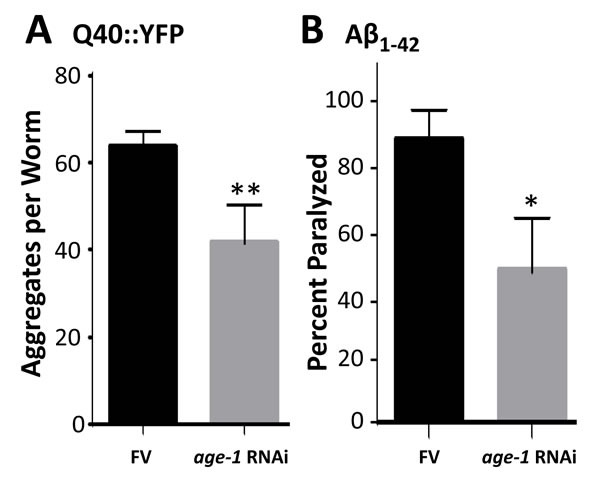
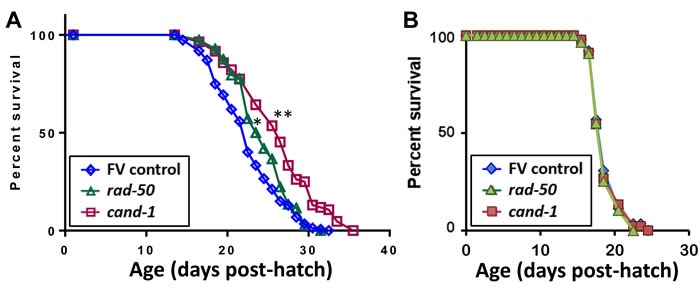
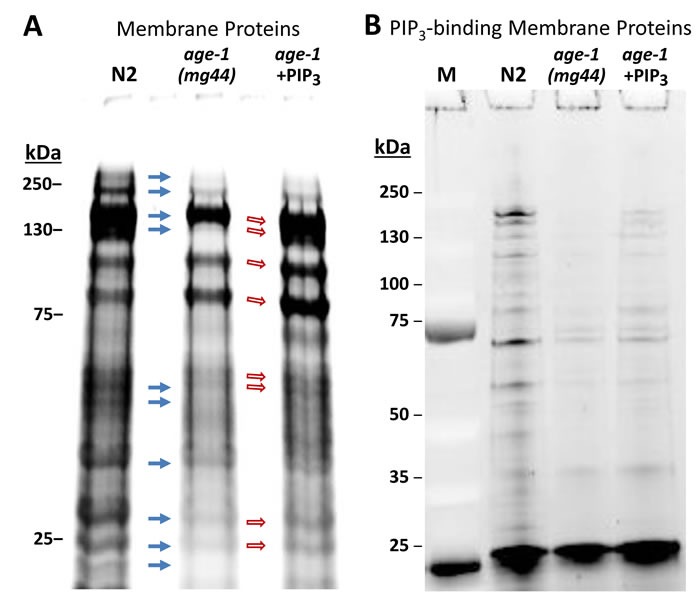
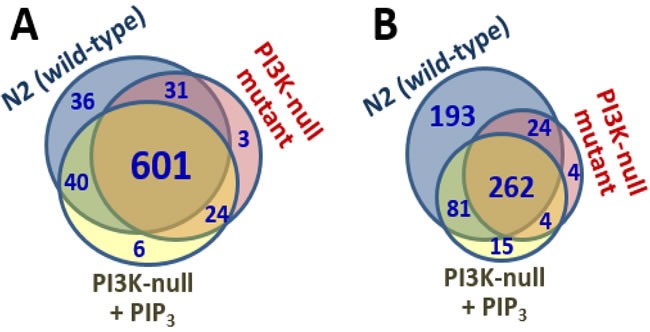
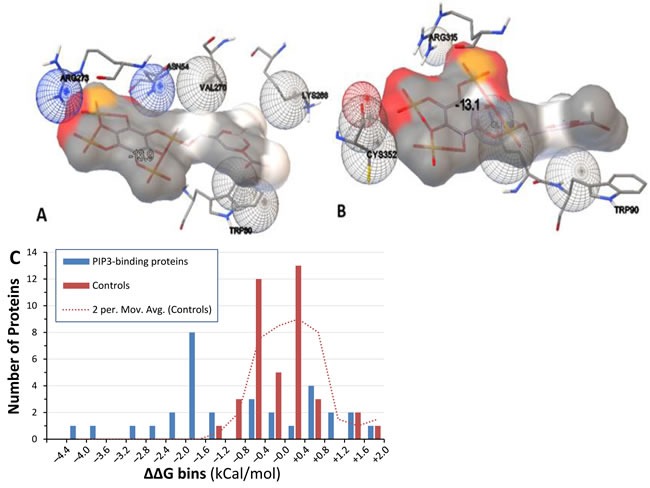
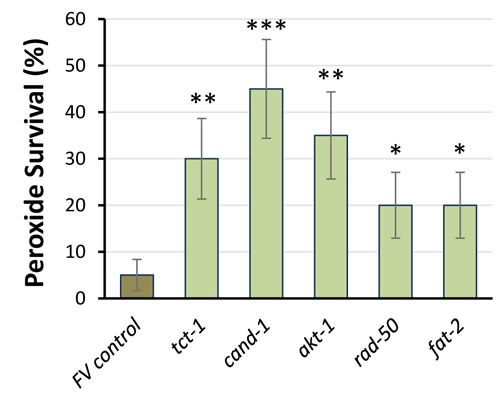
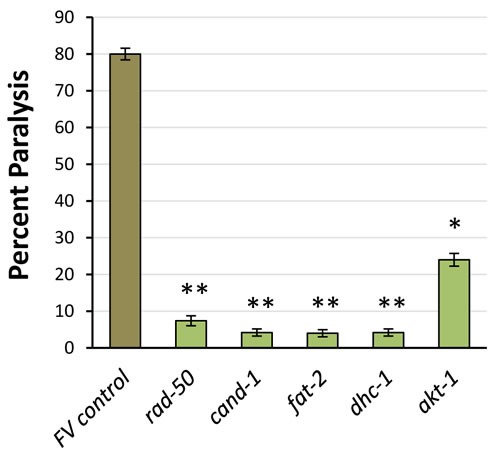
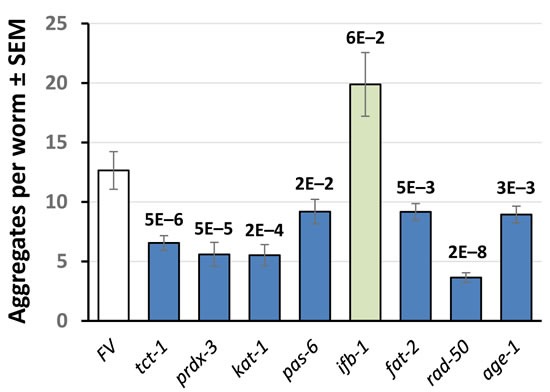
Class-I phosphatidylinositol 3-kinase (PI3KI) converts phosphatidylinositol 4,5-bisphosphate (PIP2) to phosphatidylinositol 3,4,5-triphosphate (PIP3). PIP3 comprises two fatty-acid chains that embed in lipid-bilayer membranes, joined by glycerol to inositol triphosphate. Proteins with domains that specifically bind that head-group (e.g. pleckstrin-homology [PH] domains) are thus tethered to the inner plasma-membrane surface where they have an enhanced likelihood of interaction with other PIP3-bound proteins, in particular other components of their signaling pathways. Null alleles of the C. elegans age-1 gene, encoding the catalytic subunit of PI3KI, lack any detectable class-I PI3K activity and so cannot form PIP3. These mutant worms survive almost 10-fold longer than the longest-lived normal control, and are highly resistant to a variety of stresses including oxidative and electrophilic challenges. Traits associated with age-1 mutation are widely believed to be mediated through AKT-1, which requires PIP3 for both tethering and activation. Active AKT complex phosphorylates and thereby inactivates the DAF-16/FOXO transcription factor. However, extensive evidence indicates that pleiotropic effects of age-1-null mutations, including extreme longevity, cannot be explained by insulin like-receptor/AKT/FOXO signaling alone, suggesting involvement of other PIP3-binding proteins. We used ligand-affinity capture to identify membrane-bound proteins downstream of PI3KI that preferentially bind PIP3. Computer modeling supports a subset of candidate proteins predicted to directly bind PIP3 in preference to PIP2, and functional testing by RNAi knockdown confirmed candidates that partially mediate the stress-survival, aggregation-reducing and longevity benefits of PI3KI disruption. PIP3-specific candidate sets are highly enriched for proteins previously reported to affect translation, stress responses, lifespan, proteostasis, and lipid transport.
I 类磷脂酰肌醇 3 -激酶(PI3KI)将磷脂酰肌醇 4,5 -二磷酸(PIP2)转化为磷脂酰肌醇 3,4,5 -三磷酸(PIP3)。PIP3 由两条嵌入脂质双分子层膜中的脂肪酸链组成,通过甘油与肌醇三磷酸相连。具有特异性结合该头部基团结构域的蛋白质(例如普列克底物蛋白同源[PH]结构域)因此被拴系在内质膜表面,在那里它们更有可能与其他与 PIP3 结合的蛋白质相互作用,特别是其信号通路的其他成分。秀丽隐杆线虫 age -1 基因的无效等位基因编码 PI3KI 的催化亚基,缺乏任何可检测到的 I 类 PI3K 活性,因此无法形成 PIP3。这些突变蠕虫的存活时间几乎比寿命最长的正常对照长 10 倍,并且对包括氧化应激和亲电应激在内的多种应激具有高度抗性。人们普遍认为,与 age -1 突变相关的性状是通过 AKT -1 介导的,AKT -1 的拴系和激活都需要 PIP3。活性 AKT 复合物使 DAF -16/FOXO 转录因子磷酸化从而使其失活。然而,大量证据表明,age -1 无效突变的多效性效应,包括超长寿命,不能仅通过胰岛素样受体/AKT/FOXO 信号通路来解释,这表明其他 PIP3 结合蛋白也参与其中。我们使用配体亲和捕获法来鉴定 PI3KI 下游优先结合 PIP3 的膜结合蛋白。计算机建模支持了一组预测优先直接结合 PIP3 而非 PIP2 的候选蛋白,通过 RNAi 敲低进行的功能测试证实了部分介导 PI3KI 破坏所带来的应激存活、减少聚集和延长寿命益处的候选蛋白。PIP3 特异性候选蛋白集高度富集了先前报道的影响翻译、应激反应、寿命、蛋白质稳态和脂质转运的蛋白质。