Zhang Tianjiao, Hu Yang, Wu Xiaoliang, Ma Rui, Jiang Qinghua, Wang Yadong
School of Computer Science and Technology, Harbin Institute of Technology, Harbin 150001, China.
School of Life Science and Technology, Harbin Institute of Technology, Harbin 150001, China.
Biomed Res Int. 2016;2016:2395341. doi: 10.1155/2016/2395341. Epub 2016 Jun 27.
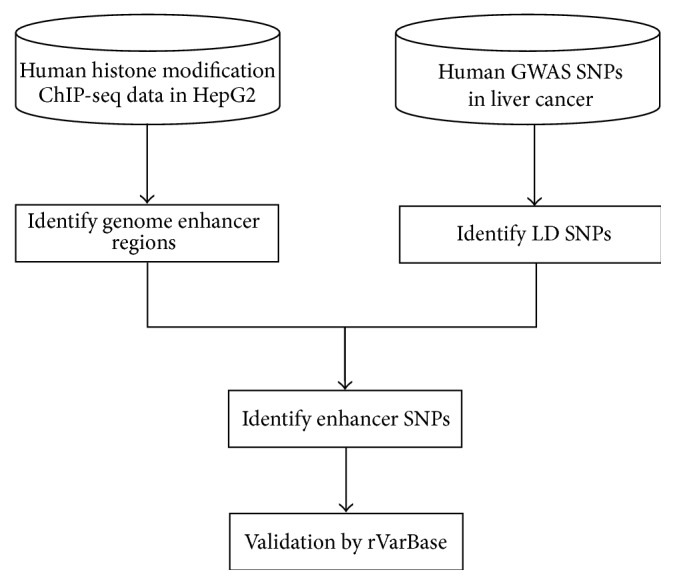
Many disease-related single nucleotide polymorphisms (SNPs) have been inferred from genome-wide association studies (GWAS) in recent years. Numerous studies have shown that some SNPs located in protein-coding regions are associated with numerous diseases by affecting gene expression. However, in noncoding regions, the mechanism of how SNPs contribute to disease susceptibility remains unclear. Enhancer elements are functional segments of DNA located in noncoding regions that play an important role in regulating gene expression. The SNPs located in enhancer elements may affect gene expression and lead to disease. We presented a method for identifying liver cancer-related enhancer SNPs through integrating GWAS and histone modification ChIP-seq data. We identified 22 liver cancer-related enhancer SNPs, 9 of which were regulatory SNPs involved in distal transcriptional regulation. The results highlight that these enhancer SNPs may play important roles in liver cancer.
近年来,通过全基因组关联研究(GWAS)已推断出许多与疾病相关的单核苷酸多态性(SNP)。大量研究表明,一些位于蛋白质编码区的SNP通过影响基因表达与多种疾病相关。然而,在非编码区,SNP如何导致疾病易感性的机制仍不清楚。增强子元件是位于非编码区的DNA功能片段,在调节基因表达中起重要作用。位于增强子元件中的SNP可能影响基因表达并导致疾病。我们提出了一种通过整合GWAS和组蛋白修饰ChIP-seq数据来鉴定肝癌相关增强子SNP的方法。我们鉴定出22个肝癌相关增强子SNP,其中9个是参与远端转录调控的调控SNP。结果表明,这些增强子SNP可能在肝癌中发挥重要作用。