Tokimitsu Motoharu, Murata Masako, Toriyama Yuichi, Hirano Takao, Iesato Yasuhiro, Murata Toshinori
Department of Ophthalmology, Shinshu University School of Medicine, 3-1-1 Asahi, Matsumoto, Nagano, 390-8621, Japan.
Department of Ophthalmology, Matsumoto Medical Center, National Hospital Organization, Matsumoto, Nagano, Japan.
BMC Ophthalmol. 2016 Jul 19;16:113. doi: 10.1186/s12886-016-0298-x.
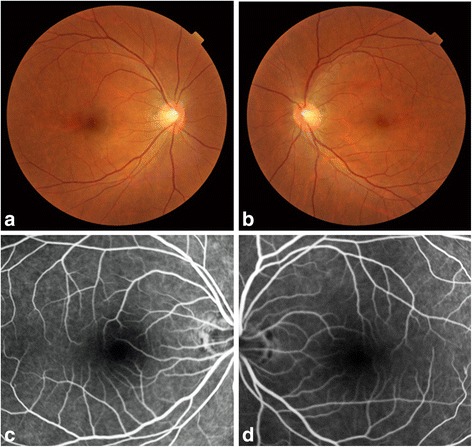
Fat embolism in the deep retinal capillary plexus is one of the reported mechanisms underlying central/paracentral scotoma in patients with Purtscher's retinopathy. Here we report the clear delineation of capillary dropout in the deep capillary plexus using optical coherence tomography angiography (OCTA) in a chronic case of unexplained scotoma that developed after femoral fracture. The patient exhibited normal fluorescein angiography (FA) findings and a normal retinal appearance.
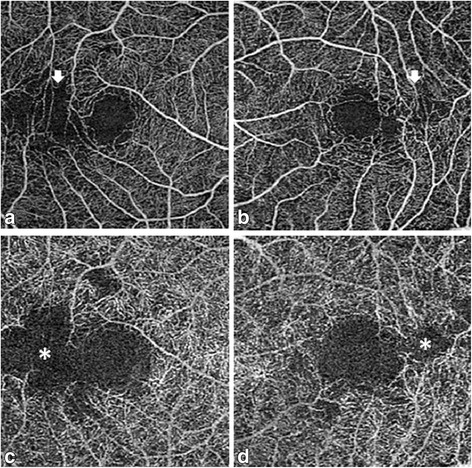
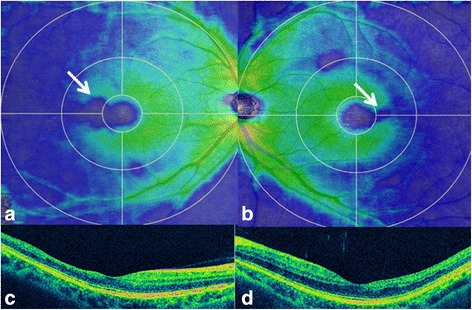
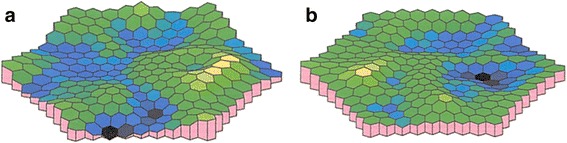
A 42-year-old Japanese man with a history of bilateral, unexplained paracentral scotoma that developed after femoral fracture and pulmonary fat embolism due to a car accident 20 years ago was referred to our outpatient clinic. Initial ophthalmological examination revealed unremarkable retinal findings. Goldmann perimetry, FA, and full field electroretinography showed no pathological changes. Although fat embolism in the retinal vasculature was suspected, psychosomatic visual field defects could not be ruled out. We performed OCTA, which clearly delineated capillary dropout in the deep retinal capillary plexus. A final diagnosis of paracentral acute middle maculopathy secondary to Purtscher's retinopathy was made on the basis of this finding.
Our findings suggest that OCTA clearly and noninvasively delineates the deep retinal capillary plexus and the superficial capillary plexus. Because conventional FA provides limited depth resolution, capillary dropout restricted within the deep capillary plexus cannot be detected, particularly when the superficial capillary plexus is well preserved. Thus, OCTA can be a useful tool for the detection of capillary dropout in the deep retinal capillary plexus.
视网膜深层毛细血管丛中的脂肪栓塞是报道的普尔夏视网膜病变患者中心/旁中心暗点的潜在机制之一。在此,我们报告了在一例股骨骨折后出现的不明原因慢性暗点病例中,使用光学相干断层扫描血管造影(OCTA)清晰描绘深层毛细血管丛中毛细血管缺失的情况。该患者荧光素血管造影(FA)结果正常,视网膜外观正常。
一名42岁的日本男性,有双侧不明原因旁中心暗点病史,20年前因车祸导致股骨骨折和肺脂肪栓塞。他被转诊至我们的门诊。初次眼科检查显示视网膜无明显异常。Goldmann视野检查、FA和全视野视网膜电图均未显示病理改变。尽管怀疑视网膜血管存在脂肪栓塞,但不能排除心因性视野缺损。我们进行了OCTA检查,其清晰地描绘了视网膜深层毛细血管丛中的毛细血管缺失。基于这一发现,最终诊断为继发于普尔夏视网膜病变的旁中心急性黄斑病变。
我们的研究结果表明,OCTA能够清晰且无创地描绘视网膜深层毛细血管丛和浅层毛细血管丛。由于传统的FA提供的深度分辨率有限,无法检测到局限于深层毛细血管丛内的毛细血管缺失,尤其是当浅层毛细血管丛保存完好时。因此,OCTA可作为检测视网膜深层毛细血管丛中毛细血管缺失的有用工具。